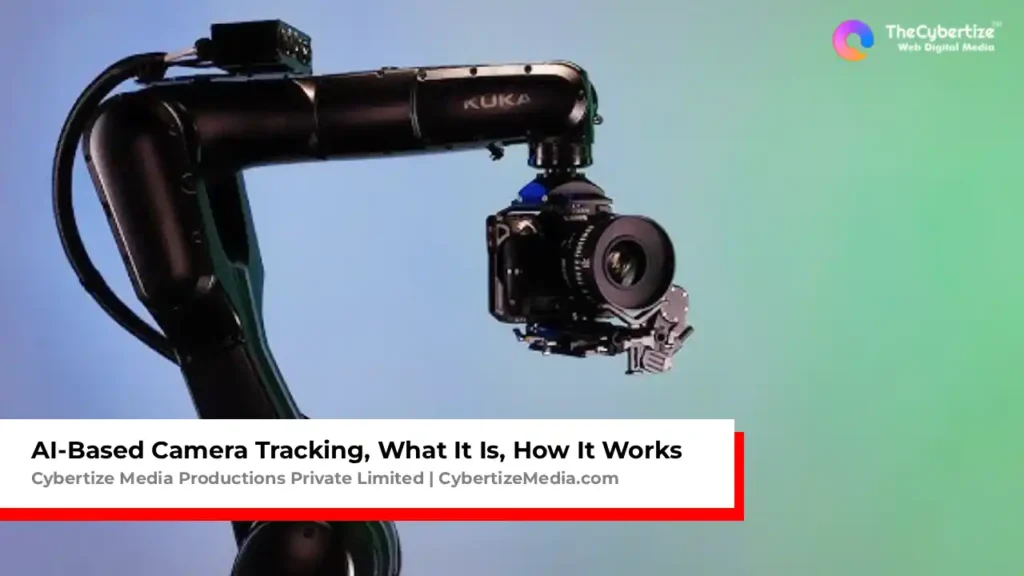

There’s a shot type that used to require a full camera department to pull off. A smooth, locked-on tracking shot that follows a subject through a crowd, or a product close-up that moves with the item as it’s handled, or a presenter-style shot that keeps the speaker perfectly framed as they move around a set. Clean. Controlled. Cinematic.
To get that shot traditionally, you needed a camera operator, a focus puller, sometimes a dolly grip, and a lot of rehearsals to get the timing right. On a tight shoot day, one complicated tracking shot could eat an hour. On a budget production, it often just got cut from the plan.
AI-based camera tracking changed the math on this entirely.
First — What Actually Is AI Camera Tracking? | AI-Based Camera Tracking
At its simplest, AI camera tracking is when a camera system uses artificial intelligence to identify, lock onto, and follow a subject — automatically — without a human operator manually controlling the pan, tilt, zoom, and focus in real time.
The “AI” part isn’t marketing fluff here. These systems use computer vision and machine learning to distinguish a specific subject (a face, a body, a product, a moving vehicle) from everything else in the frame. They track depth, predict movement, and adjust continuously to keep the subject well-composed — even as the subject moves unpredictably, turns away, or temporarily goes out of frame.
Top Cybertize Offerings
Our comprehensive Media & Tech Services in India offerings include:
| Service Category | Specific Services |
|---|---|
| Film Production | Film, Web Series, Short films, Cinematic Films, IG Reels, Ad Films |
| Animation Production | 2D animation, 3D animation, Walkthrough, Medical Animation, Explainer Videos |
| Software Development | CMS (Content Management Softwares), On Demand Software, Edtech, SaaS Portals, ERPs, Cloud Infra, AWS, Azure |
| SEO & Content Marketing | Blog writing, video production, infographics, email marketing, white papers, case studies, On Page SEO, Link Building |
| Web Development | Website design, responsive development, e-commerce, CMS implementation, site optimization |
| AI / ML | Artificial Intelligence / Machine Learning |
There are two broad categories of how this shows up in real production:
Hardware-based AI tracking systems — physical camera rigs with built-in AI tracking capabilities. Products like the Moza Air, DJI RS series with ActiveTrack, Obsbot camera systems, and robotic camera heads from brands like Bolt and Mark Roberts Motion Control fall into this category. The intelligence lives in the hardware itself.
Software-based AI tracking in post — where AI analyzes footage that’s already been shot and retroactively tracks subjects or camera movement to enable effects, stabilization, compositing, and virtual camera work. Tools like DaVinci Resolve’s Tracker, Adobe After Effects’ Camera Tracker, and SynthEyes live here.
Both matter in production. Understanding which one to use where is part of what a good production team brings to the table.
On-Set AI Tracking: What It Actually Changes
Let’s get specific about what changes when you bring AI tracking into a live shoot.
AI-Based Camera Tracking: Single-Operator Control
A traditional tracking shot with a gimbaled camera rig needs at minimum two people working in sync — one operating the physical movement of the camera, one pulling focus. With an AI tracking system on a motorized head or smart gimbal, a single operator can control the shot while the AI handles subject lock-on and, increasingly, autofocus prediction.
This matters on small-crew shoots — which describes a large percentage of commercial and brand video production in India. Fewer people on set means lower day rates, simpler logistics, and faster movement between setups.
Consistency Across Takes
This is underappreciated but genuinely important. When a human operator is tracking a moving subject, there’s natural variation between takes. The reframe speed differs slightly. The subject sits in slightly different positions in the frame. The focus breathing is inconsistent.
AI tracking locks the subject relationship to the frame with mathematical consistency. Every take looks like the camera was in the same “mind” about where the subject should sit. This makes editing significantly easier — cuts between takes feel smoother because the framing language is consistent.
Speed of Setup and Rehearsal
A complex camera move that might require 30–45 minutes of blocking and rehearsal with a manual crew can often be set up and tested in a fraction of the time with an AI tracking rig. The subject walks through the space, the system learns the environment, and you’re rolling.
For live events, product launches, corporate shoots, and run-and-gun documentary-style content — this speed is invaluable.
Remote and Unmanned Camera Positions
AI tracking opens up camera positions that would otherwise require a human to physically occupy. A camera mounted high, or in a tight space, or in a position that’s uncomfortable or unsafe for an operator — can run autonomously with AI tracking, covering angles that would otherwise be impossible or prohibitively expensive to rig.
This has genuine implications for multi-camera setups on a budget. Instead of hiring four camera operators for a four-camera shoot, you can have one or two operators handling the primary cameras while AI-tracked cameras cover secondary angles.
In Post-Production: Camera Tracking for VFX and Compositing
AI-Based Camera Tracking: The other side of AI camera tracking is what happens in the edit suite — and this is where AI has made the most dramatic jump in accessibility.
3D Camera Solving
When you shoot a moving camera shot and want to add VFX elements to it — a product label appearing on a surface, a logo integrated into a real environment, a visual effect tied to a moving object — the compositor needs to know exactly where the camera was at every frame. This is called camera solving or match moving.
Traditionally, camera solving required experienced VFX artists and significant time. You’d need to place tracking markers (usually bright colored dots) on set, and software would analyze their movement across frames to reconstruct the camera’s position in 3D space.
AI-Based Camera Tracking: AI-powered camera tracking software like DaVinci Resolve’s built-in tracker, After Effects’ 3D Camera Tracker, and professional tools like SynthEyes and PFTrack now handle this with dramatically less manual input. The AI identifies natural features in the footage — edges, texture details, light patterns — and builds the 3D camera path automatically.
For brands that want their product digitally integrated into a lifestyle film — placed on a table, appearing in an environment, or interacting with a real scene — AI camera solving makes this accessible without a dedicated VFX budget that only big agencies can afford.
Stabilization That Understands Content
AI-based stabilization is a step beyond the traditional warp stabilizer approach. Older stabilization would smooth the camera path but couldn’t distinguish between intentional camera movement and unwanted shake — so it would sometimes flatten dynamic handheld energy that was meant to be there, or fail to stabilize correctly around moving subjects.
AI stabilization tools now analyze the intent of a shot. They identify the subject, track the camera’s relationship to it, and stabilize relative to the subject rather than just averaging out the motion across the whole frame. The result is smoother footage that still feels alive — not the plasticky, over-stabilized look that plagues badly processed handheld work.
For documentary-style corporate content, run-and-gun social media videos, and event coverage — this is a daily-use feature for our editors at Cybertize.
AI Tracking and the Drone Question | AI-Based Camera Tracking
Drone cinematography gets its own mention because AI tracking changed it more dramatically than perhaps any other camera type.
Earlier drone footage required a two-person operation — one pilot flying the drone, one camera operator controlling the gimbal and framing. Getting a clean tracking shot of a moving subject (a car, a person running, a boat) was technically demanding and took experienced crews.
DJI’s ActiveTrack and Hyperlapse AI features brought single-operator AI tracking to consumer and prosumer drones. The drone autonomously follows a moving subject, maintaining frame composition while the operator manages flight path and safety.
For brand films — car launches, real estate showcases, sporting events, outdoor product films — this makes cinematic drone tracking shots accessible at a cost that wouldn’t have been possible three years ago. A ₹1.5 lakh drone with AI tracking does what a ₹6–8 lakh two-person drone operation used to do, at a quality level that is largely indistinguishable in the final output.
At Cybertize, we factor drone AI tracking into production planning for clients across our city network — especially in Noida, Chandigarh, and Bangalore where outdoor and architectural shoots are common briefs.
AI Tracking in Live and Event Production
AI-Based Camera Tracking: Live production is one of the most demanding environments for camera work. Stage performances, product launches, panel discussions, fashion events — the subjects are moving in real time, there are no second takes, and the lighting and environment are constantly changing.
AI-tracked robotic camera heads are now being used in broadcast and high-end live event production specifically because they can maintain smooth, consistent tracking without operator fatigue or reaction lag.
For brands running live-to-digital content — events that are simultaneously produced for in-person audiences and live-streamed — AI camera tracking means you can run more camera angles with fewer operators, get consistently professional framing throughout a long event, and reduce the risk of a human operator missing a key moment.
What This Means for Ad Films and Brand Content Specifically
AI-Based Camera Tracking: When a brand comes to a production house for an ad film, the brief usually includes things like:
— We want the product to feel premium — We want a dynamic, cinematic feel — We want multiple environments covered in one shoot day — We want it within a certain budget
AI camera tracking directly helps deliver all four of those outcomes simultaneously.
Premium feel comes partly from the quality and consistency of the camera movement. Choppy, inconsistently framed tracking shots read as low-budget. AI tracking delivers smooth, well-composed movement that reads as premium — without the premium crew cost.
Dynamic, cinematic feel used to mean renting sliders, jibs, and dollies — each adding logistics and time to the shoot day. A motorized AI tracking head on a light stand achieves many of the same moves in a fraction of the setup time.
Multiple environments in one day is possible because AI tracking rigs set up and tear down faster. Less time per setup means more setups per day.
Budget compliance follows directly from reduced crew size, faster setups, and fewer equipment rental line items.
The Honest Limitations
AI camera tracking is genuinely impressive. It’s also not magic, and any production team that tells you otherwise is setting you up for a bad day on set.
Complex crowd situations can confuse tracking systems. When a subject is surrounded by people of similar appearance, or moves in and out of dense crowds, AI tracking can briefly lose the subject and re-lock on the wrong person. Good operators anticipate this and have manual override ready.
Lighting extremes stress the system. Very low light or high-contrast environments (a subject moving from shadow to direct sunlight) can cause tracking inconsistencies. This is something to plan around in pre-production.
It’s not a replacement for creative camera operation. AI tracking keeps a subject in frame. It doesn’t make interesting composition choices, doesn’t react to a moment emotionally, doesn’t decide to push in because the performance just got powerful. The creative eye behind the lens is still human.
At Cybertize, our approach is always to use AI tracking where it genuinely makes the shot better or more efficient — not to use it as a substitute for craft. The tool serves the story, not the other way around.
AI-Based Camera Tracking: Cybertize Media Productions and AI Camera Technology
Across our production network in Delhi, Mumbai, Kolkata, Bangalore, Patna, Noida, and Chandigarh, our teams work with AI tracking technology across different production contexts — from tight studio ad film shoots to large outdoor brand campaigns, corporate event coverage, and social media content that needs to be fast, clean, and high quality.
AI-Based Camera Tracking: Our in-house AI video editors aren’t just working with footage after the fact — they’re part of the production planning process, advising on how to shoot with AI post-tracking in mind, where to use markers versus relying on natural feature tracking, and how to structure a shoot day to get the most out of AI-assisted camera systems.
If you’re producing an ad film, a brand film, an event video, or any commercial content and want to understand how AI camera tracking can change what’s possible within your budget — that conversation starts with us.
The Takeaway
AI-Based Camera Tracking : Camera tracking used to be a department unto itself. It required skilled people, specialist equipment, and significant time to set up and execute. The barrier to getting genuinely cinematic tracking shots was high — which is why so much mid-budget production either avoided them or accepted inconsistent results.
AI didn’t just lower that barrier. In many situations, it removed it.
AI-Based Camera Tracking: Single operators can now produce tracking work that used to need full crews. Post-production VFX integration is accessible to brands that couldn’t have touched it before. Drone tracking shots that needed specialist pilots are now achievable with a two-person team. And the consistency and quality of automated tracking — when used intelligently — often surpasses what manual operation delivers under the time and budget pressures of a real shoot day.
This is not the future of production. It’s the present. And the production houses that understand how to use it aren’t waiting.
Cybertize Media Productions | AI Video Production | Ad Films | Brand Films | Corporate Films Serving: Delhi | Mumbai | Kolkata | Bangalore | Patna | Noida | Chandigarh