
Table of Contents
Artificial intelligence is no longer a futuristic concept for advertising — it is the engine quietly running behind some of the most iconic campaigns of our time. From scriptwriting and storyboarding to hyper-personalised edits and AI-generated visual effects, the ad film industry is experiencing its most radical transformation since the invention of colour television. This guide explores what that shift means for brands, agencies, and production companies navigating the new landscape.
AI in Advertising: The Numbers That Define 2025–2030
| Stat | What It Means for Ad Film Production |
| $50 B+ | Projected global AI-in-advertising market size by 2030 (Grand View Research) |
| 70% | Of marketers already use some form of AI in their content creation pipeline |
| 3–5× | Faster creative iteration cycles reported by production teams using AI tools |
| 60% | Cost reduction potential in post-production through AI-assisted editing and VFX |
| 85% | Of consumers say they expect more personalised ad experiences — AI makes this scalable |
| 2026 | Year analysts expect AI-generated video ads to surpass 30% of all digital ad content |
1. AI-Assisted Scriptwriting and Concept Development
The creative brief has always been the heartbeat of an ad film. Today, AI language models are becoming co-writers in the room — not replacing human creatives but dramatically accelerating the ideation process. A strategist can now input a brand tone guide, audience psychographic, and campaign objective and receive fifty distinct creative territories in minutes.
At Cybertize Media Productions, we have integrated AI concept-generation into our early-stage briefing process. The result is not generic output — it is a scaffold that our writers sharpen, humanise, and inject with cultural nuance. Think of AI as a brilliant but inexperienced junior writer who produces volume while senior creatives curate excellence.
Top Cybertize Offerings
Our comprehensive Media & Tech Services in India offerings include:
| Service Category | Specific Services |
|---|---|
| Film Production | Film, Web Series, Short films, Cinematic Films, IG Reels, Ad Films |
| Animation Production | 2D animation, 3D animation, Walkthrough, Medical Animation, Explainer Videos |
| Software Development | CMS (Content Management Softwares), On Demand Software, Edtech, SaaS Portals, ERPs, Cloud Infra, AWS, Azure |
| SEO & Content Marketing | Blog writing, video production, infographics, email marketing, white papers, case studies, On Page SEO, Link Building |
| Web Development | Website design, responsive development, e-commerce, CMS implementation, site optimization |
| AI / ML | Artificial Intelligence / Machine Learning |
How it works in practice
A client in the FMCG sector recently briefed us on a product launch targeting Gen Z. Our AI-assisted approach generated 40 concept lines, three narrative arcs, and two alternate brand-voice explorations inside 90 minutes. The human team then refined these into a tight pitch with clear visual directions — saving over two days of traditional brainstorming while producing richer strategic diversity.
| “AI does not kill creative ideas. It kills creative stagnation.” |
2. AI-Powered Storyboarding and Pre-Visualisation
Pre-production has historically been one of the most labour-intensive phases of ad film-making. Storyboard artists, concept illustrators, and 3D previz teams require days or weeks to translate a script into visual form. AI image and video generation tools have fundamentally compressed this timeline.
Tools like Midjourney, Adobe Firefly, Runway, and Google Veo now allow directors and DPs to generate photorealistic frame references and animatics before a single camera is placed on set. This democratises high-production previz, previously available only to feature films and big-budget campaigns, and makes it accessible for mid-tier commercial work.
The creative control argument
Directors initially feared AI storyboarding would homogenise visual language. The opposite is proving true. When AI handles technical reference generation, directors can focus creative energy on nuance — performance notes, light quality, sound design — rather than explaining basic shot composition to artists still interpreting the brief. The vision becomes crisper, faster, and more communicable to the entire crew.
3. AI on Set: Smart Cameras, Real-Time Analytics, and Generative Lighting
The production floor itself is changing. AI-enabled camera systems now offer real-time subject tracking, automated focus pulling, and even compositional scoring that alerts the operator when a frame deviates from established shot norms. For high-volume shooting days — lifestyle content, multi-SKU product films — this reduces unusable takes significantly.
Generative lighting software, integrated with LED volume stage technology, can simulate any real-world lighting environment algorithmically. A brand shooting in Mumbai can art-direct a golden hour on a Santorini cliff — without leaving the studio. This virtual production capability, once reserved for Marvel-budget productions, is now a commercial reality for mid-size ad film studios.
On-set AI tools gaining industry adoption
- Automated focus AI (e.g., Canon AF-X, Sony ZV series): Eliminates focus puller for run-and-gun formats; consistent results in fast-paced shoots
- LED volume + Unreal Engine AI environments: Real-time virtual backgrounds with realistic parallax and lighting response
- AI script supervision tools: Automatically flags continuity errors — wardrobe, prop, eyeline — across takes
- Real-time colour pipeline AI: Live grading on set reduces post-production colour pass time by up to 40%
4. The Post-Production Revolution: AI Editing, VFX and Sound
If any single phase of video production has been most dramatically disrupted by AI, it is post-production. What once required weeks of manual rotoscoping, colour grading, audio cleanup, and motion graphics is increasingly automated or AI-assisted — with results that rival — and in some cases exceed — traditional pipelines in quality.
AI editing and assembly
Tools like Adobe Premiere’s AI-assisted edit, DaVinci Resolve’s Magic Mask, and Descript’s video editing via text transcript are transforming how editors work. Rather than scrubbing through footage manually, editors can search for moments by dialogue keyword, emotional beat, or even facial expression classification. An AI rough cut, ready within hours of wrapping a shoot, gives editors a meaningful starting point rather than a blank timeline.
Generative VFX and background replacement
AI tools can now believably replace sky gradients, remove unwanted objects, extend sets beyond physical frame borders, and generate secondary characters — all at a fraction of traditional VFX costs. For ad films, where a product must always look its absolute best, AI-powered background compositing and reflective surface rendering are removing limitations that once required expensive studio setups.
Intelligent audio: cleanup, scoring, and sound design
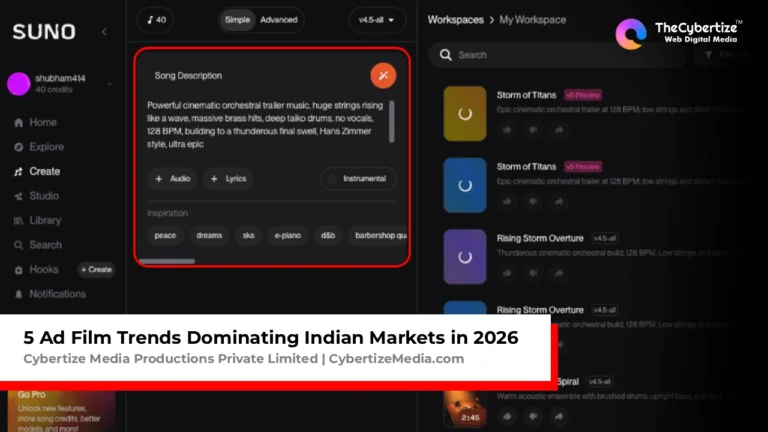
AI audio tools like Adobe Enhance Speech, iZotope RX, and Suno’s music generation eliminate background hiss, wind noise, and reverb from location audio in seconds. Meanwhile, AI music generation platforms can produce bespoke, brand-synchronised soundscapes on demand — without licensing complications or composer briefs. For fast-turnaround social ad films, this capability alone saves significant budget and time.
| “The editor of 2026 is not slower or less creative. They are doing in 3 days what once took 3 weeks — and spending the extra time on storytelling, not software.” |
5. Hyper-Personalisation at Scale: The New Advertising Frontier
Perhaps the most commercially transformative application of AI in ad films is not in production efficiency, but in personalisation. Dynamic Creative Optimisation (DCO) platforms now allow a single ad film master to automatically spawn hundreds — even thousands — of personalised variants, each tailored by geography, language, user behaviour, device, time of day, or individual purchase history.
A pan-India FMCG campaign no longer needs to produce eight language versions in eight production shoots. The AI renders each localisation from a single high-quality master, with culturally appropriate visual substitutions, lip-sync translation, and region-specific text overlays — all maintaining brand consistency. The cost differential is staggering: what once required 8 shoots and 8 post-production pipelines can now be achieved for approximately 1.2× the cost of a single version.
Personalisation use cases already in production
- AI dubbing and lip-sync for regional language versioning
- Dynamic product placement — swapping featured SKU based on viewer data
- Personalised end-cards with viewer-name integration and CTA customisation
- Geo-specific background replacement — same talent, different city skylines
- Seasonal and real-time contextual edits triggered by weather or trending events
6. AI Avatars and Synthetic Talent: Opportunity and Ethics
AI-generated presenters and brand avatars represent one of the fastest-growing — and most debated — areas in ad film production. Platforms like Synthesia, HeyGen, and ElevenLabs enable production of video content featuring fully synthetic on-screen presenters, or AI-cloned versions of real talent who consent to digital replication.
For content-heavy brands — ed-tech, fintech, pharma, e-commerce — the volume problem is real. Recording thousands of product explainers, FAQ responses, or training modules with human presenters is simply impractical. AI avatars solve this while maintaining visual consistency, brand personality, and zero talent scheduling conflicts.
The ethical framework production companies must adopt
The use of AI likenesses requires rigorous consent protocols. Cybertize Media Productions maintains a clear contractual framework for any project involving AI talent replication: explicit written consent from talent, defined usage scope and duration, guaranteed residual-equivalent compensation, and full disclosure to end audiences where legally or ethically required. The technology is neutral — the responsibility lies with production companies to deploy it with integrity.
| “The question is not whether AI talent is real enough. The question is whether the production company behind it is ethical enough.” |
Traditional vs. AI-Augmented Production: A Direct Comparison
| Production Phase | Traditional Approach | AI-Augmented Approach |
| Scripting & Concepts | 3–7 days, one creative team | 4–8 hrs, AI + creative team with 10× concept volume |
| Storyboarding | 2–5 days with illustrator | 1 day with AI image generation + director refinement |
| Shoot Day Prep | Full location recce + manual planning | AI location matching, virtual recce, automated call sheets |
| VFX / CGI | ₹5–50L depending on complexity | 30–60% cost reduction via AI compositing |
| Post-Production | 10–20 working days | 4–8 working days with AI-assisted editing suite |
| Localisation | Separate shoot per language | Single master + AI dubbing, lip-sync, and text |
| Personalisation | Not scalable beyond 3–5 variants | 100s–1000s of variants from one master asset |
| Music & Sound | Composer brief + licensing | Bespoke AI score in hours, no licensing complexity |
7. What AI Cannot Replace: The Human Advantage in Ad Filmmaking
The Future of Ad Films: For all its capability, AI in its current form lacks the one ingredient that makes advertising truly powerful: genuine human feeling. The ability to sense cultural tension, to find the comedy in a brief written between the lines, to decide that the brand needs to be brave rather than safe — these are not algorithmic outputs.
The most dangerous misconception is that AI adoption means less creative talent. The reality across high-performing production companies is precisely the opposite: leaner teams with deeper expertise, freed from repetitive execution, are producing more daring and strategically precise work.
Irreplaceable human creative contributions
- Emotional truth — the instinct for what will genuinely move a specific audience in their specific moment
- Cultural intelligence — navigating subtext, satire, sentiment, and timing in a way trained models still misfire on
- Director’s vision — the singular aesthetic sensibility that defines the look and feel of an era
- Brand courage — the willingness to recommend a risky, human-led creative idea over a safe, data-validated one
- Relationship and trust — clients buy into people and creative partnerships, not tool stacks
8. How Brands Should Brief AI-Integrated Production Companies
The way clients brief their agencies is changing, too. A brief written for a pure-human production team is fundamentally different from one designed to leverage AI capabilities fully. Brands that understand this write better briefs, get better work, and realise greater return on production spend.
Define your personalisation ambition upfront
Do you want one film or a hundred variants? AI economics change significantly at scale. Share your media plan alongside your creative brief.
Share your data assets early
First-party audience data, CRM segments, purchase behaviour insights — these fuel AI personalisation. The earlier they enter the production conversation, the more precise the creative output.
Be explicit about the human storytelling core
AI assists; humans lead. Give your production partner a clear mandate on the emotional truth the film must communicate. This anchors the AI-augmented workflow.
Budget for iteration, not just delivery
AI makes rapid prototyping economically feasible. Build test-and-learn cycles into your production budget rather than committing entirely to a single final version before testing.
9. The Road Ahead: 2025–2030 Predictions for AI in Ad Films
The trajectory of AI adoption in video production is not linear — it is accelerating. Here is where industry analysts, creative technologists, and leading production companies (including Cybertize Media Productions) expect the landscape to evolve in the next five years.
Fully autonomous short-form ad creation (2025–2026)
For standardised formats — 15-second social, product catalogue ads, retargeting content — AI will handle end-to-end production with human approval at brief and output stages only.
Real-time ad generation during live events (2026–2027)
Brands will generate contextual ad variants in minutes responding to live sporting events, cultural moments, and trending social content — shifting ad film from planned to reactive media.
AI performance prediction before shoot (2026–2028)
AI models trained on billions of engagement data points will predict the emotional response and conversion likelihood of a creative concept before it is produced — reducing expensive misfires.
Neural interface creative testing (2028–2030)
Biometric and neural response data will feed directly into creative development, allowing production companies to test pre-visualisations against genuine emotional response rather than stated preference surveys.
The Future of Ad Films: The Production Company That Will Win Is the One That Leads the Change
The Future of Ad Films: Artificial intelligence is not a threat to the ad film industry. It is the most powerful amplifier the industry has ever been handed — capable of making great work faster, taking good work further, and making ambitious work achievable at previously inaccessible budgets.
The production companies that will define the next decade are not those that resist AI until adoption is unavoidable. They are the ones actively experimenting today — building AI-augmented workflows, training human talent to direct machine output, and developing proprietary ethical frameworks that brands can trust.
At Cybertize Media Productions Private Limited, we believe the future of ad filmmaking is human creativity at full power, with AI as its most capable tool. Our commitment is to the craft that machines cannot replicate, deployed with the intelligence that AI makes possible.
| “The ad films that will define the next decade are being made right now — by teams who are not afraid of the machine and do not underestimate the human.” — Cybertize Media Productions |
Partner With Cybertize Media Productions
Whether you are planning your first AI-augmented campaign or looking to integrate advanced personalisation at scale into an established production pipeline, Cybertize Media Productions brings both the creative vision and technical infrastructure to deliver.
Contact us to discuss your next ad film project, explore our AI production capabilities, or brief us on your upcoming campaign.
Frequently Asked Questions
10 powerful questions — answered with insight, honesty, and authority