
Table of Contents
Digital Ad vs TV Commercial: They Are Both Videos. That Is Where the Similarity Ends.
A brand manager once told us something that stuck. She said, “We shot a TVC, uploaded it to YouTube, and wondered why it was not working. Then we shot something specifically for digital and put it on TV as a filler, and it looked terrible. We did not understand why the same thirty seconds could behave so differently depending on where it played.”
Digital Ad vs TV Commercial: That question is more common than most brands admit. And the answer is not just about aspect ratio or resolution. It is about psychology, platform behaviour, viewer intent, production grammar, measurement, cost structure, and the fundamental relationship between the audience and the screen they are looking at.
In 2026, understanding the difference between a digital ad and a TV commercial is not a technical curiosity for production nerds. It is a genuinely important strategic question. Because the Indian advertising market has crossed a point of no return: EY said digital media overtook television as the largest segment of India’s media and entertainment industry in 2025. Brands can no longer treat the two as interchangeable formats. They need to understand what each one does, where each one wins, and why building for both simultaneously is the only approach that makes sense for most serious advertisers.
This guide walks through every meaningful difference between the two, one by one.
The Market Context: Where India Stands in 2026
Before getting into craft and format, you need to understand the media environment these ads are competing in.
Digital Ad vs TV Commercial: The digital ad spend market in India is expected to grow by 10.1 percent annually, reaching US$14.56 billion by 2026. This upward trajectory is expected to continue, with the market forecast to grow at a CAGR of 12.0 percent from 2026 to 2029.
Digital is expected to command 68 percent of India’s total ad spend in 2026, according to WPP Media. Close to 45 to 55 percent of corporate firms in India now prefer the digital medium for advertising.
Digital Ad vs TV Commercial: Television, however, is not collapsing. TV penetration in Indian households is estimated to touch 248 million by 2026, driven by unmatched mass visibility especially in rural and regional markets. Traditional segments like linear TV are expected to grow in low to mid-single digits, with TV and outdoor advertising continuing to benefit from high-impact events and regional reach.
Also Read: Animation Cost Per Minute in India, The Complete Breakdown
So the picture in 2026 is not digital winning and TV losing. It is two different things doing two different jobs, with budgets shifting toward digital while television holds ground in specific contexts where it still has no peer. Commerce-led advertising is emerging as the fastest-growing segment, projected to expand 24.2 percent in 2026, fuelled by the rapid convergence of retail media, quick commerce platforms, and social commerce ecosystems.
What this means for a brand: choosing between TV and digital is not the right question anymore. The right question is understanding what each format does to your audience and building creative that is honest about those differences.
Difference 1: Who Is Watching and What State Are They In
This is the most important difference, and it is almost never discussed in brand briefs.
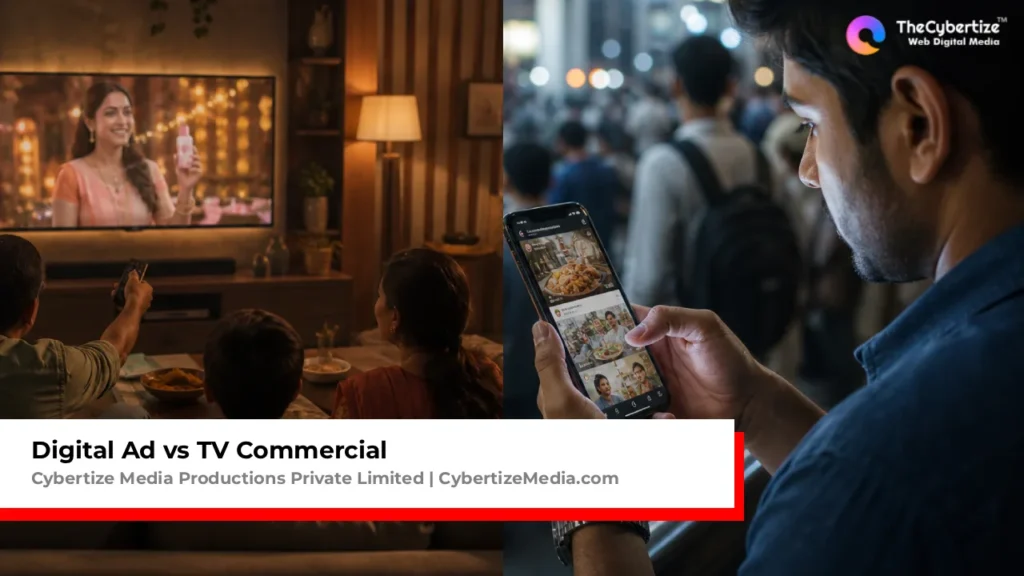
Digital Ad vs TV Commercial: When someone is watching television in the evening, they have made a conscious decision to sit down and watch. The screen is large. The room may be dark. The audio is on and often loud. The viewing experience is intentional, shared in many Indian households, and relatively passive. The viewer is not doing twelve other things simultaneously. They are leaning back.
When someone encounters a digital ad, they are almost certainly in motion. They are scrolling a feed, watching a video that they chose, using an app, or reading something. The ad is arriving uninvited into an activity they were already engaged in. The screen is small, usually a phone. The audio is very often off. Their thumb is on the screen and ready to move. They are leaning forward, in control, and have the power to skip.
Digital Ad vs TV Commercial: These are not the same psychological states. They require fundamentally different creative strategies.
A TV commercial has time to breathe. It can open slowly, build a world, develop characters, take ten seconds to establish a mood before introducing the brand. The viewer is not going anywhere. They have nowhere to swipe to.
Digital Ad vs TV Commercial: A digital ad, particularly on social media or YouTube, has roughly three seconds before the viewer decides to continue watching or scroll past. Not three seconds to make a sale. Three seconds to earn the next three seconds. The creative logic is completely different. The hook, the reason to keep watching, has to arrive before the viewer’s thumb has made up its mind.
Research shows pairing TV and social media ads produces 2.8 times higher brand recall than social ads alone. This is because the two formats are doing different things to the same brain. TV builds the emotional foundation. Digital reinforces and converts. They work together in a way that neither works alone at the same cost efficiency.
Difference 2: Production Requirements and Technical Specs
A TV commercial in India must meet broadcast delivery specifications set by the channels it will air on. These are not suggestions. They are technical requirements that the commercial must meet to be accepted for broadcast.
Broadcast specifications include codec requirements, specific bitrate settings, audio loudness levels normalised to Indian broadcast standards, colour space compliance, and in some cases ASCI clearance for certain product categories. A commercial that does not meet these specifications will not go to air. The quality bar is enforced by technical gate-keeping, not just aesthetic judgement.
Digital ads have far more flexibility in delivery specification. A YouTube ad can be delivered in a wide range of resolutions and codecs. A Meta (Instagram and Facebook) ad has specific aspect ratio requirements but no broadcast-grade technical compliance. The barrier to delivery is lower, which is one reason digital production is faster and cheaper per execution.
Digital Ad vs TV Commercial: But the format requirements of digital add creative complexity. A TV commercial is almost always produced in 16:9 widescreen, because televisions are widescreen. A digital campaign typically needs multiple aspect ratio versions from the same creative: 16:9 for YouTube, 1:1 square for Instagram feed, 9:16 vertical for Reels and Stories, 4:5 for Facebook feed, sometimes 2:3 for Pinterest. Each of these is not just a crop. It is a reframe. Safe zones for text, logo, and the key visual need to be planned at the production stage, not the editing stage.
Brands that produce a TV commercial and then try to adapt it for digital after the fact consistently end up with compromised digital creative. The hero shot of the product that works beautifully in widescreen gets cropped out of the vertical frame. The title card that reads clearly on a 55-inch screen is unreadable on a phone. The production logic of a TV commercial and the production logic of a digital-first campaign are different enough that they should be planned simultaneously from the brief stage, not sequentially from the same footage.
Also Read: India’s Best Commercial Directors, The People Behind the Ads You Never Forgot
Digital Ad vs TV Commercial: For a TV commercial, the standard delivery formats in India are HD (1920×1080) or SD (720×576) in the specified codec for the channel. Duration is typically 10 seconds, 15 seconds, 20 seconds, 30 seconds, 40 seconds, 45 seconds, or 60 seconds, with 30 seconds being the most common working unit. The commercial must be delivered as a broadcast-quality master, not a compressed digital file.
For digital, the same creative concept needs a 30-second or 15-second pre-roll version for YouTube, a 15-second or 6-second bumper for certain digital buys, a vertical 9:16 version for Reels and Stories, and a square 1:1 version for feed placements. Each has its own safe zone for text and logo. Planning all of these from the start of production, rather than adapting after, typically adds 15 to 20 percent to the production budget but saves far more in post-production rework.
Difference 3: Targeting Capabilities
This is where digital advertising’s advantage is most concrete, and where the difference from television is most stark.
A TV commercial, when it airs on a national channel during prime time, is broadcast to everyone watching that channel at that moment. You can choose the channel (and therefore get a rough sense of the audience demographic), and you can choose the time slot (and therefore get a rough sense of the audience behaviour), but beyond that, your targeting is essentially the programming. If you buy a 30-second slot during a prime time family drama on Star Plus, you reach whoever is watching that drama. You cannot filter by age, income, location within India, purchase behaviour, brand affinity, or any other variable.
Digital Ad vs TV Commercial: Digital advertising inverts this completely. A digital ad campaign on Google, Meta, YouTube, or any programmatic platform can target by age, gender, location down to pin code, device type, interests, browsing history, purchase intent signals, relationship status, income bracket, and hundreds of other variables. You can reach 28-year-old women in Tier 2 cities who have recently searched for pregnancy-related products. You can reach 45-year-old men in metros who have visited luxury car dealership websites in the last 30 days. You can reach your own existing customers and exclude them from acquisition campaigns to avoid wasted spend.
With AI, data, and measurement rapidly maturing, 2026 is being described as a defining year for accountable, outcome-led digital growth, with the DPDP Act accelerating the shift toward first-party data, consent-led marketing, and privacy-safe measurement.
The trade-off is scale. A well-placed national TVC during an IPL match reaches tens of millions of people simultaneously, in a shared moment, with a quality of attention that digital simply cannot replicate at that scale. Digital targeting precision comes at the cost of reach breadth. Television’s reach breadth comes at the cost of audience precision.
For most FMCG brands, both matter. Reach breadth builds penetration and top-of-mind awareness. Targeting precision converts that awareness into consideration and purchase. Running only one without the other leaves money on the table in both directions.
Difference 4: Cost Structure | Digital Ad vs TV Commercial
The cost structures of TV and digital advertising are so different that comparing them directly is almost meaningless without understanding what you are comparing.
TV Commercial Costs: The Fixed Commitment Model
Television advertising in India operates on a fixed cost, fixed placement model. You buy a specific slot on a specific channel for a specific duration, and you pay that rate regardless of how many people watch and regardless of whether they pay attention.
Prime time on major national GEC channels (Star Plus, Sony, Colors, Zee TV) runs between ₹1.5 lakh and ₹4 lakh per 10-second spot. During IPL 2025, a 10-second spot on linear TV cost ₹15 lakh to ₹18 lakh per placement. These are guaranteed placements. The ad will air. Whether the viewer goes to the kitchen during the break is not something you pay more or less for.
Digital Ad Costs: The Performance-Based Model
Digital advertising in India typically operates on impression-based or performance-based pricing. You pay per thousand impressions (CPM), per click (CPC), per view (CPV), or per specific action (CPA). You set a daily or campaign budget, and the platform’s algorithm spends that budget against your target audience.
A YouTube pre-roll campaign in India might cost ₹200 to ₹600 CPM, meaning ₹200 to ₹600 per thousand times the ad appears before a video. A Meta (Facebook and Instagram) campaign might cost ₹150 to ₹500 CPM for video views. A Google Display campaign for awareness might cost ₹50 to ₹200 CPM. OTT pre-roll on platforms like JioCinema or SonyLIV during premium content tends to cost ₹300 to ₹800 CPM.
Also Read: Ad Film Production Cost in Mumbai, What Brands Actually Pay in 2026
The key difference: on digital, you can start with ₹10,000, measure what it does, and decide whether to continue. On television, you commit to the buy before the campaign runs, and if the concept does not land, you have still paid for the slot.
Digital also gives you the ability to pause, adjust, and optimise in real time. If one version of an ad is outperforming another by a measurable margin in the first 48 hours, you can shift the entire budget to the stronger performer. This is not possible with a TV buy that has already been confirmed and scheduled.
Production Cost Difference
A TV commercial in India typically costs ₹5 lakh to ₹30 lakh or more to produce to broadcast quality, depending on the concept, crew, talent, and post-production requirements.
A digital-first ad can be produced for ₹50,000 to ₹5 lakh depending on the quality level required. Some of the most effective digital ads are shot on phones with a small crew and edited in a week. Others are produced to a quality that matches or exceeds broadcast, because they are intended to run on OTT platforms and CTV where quality expectations are high.
Digital Ad vs TV Commercial: The production cost gap is real. But the media buy gap is often larger. A brand spending ₹20 lakh producing a TVC and ₹50 lakh buying airtime for it is spending ₹70 lakh to run one campaign. The same brand could produce three high-quality digital ad films for ₹15 lakh and run a sustained digital campaign for the remaining ₹55 lakh across a far longer period with far more targeting precision and real-time optimisation.
Neither approach is automatically right. The right answer depends on what the brand needs to achieve.
Difference 5: Measurement and Attribution
Digital Ad vs TV Commercial: If you ask a TV advertiser how they know their campaign worked, the honest answer in most cases is: brand tracking studies, GRP (Gross Rating Points) calculations, and sales data that they correlate with the campaign window. These are legitimate tools. They are also imprecise. You know the campaign aired. You believe it reached a certain number of people. You see a movement in sales. You attribute the movement partially to the campaign. But the chain of evidence has gaps.
Industry data shows that only 30 percent of viewable digital ads are actually looked at, meaning 70 percent of ad spend goes to impressions that technically render but capture no real attention. This is a real problem with digital advertising. But at least with digital, you can measure it. You can see impression counts, completion rates, click-through rates, conversions, view-through attributions, and audience engagement signals in real time.
CTV dramatically outperforms other video platforms with 90 to 98 percent completion rates, compared to YouTube’s 20 to 40 percent and social video’s sub-30 percent completion rates. Even 30-second CTV ads achieve approximately 96 percent completion.
TV measurement in India is based on BARC (Broadcast Audience Research Council) ratings, which use a panel of households to estimate viewership. The sample, while methodologically sound, is still an estimate. You cannot know for certain how many people in your target demographic watched your ad, whether they skipped the channel during the break, or whether they had the room to themselves or were distracted by a family conversation.
Digital measurement is real-time, granular, and increasingly accurate. You can see that 12,000 people in Pune aged 25 to 35 watched your ad to completion and then visited your product page within 24 hours. You cannot get that level of precision from a television campaign.
The flip side: digital metrics are gameable and sometimes misleading. A high view count on a social platform means different things depending on whether views are counted at three seconds or thirty seconds. An impression on a mobile app that is technically viewable but appears in a small banner while the user reads something else is not the same as a viewer watching your ad in their living room on a 55-inch screen with the volume up.
The measurement advantage lies with digital. The quality of attention advantage, in most environments, lies with television.
Difference 6: Viewer Control and Skippability
This difference shapes creative strategy more than almost any other factor.
Digital Ad vs TV Commercial: A television viewer during a commercial break cannot skip your ad. They can change the channel, leave the room, or look at their phone, but the ad plays whether they engage with it or not. This means a TV commercial can afford to build slowly. It can earn the viewer’s attention over the first eight to ten seconds before delivering the brand message.
A digital viewer, particularly on YouTube, can skip a pre-roll ad after five seconds. On social media platforms, they can scroll past instantly. On OTT platforms and CTV, many premium placements are non-skippable, which is why CTV completion rates are so high.
Mid-roll ads significantly outperform other formats for conversions, achieving 16.95 percent conversion rates compared to pre-roll’s 3.15 percent. Mid-roll ads feel like natural content breaks and capture viewers who are already engaged with the programming, making them more receptive to advertising messages.
For skippable digital ads, the creative principle is simple and non-negotiable: the first three seconds must earn the next three seconds. If the ad opens with a logo, a brand name, or a slow scene-setting sequence, the viewer has already left. The most effective digital ads open with something that creates immediate curiosity, emotion, or relevance. They front-load the reason to keep watching.
For non-skippable digital ads (bumpers, CTV placements, OTT premium), the logic is closer to television. The ad will be watched to completion. The task becomes making something memorable and worth the viewer’s involuntary attention, not just something that prevents them from leaving.
For TV commercials, the creative logic is almost the opposite of social media. The opening can breathe. The story can develop. The emotional payoff can arrive in the final ten seconds. This is why great TV commercials often feel like short films, with genuine narrative structure that would be completely ineffective as a five-second digital pre-roll.
Difference 7: Brand Trust and Perceived Credibility
This is one of television’s most underappreciated advantages, and it is almost impossible to replicate digitally.
When a brand appears on national television, there is an implicit quality signal. The consumer knows, consciously or not, that television airtime is expensive and regulated. Not just anyone can put an ad on Star Plus or Sony. The mere fact of being on television confers a level of legitimacy that digital advertising cannot manufacture.
Digital Ad vs TV Commercial: Television advertising delivers 39 percent higher brand recall than other channels and generates seven dollars in return for every dollar spent. Nothing beats the cinematic experience of a well-produced TV ad for making people feel something.
For categories where consumer trust is the primary purchase barrier, television remains a uniquely powerful tool. Healthcare, financial services, insurance, real estate, and FMCG all benefit from the trust signal that television inherently carries.
Digital advertising, particularly on social media, faces a credibility gap. Consumers have become accustomed to sponsored content, paid reviews, and performance-based claims that may or may not be accurate. The very targeting precision that makes digital efficient also makes consumers vaguely suspicious. “How does this app know I was just talking about needing a new laptop?” is not a feeling that builds brand trust.
Digital Ad vs TV Commercial: This is not an argument that digital advertising is untrustworthy. It is an observation that the environment in which digital ads appear, the feed of friends, memes, news, and entertainment, does not carry the same implicit quality signal that a national television broadcast does.
Difference 8: How They Work Together (And Why Both Is the Right Answer) | Digital Ad vs TV Commercial
Here is the point where most guides on this topic either go vague or choose a side. We are not going to do either.
The data is clear: the best advertising outcomes in 2026 come from running TV and digital together, not from choosing one.
Digital does not kill TV. It reshapes it. TV keeps its impact, while digital adds precision and speed. Smart marketers use both. They run CTV to find the right homes, add linear for scale moments, and retarget on other screens. This mix improves attention, recall, and results.
The practical strategy for most brands in India in 2026 looks like this:
Television, particularly on relevant national or regional channels, does the brand-building work. It reaches a broad audience at scale, creates the emotional foundation of the brand story, and establishes the trust and legitimacy that no other medium delivers as efficiently at scale.
Also Read: The Future of Ad Films, Human Creativity vs AI, Who Really Wins?
Digital Ad vs TV Commercial: Digital follows up. After someone has seen a TV commercial, a retargeted digital ad delivers three to five times higher engagement than the same digital ad shown cold. The TV ad primes the audience. The digital ad converts the primed audience.
For brands with limited budgets that cannot access both simultaneously, digital-first makes sense for newer brands that need to test messaging and build audiences before committing to expensive television buys. Television makes sense for brands that have already established a product-market fit and need to scale reach rapidly, particularly around key seasonal moments or major sporting events.
For brands that are already spending on television, adding digital does not require replacing or reducing the TV budget. It requires understanding that the two formats are complementary by design. The TV campaign earns trust. The digital campaign earns action.
Digital Ad vs TV Commercial:
The Production Implication, Build for Both from the Brief Stage
At Cybertize Media Productions Private Limited, the question we ask every client before production begins is: where does this film need to live, and how does it need to behave in each environment?
Digital Ad vs TV Commercial: That question changes everything about how a concept is developed. A concept built for television, with a slow emotional build and a payoff in the last ten seconds, will need to be fundamentally reconceived for digital, not just technically adapted. A concept built for digital, with a front-loaded hook and a six-second core message, will need significant additional development to carry a full 30-second TV commercial.
The most cost-efficient approach is to develop the creative platform first, then build the TV version and the digital suite simultaneously from that platform. The hero emotion, the brand message, and the visual identity carry through across both. The execution, the pacing, the opening, and the format-specific grammar are developed separately for each environment.
This approach costs more at the brief and pre-production stage. It saves significantly in post-production adaptation and reshooting. And most importantly, it produces work that actually performs in the environments it is built for, rather than work that was compromised in translation.
Quick Reference: Digital Ad vs TV Commercial at a Glance
| Factor | TV Commercial | Digital Ad |
|---|---|---|
| Viewer state | Passive, intentional, lean-back | Active, scrolling, lean-forward |
| Skip control | None (viewer changes channel) | High (thumb control, skip button) |
| Targeting | Broad (channel and time slot) | Precise (demographic, interest, behaviour) |
| Measurement | Estimated (BARC ratings, brand tracking) | Real-time, granular |
| Brand trust signal | Very high | Moderate |
| Minimum viable budget | ₹15 lakh to ₹30 lakh+ (production + media) | ₹50,000 for production, any amount for media |
| Production specs | Broadcast compliance required | Flexible, multiple aspect ratios needed |
| Optimal format | 30 seconds, 16:9 widescreen | 6s, 15s, 30s, multiple ratios |
| Creative opening | Can build slowly | Must hook in 3 seconds |
| Reach at scale | Unmatched for national campaigns | Scalable but fragmented |
| Campaign flexibility | Fixed once booked | Adjustable in real time |
| Completion rate | High (passive viewing) | 20 to 98 percent depending on format |
Digital Ad vs TV Commercial: Final Word from Cybertize Media Productions
The brands that understand the difference between these two formats at a creative level, not just a media buying level, consistently outperform the ones that treat a TV commercial as a piece of content and a digital ad as a smaller piece of content.
Digital Ad vs TV Commercial: They are not the same thing made smaller. They are different creative genres with different rules, different viewer relationships, and different jobs to do. The sooner a brand internalises that truth, the better its advertising will perform across both.
We work with brands to develop advertising that is built correctly for the environment it will live in, and that works together across environments when both are in play. That is not a media planning conversation. It is a creative production conversation, and it starts before the first frame is shot.
Cybertize Media Productions Private Limited is a full-service ad film and corporate video production company working with brands across India.