
Table of Contents
AI in VFX: The Shot That Would Have Taken Three Weeks Now Takes Three Days
There is a specific kind of conversation that production teams used to have with clients around VFX.
The client would describe what they wanted. A product floating in space. A cityscape that does not actually exist. A crowd of five hundred people when the budget allowed for forty extras. A car driving through a monsoon in a studio. The production team would nod, do some silent math, and come back with either a number that made the client wince or a timeline that made the marketing calendar unworkable. Usually both.
That conversation is changing.
AI in VFX: Not because VFX has become easier. It has not. The artistry involved in making a visual effect that does not break the viewer’s trust is still one of the most demanding crafts in film production. What has changed is where human skill needs to be applied, and what the machines can now do without a human artist spending twelve hours on it.
For Ad Film Production: Best Ad Film Agency in India
In 2026, artificial intelligence has embedded itself into virtually every stage of the VFX pipeline. And the practical consequence for ad film production, where timelines are measured in weeks rather than months and budgets are measured in lakhs rather than crore, is significant. Work that once required extensive manual labour from specialist artists can now be accomplished in a fraction of the time. That does not mean the artists have disappeared. It means they are spending their time on the problems that actually require human creative judgment, rather than on tasks that can be automated with software that does it more consistently and faster.
This guide covers what AI is actually doing in the VFX pipeline for ad films, which specific tasks have been transformed, what the real-world time savings look like, what tools are driving this change, and where the honest limits of AI in VFX currently sit.
The Scale of What Is Happening
Before getting into specific workflows, you need to understand the size of the transformation underway.
The global AI in VFX market was valued at USD 4.87 billion in 2025 and is expected to reach USD 28.66 billion by 2035, growing at a CAGR of 19.46 percent. That rate of growth is not driven by research labs experimenting with promising technology. It is driven by production companies finding genuine ROI in tools that are already working in live production pipelines.
AI in VFX: NVIDIA’s AI-driven Omniverse platform accelerates VFX rendering by four times for films, and is used by over 50,000 enterprises including ILM and Weta Digital. Adobe Firefly’s generative AI manages more than one billion VFX assets monthly, automating compositing and inpainting with up to 90 percent accuracy improvements in post-production workflows.
In August 2025, Adobe announced the launch of a new AI-driven tool that automates rotoscoping, one of the most traditionally labour-intensive tasks in VFX production.
Real-time VFX compositing on set is now reducing post-production timelines by 40 to 60 days on productions where the full pipeline has been implemented. AI-driven lip-sync dubbing for localization is reducing localization timelines by 60 to 70 percent while maintaining quality parity with traditional dubbing methods.
These are not projections. They are results being reported by production companies currently working in these tools.
Also Read: Animation Cost Per Minute in India: The Complete Breakdown
For ad film production in India specifically, where a campaign window often gives the production team four to six weeks from brief to broadcast-ready delivery, these kinds of timeline compressions are not conveniences. They are genuinely competitive advantages.
AI in VFX: What AI Is Actually Doing in the VFX Pipeline
Let us go task by task through the VFX pipeline and look at where AI has changed the work and how significantly.
Rotoscoping: From Days to Hours
Rotoscoping is the process of manually tracing the outline of an object or person in each frame of footage so that they can be separated from the background. It is essential for dozens of common VFX tasks: placing an actor in a digitally created environment, isolating a product for colour treatment, removing a wire rig from a stunt shot, replacing a background.
It is also brutally time-consuming when done manually. A single minute of footage runs at 24 or 25 frames per second. Manual rotoscoping of a complex shot can take an artist a full day of careful work per second of footage. On a 30-second ad film with multiple composited shots, rotoscoping alone used to represent a significant portion of the post-production timeline and budget.
AI-powered rotoscoping tools, including DaVinci Resolve 19’s Magic Mask, Runway’s Remove Background tool, and Adobe’s dedicated roto AI, now handle this automatically. The artist points at the subject, and the AI tracks it through the clip. What used to require hours of manual frame-by-frame work now takes minutes.
AI in VFX: DaVinci Resolve 19’s Magic Mask automates rotoscoping and object isolation that previously required hours of manual work. For VFX artists and editors, this is one of the most immediate and measurable time savings in the current toolkit.
The result for ad film production: a task that could add two to four days to a post-production schedule for a complex composited shot can now be done in the same day. Studios are redirecting that recovered time into quality refinement of the shots that matter most.
Background Generation and Environment Replacement
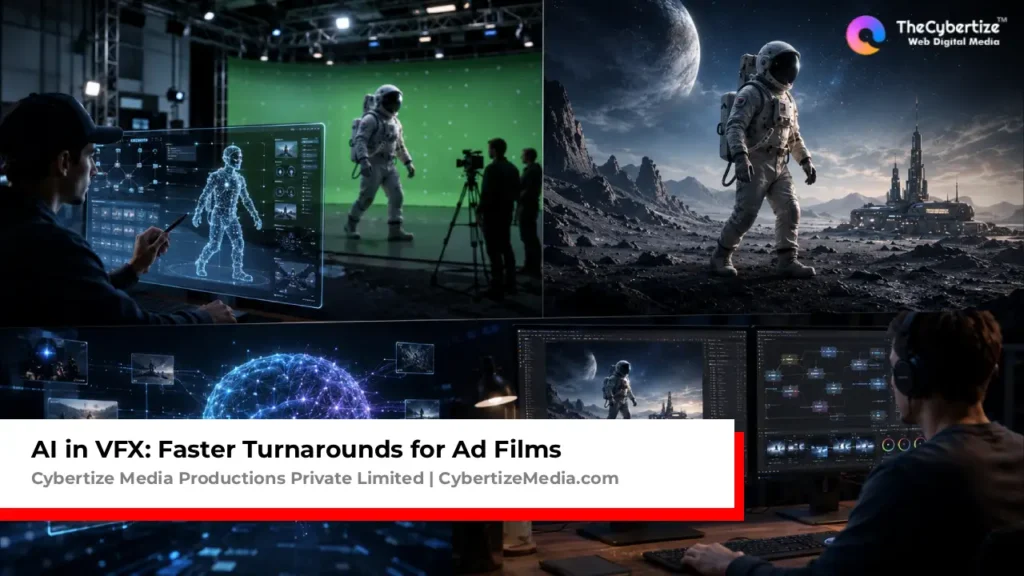
AI in VFX: One of the most expensive and logistically complicated aspects of ad film production has always been location. If the brand wants their product shown against a specific landscape, inside an architectural space that does not exist, or in a visual environment that the shoot location cannot deliver, traditionally the options were: find the location and travel to it, build a set, or shoot against green screen and composite the background in post.
All of these options are expensive and time-consuming. AI background generation is beginning to change the economics of this decision.
Tools like Runway’s Aleph model allow artists to upload footage and transform backgrounds using text prompts: change the lighting, swap the weather, replace the environment entirely, reframe the shot to suggest a different location. Luma AI’s Dream Machine enables creators to change video framing and camera angles using only a text prompt with 3D scene awareness and temporal consistency, effectively simulating new camera moves in post-production.
For studios, this means faster turnaround on previsualization, easier creation of digital environments, and the ability to tell stories with fewer logistical limitations.
AI in VFX: The practical implication for an ad film: a product shot in a controlled studio environment can be placed convincingly in a beach, a mountain landscape, a luxury interior, or an urban street without travelling to any of those locations. The product shot remains under the director’s total control. The environment is generated and refined in post.
For Indian ad film production specifically, this changes cost conversations for campaigns that need to feel geographically aspirational without the budget for international shoots. A brand that wants to communicate a sense of global quality does not necessarily need to fly a crew to Europe. A studio shoot combined with AI environment generation can achieve a significant portion of that visual goal.
AI in VFX: AI-Powered Colour Grading
Colour grading is the process of adjusting the colours, tones, and overall look of footage in post-production. It is a craft skill, and the difference between grading done by a skilled colourist and grading done without that skill is immediately visible in the finished film.
What AI is doing in this space is not replacing the colourist. It is handling the consistency problem that slows colour work down significantly.
Also Read: Digital Ad vs TV Commercial, What’s Actually Different and Why It Matters in 2026
AI in VFX: In a multi-day ad film shoot, footage might come from multiple camera setups, different times of day, different locations, and with subtle variation in lighting between shots. Before a colourist can build the intended look of the film, they need to match all of this footage to a consistent baseline. This colour matching process, shot by shot, used to take significant time before the creative colour work could begin.
Tools like Colorlab AI automatically handle colour grading for consistent scenes, while Cinematch matches footage from different cameras for a unified look. AI handles the conforming and matching work automatically. The colourist can then apply their creative judgment to the unified baseline rather than spending the first day of a three-day grade just getting everything to match.
AI in VFX: For a two-camera, two-day ad film shoot, this can recover eight to twelve hours of a colourist’s time per project. Across the volume of work a busy production house handles in a year, that efficiency compounds significantly.
AI-Enhanced Motion Capture
Motion capture for character animation in ad films, whether for a branded mascot, an animated product, or digital character integration, traditionally required either a physical mocap stage with markers and specialized cameras, or extensive manual keyframe animation. Both options were expensive and time-consuming.
AI markerless motion capture tools like Move.ai, DeepMotion, and RADiCAL now allow teams to capture performances from standard video footage. No suits. No stage. Upload a video of a performer and get motion capture data that can drive a CG character. According to a 2025 industry report, the appeal is “no suits, no stage, just upload a video and retarget to your rig.”
AI in VFX: For ad films involving brand mascots, animated characters appearing in live-action environments, or product animations that require character-driven movement, this significantly reduces the cost and complexity of getting performance-quality animation. A performer’s reference video shot on set can become the motion data that drives the animated character, connecting the human performance to the digital asset without a dedicated mocap session.
Real-Time Rendering: The Pipeline That Changes Everything
Rendering has always been the bottleneck at the end of every 3D VFX pipeline. Complex scenes with detailed geometry, accurate lighting simulation, and high-quality textures take significant computing time to process into final frames. On traditional render farms, a single complex frame could take hours. A thirty-second ad film with heavy 3D content might require days of continuous rendering across multiple machines.
AI in VFX: In 2026, that distinction is disappearing fast. Modern engines like Unreal Engine 5 can now produce final-pixel VFX for professional productions. The same tool used to block a shot can now deliver it at near-cinematic quality, eliminating entire pipeline stages and dramatically reducing iteration cycles.
Real-time engines now deliver final-pixel output. AI handles tasks that once consumed entire artist weeks. And cloud rendering has become the backbone of distributed production worldwide.
AI in VFX: Platforms like NVIDIA Omniverse offer live GPU-accelerated scene optimization, allowing instant rendering and collaboration, drastically reducing turnaround times. Real-time VFX workflows are becoming mainstream. They are used for previsualization, virtual production, and even final renders, especially within tools like Unreal Engine and Omniverse.
Also Read: Prompt Engineering for Ad Film Concepts, A Creative Director’s Guide
For an ad film production team working against a four-week delivery deadline, the difference between a rendering pipeline that delivers overnight and one that delivers in real time is the difference between five revision cycles and twelve. More iterations mean better creative decisions and a stronger final film.
AI Dubbing and Localization
For Indian brands producing campaigns that need to run across multiple languages, Hindi, Tamil, Telugu, Kannada, Bengali, Marathi, the post-production localization process has traditionally meant multiple voice recording sessions, multiple editing passes to sync audio, and significant time spent on quality control across each language version.
Tools like Flawless AI’s TrueSync enable seamless visual dubbing by syncing new voiceovers with lip movements, retaining cinematic authenticity across languages. Speechify offers real-time AI dubbing that preserves the original voice while adapting it to new language audio. AI-driven lip-sync dubbing has demonstrated the ability to reduce localization timelines by 60 to 70 percent while maintaining quality parity with traditional dubbing methods.
For a pan-India campaign that needs five regional language versions of a 60-second brand film, this represents a very significant reduction in post-production time and cost. The work that previously stretched a post-production schedule by two to three weeks per language version can now be completed in a fraction of that time.
AI Video Upscaling and Restoration
Topaz Video AI has become a standard tool for upscaling and enhancing footage to production standards. For ad film production, this has several specific applications.
AI in VFX: If a client requests higher resolution delivery than the shoot format supports, AI upscaling can intelligently increase resolution without the artefacts that traditional upscaling produces. If archival footage needs to be integrated into a current campaign, AI restoration can bring older material up to modern quality standards. If a shot was captured under difficult conditions and needs clean-up work, noise reduction and detail enhancement tools can recover footage that would previously have been unusable.
DaVinci Resolve 19’s neural engine handles object removal, voice isolation, smart reframe, and colour grading at no cost in its free version, making these capabilities accessible to production teams at any budget level.
The Tools That Are Actually Being Used in Ad Film Production
The AI VFX toolset in 2026 is large enough to be confusing. Here is a practical guide to what is actually being used in production pipelines for ad film work, and what each tool is genuinely good for.
Runway Gen-4 and Runway Aleph
Runway has become one of the most widely used AI video tools in commercial production workflows. Its automated rotoscoping and masking is genuinely useful for pulling temp keys and creating mattes. The text-to-video generation is used for concept visualization and look development, letting a director show a client what a specific visual territory looks like before committing to a full production. The Aleph model’s ability to transform existing footage with text prompts makes it valuable for shot variety without additional production days.
Pricing runs from a free tier with limited credits to a Standard plan at $15 per month for professional use.
DaVinci Resolve 19
AI in VFX: The most generously free professional tool available in 2026. The free version includes a neural engine that handles object removal, face refinement, depth mapping, voice isolation, and smart reframe. The Magic Mask automated rotoscoping alone saves hours of manual work per project. The Studio version is a one-time purchase of $295, not a subscription, and adds AI noise reduction, HDR processing, and collaboration features.
For Indian production houses managing multiple projects simultaneously, DaVinci Resolve 19 represents exceptional value for the AI capabilities it delivers.
Also Read: AI Voiceovers vs Real Voice Artists, What Works Better for Brand Films?
Adobe Firefly and After Effects AI Tools
AI in VFX: Adobe’s Firefly integration across After Effects and Premiere is making specific repetitive compositing tasks faster across the pipeline. The AI-driven rotoscoping tool announced in August 2025 automates a task that was previously one of the most time-intensive steps in compositing. Firefly’s generative fill and inpainting capabilities handle background extension and object removal with accuracy that would have required specialist work two years ago.
Adobe Firefly generative AI manages more than one billion VFX assets monthly, automating inpainting and compositing with up to 90 percent accuracy improvements in post-production workflows.
Luma AI Dream Machine
Particularly useful for previsualization and camera movement simulation. By 2026, Luma’s Dream Machine is enabling creators to change video framing and camera angles using only a text prompt with 3D scene awareness and temporal consistency. For ad film directors working out shot lists and camera movements in pre-production, this means being able to visualize camera options quickly without committing to a shoot day.
NVIDIA Omniverse
AI in VFX: For productions involving significant 3D content and real-time rendering, NVIDIA Omniverse has become the platform of choice for large studio pipelines. Its live GPU-accelerated scene optimization allows instant rendering and collaboration across a distributed team. Used by ILM, Weta Digital, and major animation studios, it is increasingly accessible to mid-sized production houses as GPU hardware costs have dropped approximately 40 percent since 2022.
Topaz Video AI
The standard tool for footage upscaling, noise reduction, and restoration. For ad films where delivery specifications require higher resolution than the acquisition format, or where difficult shooting conditions have introduced noise or artefacts that need to be removed, Topaz Video AI handles this work more effectively and more quickly than traditional approaches.
Google Veo 3.1
AI in VFX: The most reliable text-to-video generator available in 2026. Particularly useful for concept testing and client previews. For directors who need to communicate a visual idea quickly, generating a rough video reference from a text description is faster than building a storyboard and more communicative than describing the shot verbally. Veo 3.1 stays close to instructions with strong consistency, especially when image references are combined with text prompts. Access is primarily through Google Flow.
What This Means for Indian Ad Film Production Specifically
The adoption of these tools in the Indian market is real, though uneven. Large Mumbai production houses with established post-production departments have integrated many of these workflows. Smaller studios and freelance compositors are adopting tools selectively, starting with the ones that deliver the most immediate time savings.
The cost context matters here. Indian ad film budgets are typically more compressed than their Western equivalents. A campaign that a US agency would budget $500,000 for might have a ₹30 to ₹50 lakh equivalent in India. That compression makes the per-task time savings from AI tools even more meaningful, because every hour recovered in post-production has a direct impact on whether a project is profitable for the studio.
Specific areas where Indian production teams are seeing the most benefit from AI in VFX:
AI in VFX: Background replacement and environment generation for campaigns that need aspirational locations without international shoot budgets. A product filmed in a Mumbai studio placed against a Himalayan landscape, a European street, or a luxury interior.
Crowd simulation for campaigns that need scale without the cost of large extras, particularly useful for mass-market brand campaigns that want to suggest reach and cultural penetration.
Rapid localization of campaigns across regional languages, reducing the timeline and cost of producing five or six language versions of the same film.
Consistency in colour grading across multi-day shoots with multiple camera setups.
Previsualization and concept visualization in client presentations, allowing directors to show rather than describe.
The Honest Limits of AI in VFX
Any guide that does not address the limits of AI tools in VFX is either selling something or not paying attention.
AI in VFX is genuinely powerful for tasks that involve pattern recognition, consistency, and automation of technically defined processes. Rotoscoping, colour matching, rendering, noise reduction, and lip sync are all areas where the task has a correct answer and the AI can be trained to find it with high accuracy.
AI in VFX: AI in VFX is still unreliable for tasks that require genuine creative judgment, cultural nuance, or the kind of visual decision-making that separates a technically acceptable shot from a cinematically effective one. The composited background that is technically correct but feels slightly wrong for the mood of the scene. The colour grade that matches the reference but does not serve the emotional arc of the film. The roto that is accurate but needs a human artist to look at it and decide that the edge needs to be slightly softer to feel organic.
Limited control over micro-details remains a real limitation of AI VFX tools. The tools that produce backgrounds and environments from text prompts still struggle with specific details that a director or production designer has in mind. The gap between “what the AI generated” and “what I actually want” can require significant iteration.
AI in VFX: The studios navigating AI adoption best treat it as a capacity multiplier for existing talent, not a replacement strategy. That is not a moral position. It is a practical one. VFX artists who understand both the creative intent of a shot and the AI tools available to achieve it faster are producing better work than either the AI operating alone or the artist working without AI assistance.
The creative decision still belongs to the human. What AI changes is how much time that human needs to spend on the preparatory and mechanical work before they can make that decision and execute it.
The Workflow Shift: What a Modern AI-Assisted VFX Pipeline Looks Like
For a 30-second ad film with significant VFX content, here is what a modern AI-assisted post-production pipeline looks like in comparison to a traditional one.
Traditional Timeline (30-second TVC with 8 VFX shots)
AI in VFX: Day 1 to 3: Offline edit and picture lock Day 4 to 7: Rotoscoping across VFX shots (manual, artist-intensive) Day 8 to 10: Compositing and background placement Day 11 to 12: Colour grading (including camera matching and conforming) Day 13 to 15: Sound design, mix, and audio delivery Day 16 to 18: Final render, quality check, broadcast mastering
Total: approximately 18 production days in post, not counting revision cycles
AI-Assisted Timeline (same 30-second TVC with 8 VFX shots)
Day 1 to 2: Offline edit and picture lock (AI-assisted assembly cut from transcription and scene detection) Day 3: AI rotoscoping across all shots (reviewed and refined by artist, not rebuilt from scratch) Day 4 to 6: Compositing with AI-generated environment references already prepared during pre-production Day 7: Colour grading (AI conforming handles camera matching, colourist focuses on creative grade) Day 8: Sound design, mix, and audio delivery Day 9: Final render using real-time or AI-accelerated pipeline, quality check, broadcast mastering
AI in VFX: Total: approximately 9 to 10 production days in post, with more revision cycles available within the same window
That is not a marginal improvement. For a production house working on campaigns with four to six week total delivery windows, compressing the post-production phase from 18 days to 9 days means more time for revision cycles, better creative outcomes, and the ability to take on more work within the same operational capacity.
What This Means for Brands Commissioning Ad Films
If you are a brand manager or marketing head commissioning ad film production in India in 2026, the implications of AI in VFX are directly relevant to how you plan campaigns.
AI in VFX: Shorter quote-to-delivery timelines are now achievable for projects that were previously constrained by VFX production schedules. If your campaign window is tight because of a product launch date or seasonal moment, a production partner with an AI-integrated VFX pipeline can deliver within timelines that would have been impossible three years ago.
More visual ambition within the same budget is possible. Backgrounds, environments, crowd scale, and complex composites that previously required dedicated budget line items are becoming more cost-efficient. That budget can be redirected into stronger creative direction, better talent, or more platform-specific versions of the finished film.
AI in VFX: More revision cycles within the same timeline. When AI tools compress the mechanical parts of the VFX pipeline, the time recovered can be used for creative iteration rather than simply hitting the delivery date. More revision cycles typically mean a better film.
Platform-specific versioning is easier. Once the core VFX assets are built for the primary version of the film, producing additional versions for different aspect ratios, different platform specs, and different durations is faster when AI tools handle the reframing and adaptation work.
Final Word from Cybertize Media Productions
The most honest way to describe what AI is doing to VFX for ad films is this: it is not changing what a great ad film looks like. It is changing how quickly and cost-efficiently that great film can be delivered.
AI in VFX: The creative direction still comes from the director. The visual intelligence still comes from the DOP and the VFX supervisor. The judgment about whether a shot works still comes from a human looking at a screen and deciding that it does or does not serve the film. What AI has changed is how much of the mechanical, repetitive, technically defined work that used to stand between the creative intent and the finished frame a team needs to do by hand.
At Cybertize Media Productions Private Limited, we have integrated AI tools across specific stages of our VFX and post-production workflow. Not as a replacement for the craft that has always defined good commercial work. As a tool that lets us spend more of our time and our clients’ budgets on the decisions that actually make the difference between a forgettable ad and one that people remember.
That is what faster turnarounds are actually for. Not to deliver faster for its own sake. To have more time to make something worth remembering.
Cybertize Media Productions Private Limited is a full-service ad film and corporate video production company working with brands across India.