
Table of Contents
The Question That Is Splitting the Indian Advertising Industry in Two
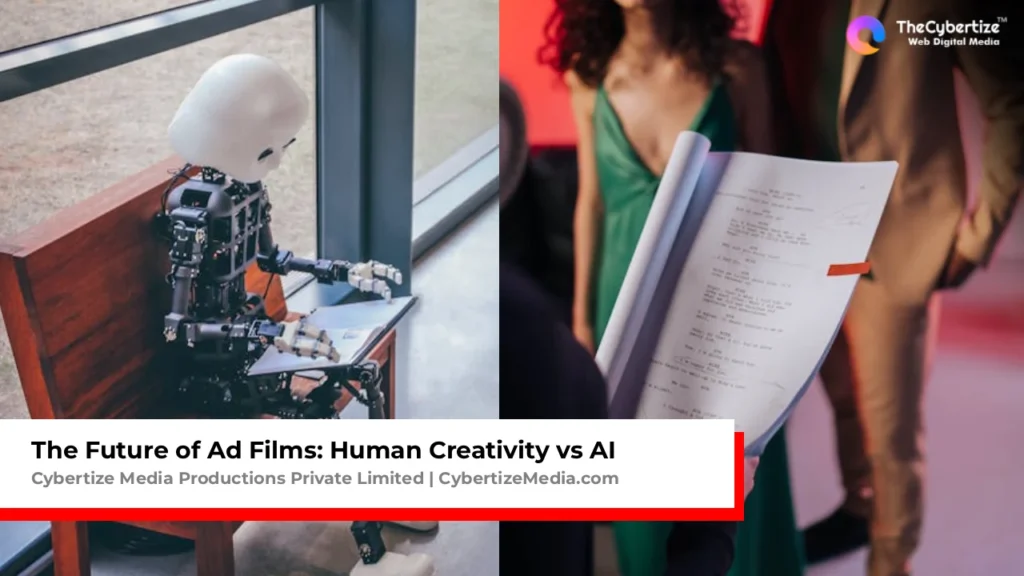
The Future of Ad Films: Human Creativity vs AI, There are two conversations happening simultaneously in Indian advertising right now, and they are happening in the same rooms, sometimes between the same people, sometimes on the same day.
The first conversation is about AI: which tools to adopt, which workflows to automate, how much of production cost can be eliminated, whether generative video will replace the shoot day, whether ChatGPT can replace the copywriter, whether Runway and Sora will make the DOP redundant. This conversation is happening with urgency, because the tools are genuinely impressive and the cost implications are genuinely significant.
The second conversation is about humanity: why Coca-Cola’s AI-generated holiday trucks felt wrong to millions of viewers who couldn’t quite explain why, why brands like Heineken and Polaroid are declaring their work ‘human-made’ as a premium selling point, why Indian consumers — who have the most sophisticated relationship with celebrity culture, emotional storytelling, and cultural specificity of any market in the world — continue to reward ads that feel made by people who understand them.
At Cybertize Media Productions, we make ad films for a living. We have been watching this debate with more than academic interest — because it is a debate about the future of our craft, our industry, and the value of what we create. And after careful analysis of the data, the case studies, the failures, and the genuine breakthroughs, we have a clear position.
The question ‘human creativity or AI — who wins?’ is the wrong question. But it took a year of watching brands get it spectacularly wrong to understand why — and who actually benefits from asking the right one.
1. The Case for AI in Ad Film Production — What It Does Brilliantly
Let’s be honest first. AI is not a gimmick, and pretending otherwise is both wrong and strategically dangerous for brands and production houses that dismiss it too quickly. In specific, well-defined applications, AI tools are genuinely transforming the speed, cost, and scale of advertising production in 2026.
Speed and Volume at Scale
The advertising world has a content volume problem that human production alone cannot solve. Brands now need dozens of variations of each ad — different lengths, formats, languages, platform optimisations, audience segments, A/B testing variants. Producing all of these through traditional production methods is economically and logistically impossible at the speed digital platforms demand.
AI Advantage: Dynamic Creative Optimisation (DCO) using AI allows brands to generate hundreds of creative variations automatically — testing different headlines, visuals, CTAs, and formats simultaneously across platforms. Campaigns using DCO deliver a 32% higher click-through rate and 56% lower cost per click compared to standard campaigns.
Pre-Production Acceleration
The Future of Ad Films: Human Creativity vs AI, AI tools are already reducing pre-production timelines significantly for those who know how to use them. Scriptwriting assistance (not replacement), storyboard generation from text prompts, location reference compilation, mood board creation, casting shortlist generation, budget estimation — all of these tasks that previously consumed days of human effort can be accelerated dramatically with AI tooling.
AI Advantage: AI tools reduce pre-production budgets by up to 40%, enabling smaller studios and new production houses to compete with established players on planning and conceptual output.
Post-Production Efficiency
AI-powered post-production tools — automated colour correction, AI-assisted editing suggestions, AI dubbing and subtitle generation for regional language adaptations, VFX compositing assistance, background replacement — have compressed multi-week post timelines into days for specific task categories. For brands producing regional language variants of a national TVC, AI dubbing and lip-sync tools have reduced adaptation costs by 60–70%.
AI Advantage: Localization AI tools for dubbing and subtitling are significantly reducing the cost and time of producing vernacular versions of national ad films — one of the most significant cost savings available to Indian brands running multi-language campaigns.
Performance Prediction and Testing
Perhaps the least glamorous but most genuinely useful AI application in advertising: predicting how a creative will perform before it’s produced. AI tools trained on enormous datasets of ad performance can now analyse storyboards, scripts, and rough cuts to predict viewer engagement, brand recall lift, and likely CTR — providing directional validation before significant production investment is committed.
AI Advantage: 83% of ad executives deployed AI in creative processes in 2025, up from 60% the year before — driven primarily by performance prediction and creative testing applications, not content generation.
Personalisation at Impossible Scale
AI enables a form of personalisation that was previously completely out of reach for most brands: genuinely individual ad experiences. Product recommendations, location-specific offers, behaviour-based creative variants, weather-triggered messaging — AI can generate and serve thousands of micro-personalised versions of the same core ad concept, each one more relevant to the specific viewer than any single human-crafted version could be.
2. Where AI Fails — The Spectacular, Documented Failures That Changed the Debate
2025 was the year the advertising world discovered, through public humiliation, exactly where AI cannot go. These are not theoretical concerns — they are documented cases of major global brands spending significant budgets on AI-generated advertising and being rejected by audiences who responded with words like ‘soulless,’ ‘creepy,’ and ‘AI slop.’
The Coca-Cola Catastrophe
Coca-Cola spent significant production budget and enormous engineering effort — reportedly 70,000 AI-generated video clips, five AI specialists working for a month, and 100 Coca-Cola staff involved — remaking its iconic ‘Holidays Are Coming’ Christmas ad with generative AI. The result was widely condemned as ‘soulless,’ ‘creepy,’ and ‘lacking the heart and humanity’ of the original. They did it again in 2025 with an all-AI version featuring anthropomorphic animals. The backlash was worse.
Coca-Cola’s Christmas ad is arguably the world’s most emotionally loaded piece of brand communication — it triggers nostalgia, warmth, and specific childhood memories in hundreds of millions of viewers simultaneously. AI cannot access that accumulated emotional territory. It can replicate the visual components. It cannot replicate the feeling.
McDonald’s Netherlands — Pulled in Three Days
McDonald’s Netherlands produced an AI-generated holiday ad depicting Christmas chaos — a satirical concept that required the audience to feel the warmth of Christmas first, before the chaos became funny in contrast. AI-generated visuals depicted the scenes with technical accuracy but zero emotional warmth. Viewers said it ‘ruined their Christmas spirit.’ The ad was pulled three days after launch. McDonald’s called it ‘an important learning.’
Also Read:
How to Come Up With an Ad Film Concept, Creative Director’s Guide
Fashion’s AI Problem
Vogue ran a Guess campaign featuring AI-generated models. The backlash was immediate and sustained — readers threatened to cancel subscriptions, the fashion community rallied against the replacement of real models and photographers with algorithmic imagery, and the discourse revealed something important: in categories where the aspiration is inseparable from the humanity of the people expressing it, AI cannot carry the creative load.
A 2025 study from the Nuremberg Institute for Market Decisions found that simply labelling an ad as AI-generated makes people see it as less natural and less useful — lowering ad attitudes and willingness to research or purchase, even when the content is visually identical. — Nuremberg Institute for Market Decisions, 2025
When consumers believe emotional marketing communications are written by AI rather than humans, they judge them as less authentic, feel moral disgust, and show weaker engagement and purchase intentions — even when the content is otherwise identical. — Journal of Business Research, 2025
Roughly 50% of consumers express caution about AI’s role in daily life, including advertising. Among Gen Z, the rejection of AI-generated content is even stronger. — Pew Research Center, 2025
The ‘Human-Made’ Counter-Movement
The most revealing development of 2025 was not an AI success story. It was the emergence of a counter-movement — major brands actively declaring their work ‘human-made’ as a premium positioning statement.
- Heineken ran billboards urging people to make friends ‘over a beer’ instead of through AI — directly positioning human connection as superior to technology-mediated interaction.
- Polaroid placed posters near Apple stores and Google’s New York headquarters declaring ‘AI can’t generate sand between your toes’ — celebrating the irreducibility of physical, human experience.
- Cadbury 5 Star in India launched ‘Make AI Mediocre Again’ — an Indian brand, in the Indian market, explicitly associating the AI content flood with mediocrity.
- Apple’s new series ‘Pluribus’ included ‘Made by Humans’ in its closing credits — arguably the most pointed cultural commentary on AI authenticity from a technology company that has more reason than anyone to embrace AI aesthetics.
- Aerie declared it won’t use AI in its ads — this became its most popular Instagram post of the year.
When brands build campaigns around not using AI, the ‘human-made’ label has become a product differentiation strategy. That is a cultural moment of the highest significance.
Cybertize View: The ‘Made by Humans’ counter-movement is not nostalgia or fear. It is a market signal that audiences have developed a sensitivity to authenticity that AI cannot yet satisfy in emotionally high-stakes contexts. Indian brands would be wise to read this signal carefully.
3. The Authenticity Premium — What Indian Audiences Actually Respond To
The concept of the ‘authenticity premium’ — the measurable, real value that human-made creative carries in emotionally significant contexts — is the key to understanding where this debate is actually going.
Studies show that people value creative works more when attributed to humans, perceiving them as more meaningful and beautiful — even if they are visually identical to AI-generated outputs. This is not about quality. It is about origin. And in advertising, where trust is the primary currency, origin matters enormously.
The Future of Ad Films: Human Creativity vs AI, Why This Matters More in India
India is not a generic consumer market for this debate. Several specific cultural characteristics make the human-vs-AI question particularly consequential for Indian advertising:
Cultural specificity: The best Indian advertising has always been rooted in hyper-specific cultural truths — the specific texture of a Diwali morning, the particular dynamic between a bahu and saas, the distinct emotional register of a first-generation professional’s relationship with their family. AI trained on global datasets does not know these things. A human writer raised in Kanpur, Hyderabad, or Kolkata does.
Language and register: The Hindi of Lucknow sounds different from the Hindi of Mumbai. The rhythm of spoken Tamil in advertising is culturally coded. Vernacular registers, idioms, and the music of spoken language in Indian advertising are the product of lived cultural experience — not pattern recognition. AI can approximate these. It cannot inhabit them.
Celebrity and human trust: Indian consumers’ relationship with celebrity is built on the feeling that they know these people — from films, from cricket, from years of cultural presence. An AI-generated celebrity likeness or an AI-composed brand film around a real personality cannot access the accumulated human familiarity that makes celebrity endorsement work. The magic requires a real person.
Emotional density: Indian advertising’s most memorable moments — Fevicol’s absurdist strength metaphors, Surf Excel’s ‘Daag Achche Hain,’ Cadbury’s iconic rain dance — are not just emotionally resonant. They are culturally resonant. They understand specific emotional experiences in specific Indian contexts that an AI system, without lived experience, cannot navigate with genuine authenticity.
Also Read: Top Storytelling Techniques for Brand Films
Human Advantage: In India specifically, the deepest human truths in advertising — family obligation, aspiration and sacrifice, the specific texture of Indian relationships — require a human who has lived those truths to express them with the precision and authenticity that Indian audiences recognise and reward.
4. What Actually Wins, The Hybrid Model That the Best in the World Are Building
The brands and agencies that are winning in 2026 are not the ones that went all-in on AI. They are not the ones that rejected AI entirely. They are the ones that asked a different question: not ‘AI or human?’ but ‘AI for what, and humans for what?’
This is the question that leads to the only answer that makes strategic sense.
| Task / Stage | AI Wins | Human Wins | Why |
|---|---|---|---|
| Brand strategy and positioning | Provides data and pattern analysis | Owns the decision | Brand decisions require cultural judgment AI cannot simulate |
| Creative concept (Big Idea) | Can generate volume of surface concepts | Owns the Big Idea | Insight + emotion + cultural truth = human domain |
| Scriptwriting (structural) | Can draft frameworks and variations | Refines, edits, owns final voice | First drafts are fast; authentic voice is human |
| Storyboarding | Can generate visual references quickly | Directs creative intention | Reference generation is mechanical; vision is human |
| Casting direction | Can shortlist based on data | Makes the final creative judgment | Chemistry, instinct, and story fit are human judgments |
| Production planning | Optimises schedules and logistics | Leads on-set creative decisions | Logistics are data problems; direction is craft |
| Post-production editing (technical) | Automates cuts, transitions, pacing drafts | Curates the story and emotional rhythm | Assembly is mechanical; editorial judgment is human |
| Colour grading | Can apply reference grades automatically | Crafts the emotional tone of each shot | Automated grading is starting point; human grade is the finish |
| Music selection | Can suggest tracks based on mood data | Makes the final emotionally resonant choice | Data matches parameters; humans feel the fit |
| Localisation and versioning | Excellent — dubbing, subtitle generation, format adaptation | Reviews for cultural accuracy | Volume work is AI’s domain; cultural nuance is human |
| Performance optimisation | Excellent — testing, iteration, targeting | Sets the optimisation brief and reviews results | Data analysis is AI’s strength; strategic interpretation is human |
| Brand voice and authenticity | Provides consistency checking | Guards and develops the voice | Brand voice is a human creative asset, not a data pattern |
Cybertize View: The most important insight in this table: AI is strongest at tasks that are mechanical, data-driven, and high-volume. Humans are strongest at tasks that require judgment, cultural insight, emotional truth, and genuine creative authorship. These two strengths are not in competition — they are complementary. The winning model deploys each where they excel.
5. The Five Laws of AI-Human Creative Collaboration for Ad Film Production | The Future of Ad Films: Human Creativity vs AI
After studying the successes and failures, talking to creative directors, and testing these principles against our own production work at Cybertize Media, we’ve arrived at five laws that determine whether AI and human creativity work together effectively:
Law 1: Humans Define the Concept; AI Executes the Variants
The creative concept — the Big Idea, the human truth, the emotional territory — must always originate from a human creative process. Once the concept is locked by human judgment, AI can generate, test, and optimise dozens of executional variations faster than any human team could. The direction must be human. The volume can be machine.
The Coca-Cola failure happened because they applied AI at the concept level — using it to reimagine their most emotionally sacred brand property. The brands using AI successfully use it at the executional level — generating variants of concepts that humans have already approved.
Law 2: The Emotional Stakes Determine the Human Requirement
Not all advertising has the same emotional stakes. A targeted digital ad for a product comparison at the bottom of the purchase funnel has low emotional stakes — the viewer is already in decision mode, the emotional temperature is low, and AI-generated creative can perform perfectly well. A Christmas campaign for a legacy brand has the highest possible emotional stakes — the audience brings decades of accumulated feeling and expectation. The higher the emotional stakes, the more human creative judgment is required.
Also Read: How to Shoot a Professional Ad Film on a Budget, Complete Guide
Low emotional stakes (AI appropriate): Dynamic retargeting, product specs, offer-led direct response, price comparison, category-entry information.
High emotional stakes (human required): Brand-building campaigns, festive advertising, category trust moments, brand heritage, identity and values communication.
Law 3: Cultural Specificity Requires Human Authority
Any advertising that requires cultural specificity — and in India, virtually all effective advertising does — requires human creative authority. This is not a limitation that AI will eventually overcome with better training data. Cultural specificity in Indian advertising is not about pattern matching; it is about meaning-making that arises from shared lived experience. A human creative director from Chennai making a Tamil Nadu campaign brings something to that work that no AI system trained on Tamil-language content can replicate: they have been to weddings in Salem, they know how a grandmother in Coimbatore speaks, they understand the specific emotional register of a family gathering over biryani in Madurai.
Brands that outsource Indian cultural specificity to AI are outsourcing the thing that makes Indian advertising connect with Indian audiences.
Law 4: Transparency Is Non-Negotiable
The audience’s trust in a brand’s communication is partially determined by their sense of whether the communication is honest. As AI-detection capabilities improve and consumer awareness of AI-generated content grows, brands that use AI covertly in high-emotional-stakes contexts risk the same backlash that Coca-Cola and McDonald’s experienced — but with the added dimension of dishonesty. The brands that are winning with AI in 2026 are transparent about how they use it, separating AI-assisted backend efficiency from human-led brand communication.
In India, where brand trust is built on a foundation of personal connection and cultural understanding, any perceived deception in the communication process carries a particularly high reputational risk.
Law 5: The Question Is Not Replacement — It Is Re-Allocation
The most productive way to think about AI in ad film production is not as a technology that replaces human roles, but as one that re-allocates human effort. When AI handles the mechanical volume tasks — variations, localisations, performance testing, technical post-production — human creative energy is freed from the mechanical and directed entirely toward the uniquely human: the insight, the story, the emotional truth, the cultural specificity, the directorial judgment that turns footage into feeling.
The best creative teams in India in 2026 are not smaller because of AI. They are differently composed — with the same human creative leadership and a larger layer of AI tooling beneath them that multiplies the executional output of every human decision.
6. The Indian Context — Why This Debate Plays Out Differently Here
The global conversation about AI and creativity is happening in a specific cultural and economic context that does not translate directly to India. Several distinctly Indian factors shape how this debate should be understood by brands and production houses operating in the Indian market:
India’s Emotional Advertising Heritage
Indian advertising has a long and distinguished tradition of emotionally intelligent, culturally specific storytelling that has built the country’s most trusted brands. Surf Excel’s ‘Daag Achche Hain’ is twenty years old and still remembered. Amul’s topical billboard campaigns have been running for sixty years. Fevicol’s creative work is studied in advertising schools globally. This heritage was not built by efficiency tools — it was built by human creativity with deep cultural roots and the willingness to take creative risks.
The risk with AI in Indian advertising is not that it produces bad work. It is that it produces work that is statistically average — competent, inoffensive, and completely unmemorable. And in a market where the most effective advertising has always stood dramatically apart from the category average, average is the most expensive creative outcome of all.
India’s Cost Structure Makes AI More Appealing — But the Stakes Are Higher
India’s production costs are already among the lowest for professional quality ad film production in the world — a ₹5 lakh digital ad film in India would cost ₹40 lakh or more in the UK or US. This means the cost savings that AI offers are proportionally smaller in India than in high-cost Western markets. But the reputational risk of getting it wrong is the same — perhaps higher, because Indian audiences have a highly developed ability to sense inauthenticity in advertising that speaks to their cultural experience.
The Vernacular Opportunity Is Real — and Requires Human Authority
AI’s most genuine advantage in the Indian market is in vernacular adaptation and content localisation. India’s 22 official languages and hundreds of regional dialects represent a content localisation challenge that no production team could address at the required scale with traditional methods. AI dubbing, subtitle generation, and text adaptation tools can responsibly handle the mechanical translation layer — but the cultural validation of whether an adapted piece of content ‘feels right’ in a specific linguistic and cultural context must remain with a human editor who inhabits that culture.
The D2C and Digital-First Brand Opportunity
For India’s rapidly growing D2C brand ecosystem — brands born digital, selling direct, iterating rapidly — AI-generated creative at the digital-distribution level represents a genuine strategic opportunity. A Bengaluru-based skincare D2C brand that needs 40 variants of a product ad for testing across Meta, Google, and YouTube, in four languages, with different CTA versions for different audience segments — that brand can use AI to generate and test creative at a speed and cost that traditional production cannot match. When the emotional stakes are low and the performance objective is measurable, AI delivers real ROI.
Cybertize View: At Cybertize Media, we use AI tools in specific, defined stages of our production workflow: pre-production reference generation, post-production technical tasks, and content localisation for multi-language campaign adaptation. We do not use AI at the concept, direction, or cultural authenticity stages. The distinction matters — and our clients’ audiences can feel it.
7. The Future of Ad Films — What the Next Five Years Actually Look Like
Here is our honest, specific prediction for how the AI-human dynamic in Indian ad film production will evolve through 2030:
| Timeframe | Where AI Will Be | Where Humans Will Be | What Changes for Indian Brands |
|---|---|---|---|
| 2026 (Now) | Performance ads, DCO, versioning, technical post | Brand films, emotional campaigns, cultural strategy, direction | AI supplements volume; humans lead quality — divided clearly |
| 2027–28 | Pre-production workflow (storyboarding, logistics, casting research) | Concept development, direction, cultural intelligence | Production timelines compress; creative development becomes more intensive |
| 2028–29 | AI generates draft scripts, rough cuts, colour reference grades | Human creative directors review and elevate AI outputs | Production cost falls 20–35%; creative director role becomes more powerful |
| 2030 | AI can produce a competent 30-second ad for a defined brief autonomously | Human creativity creates the brief, the concept, and the emotional ambition | Commodity production is AI-automated; breakthrough creative is a human premium |
The Future of Ad Films: Human Creativity vs AI: The conclusion this timeline points toward is not the replacement of human creativity. It is the elevation of it. As AI automates the mechanical layers of production, what remains non-automatable — and therefore increasingly valuable — is the specifically human: the insight that comes from lived experience, the emotional truth that requires empathy, the cultural specificity that requires belonging, the creative courage that requires conviction.
The most successful Indian ad film makers in 2030 will not be the ones who mastered AI tools. They will be the ones who used AI tools to free their human creativity for the work that only humans can do — and who understood the difference between the two clearly enough to never confuse them.
8. Where Cybertize Media Stands — Our Position and Our Practice
We have been deliberate and specific about this throughout the article, but we want to state it plainly: Cybertize Media Productions uses AI tools. We are not afraid of them, we are not dismissive of them, and we do not treat this as an identity debate about whether we are a ‘human’ or ‘technology’ company.
The Future of Ad Films: Human Creativity vs AI, We are a production company. Our job is to make ad films that change how people think, feel, and act toward our clients’ brands. We use every tool that serves that objective. And we decline to use any tool — including AI — where its use would compromise the quality, authenticity, or effectiveness of the work.
What We Use AI For
- Pre-production reference gathering — mood boards, location research, visual reference compilation
- Script drafting assistance for structural frameworks and first-pass language options (always human-edited)
- Post-production technical efficiency — colour reference analysis, subtitle generation, format adaptation
- Vernacular content adaptation — AI-assisted dubbing with mandatory human cultural validation
- Performance prediction — testing creative concepts against historical engagement data
- Production scheduling and logistics optimisation
What We Will Never Use AI For
- The creative concept — the Big Idea is always human-originated at Cybertize Media
- The cultural intelligence layer of any brief involving specific Indian regional, linguistic, or community identity
- The directorial judgment on any shoot day
- The final editorial judgment on pacing, emotional rhythm, and story structure
- Any client-facing representation of creative work as human-generated when it is not
This is not a philosophical position. It is a quality position. Our clients hire us because they trust that the ad films we produce will connect with Indian audiences in ways that move their brands forward. That trust is built on creative work that audiences can feel was made by people who understand them. We will never risk that trust for a production cost saving that comes with an authenticity deficit.
Also Read: Corporate Films vs. Ad Films: Key Differences Explained
Cybertize View: The future of Indian ad film production is not AI replacing human creativity. It is human creativity, freed from mechanical tasks by AI, reaching new levels of cultural precision, emotional depth, and creative ambition. That is the future we are building toward at Cybertize Media. And it requires both — wielded with the wisdom to know which is which.
The Verdict — Who Really Wins?
The answer to ‘human creativity or AI — who wins?’ is this: the question is wrong, and whoever keeps asking it will lose.
The Future of Ad Films: Human Creativity vs AI: AI wins when it handles the mechanical, the high-volume, the data-intensive, and the technically repetitive. Human creativity wins when it navigates the emotional, the cultural, the instinctive, and the authoritatively original. The brands and production houses that understand this distinction — and build their creative processes accordingly — win in both dimensions simultaneously.
The brands that lose are those on either extreme: the ones who deploy AI in emotionally sacred contexts where audiences can feel the absence of human authorship, and the ones who dismiss AI entirely and allow their more agile competitors to out-produce them at the volume and speed that digital advertising now demands.
The Future of Ad Films: Human Creativity vs AI: In Indian advertising specifically, the stakes of getting this wrong are particularly high — because Indian audiences have a more developed sensitivity to cultural authenticity and a lower tolerance for emotional inauthenticity than almost any other market in the world. The human creativity that has built India’s greatest advertising campaigns — the Fevicols, the Surf Excels, the Amuls — is not a historical artefact. It is a competitive advantage that becomes more valuable, not less, as AI makes the culturally generic cheaper and faster to produce.
The future of Indian ad films belongs to those who understand the difference between what can be computed and what must be felt. And at Cybertize Media Productions, that distinction is the foundation of everything we make.