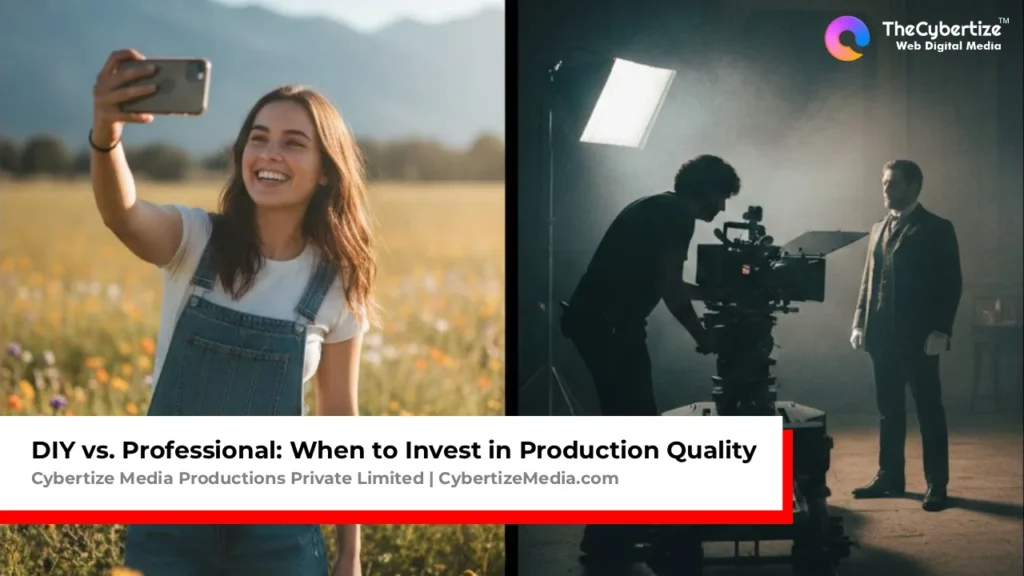
Your smartphone just shot 8K video. Free editing software downloaded. YouTube tutorials watched. You’re ready to create your brand’s next marketing video—right?
Maybe. Or maybe you’re about to make a costly mistake that no amount of post-production can fix.
The line between DIY and professional video production has never been more blurred—and never more consequential. In 2026, with iPhone 17 Pro Max cameras rivaling professional cinema cameras and AI editing tools democratizing post-production, the technical barriers to creating video content have virtually disappeared. Yet the gap between amateur and professional results remains as wide as ever.
At Cybertize Media Productions Private Limited, we field this question constantly: “When should we handle video ourselves, and when should we hire professionals?” After producing hundreds of commercial films and watching countless brands navigate this decision, we’ve developed a framework that goes beyond budget considerations to address the real question: what does your video need to accomplish?
Top Cybertize Offerings
Our comprehensive Media & Tech Services in India offerings include:
| Service Category | Specific Services |
|---|---|
| Film Production | Film, Web Series, Short films, Cinematic Films, IG Reels, Ad Films |
| Animation Production | 2D animation, 3D animation, Walkthrough, Medical Animation, Explainer Videos |
| Software Development | CMS (Content Management Softwares), On Demand Software, Edtech, SaaS Portals, ERPs, Cloud Infra, AWS, Azure |
| SEO & Content Marketing | Blog writing, video production, infographics, email marketing, white papers, case studies, On Page SEO, Link Building |
| Web Development | Website design, responsive development, e-commerce, CMS implementation, site optimization |
| AI / ML | Artificial Intelligence / Machine Learning |
This comprehensive guide cuts through the confusion, revealing when smartphone videos shot by your marketing team make perfect sense—and when they represent false economy that undermines brand credibility and campaign effectiveness. We’ll examine the hidden costs of DIY production, the measurable ROI of professional investment, and most importantly, help you make strategic decisions that align production approach with business objectives.
The 2026 Reality: DIY Production Has Never Been More Capable (Or More Dangerous)
Let’s establish a critical truth upfront: the technical quality achievable through DIY video production in 2026 is extraordinary—and often sufficient for many business needs.
What Modern Smartphones Can Actually Do
The latest flagship smartphones represent remarkable engineering achievements:
iPhone 17 Pro Max offers:
- 4K video at 120fps
- ProRes and Log format recording
- Dolby Vision HDR
- Seven optical focal lengths (13mm to 120mm)
- Computational photography rivaling dedicated cameras
- Four studio-quality microphones with wind reduction
Samsung Galaxy S26 Ultra provides:
- 200MP main sensor
- 8K video recording at 30fps
- Professional-grade stabilization
- AI-powered scene optimization
- Multiple telephoto options (3x and 5x optical zoom)
Google Pixel 10 Pro delivers:
- 8K video with Video Boost technology
- AI Camera Coach for improved composition
- Exceptional low-light performance
- Advanced computational photography
- 42MP front-facing camera for vlogging
These aren’t just impressive specifications—they represent genuinely professional capabilities that would have required $50,000+ in equipment just a decade ago.
The Democratization of Post-Production
Beyond camera technology, editing has become extraordinarily accessible:
Free Professional-Grade Tools:
- DaVinci Resolve (full-featured color grading and editing)
- CapCut (AI-powered editing optimized for social media)
- Canva Video (template-based creation)
- Adobe Express (simplified creative suite)
AI-Powered Efficiency:
- Automated color correction and grading
- AI-generated B-roll and transitions
- Voice cloning for multilingual content
- Automatic captioning and transcription
- Music generation and synchronization
A competent intern with a smartphone and laptop can now produce content that looks technically competent. This is both liberating and dangerous.
Why Technical Quality Doesn’t Equal Professional Results
Here’s the uncomfortable reality that brands discover too late: smartphone cameras can capture professional-quality footage, but that doesn’t mean your videos will look or perform professionally.
Professional production isn’t about equipment—it’s about expertise, strategy, and craft in areas that technology can’t automate:
Strategic Planning:
- Aligning creative approach with business objectives
- Understanding audience psychology and platform behavior
- Structuring narratives for maximum emotional impact
- Anticipating how videos will perform across the entire customer journey
Production Design:
- Lighting that creates mood and guides attention (smartphone cameras capture light beautifully; they don’t create it)
- Sound design that operates at conscious and subconscious levels
- Composition that follows centuries of visual storytelling principles
- Direction that extracts authentic performance from on-camera talent
Professional Craft:
- Color science that maintains brand consistency
- Audio engineering that professional audiences expect
- Pacing and editing rhythm that holds attention
- Quality control that catches errors before publication
The smartphone in your pocket is an amazing camera. But a professional photographer with that same smartphone will produce dramatically better results than an amateur—not because of equipment, but because of the expertise behind the lens.
The Hidden Costs of DIY Production: What Brands Don’t Calculate
When evaluating DIY versus professional production, most brands focus exclusively on direct costs: equipment, software, and perhaps staff time. This incomplete calculation leads to decisions that appear financially sound but prove expensive in ways that never appear on balance sheets.
Opportunity Cost: What Else Could Your Team Be Doing?
Your marketing manager earning ₹80,000/month ($960/month) spends two weeks creating a product video. Direct cost calculation: roughly ₹40,000 in salary allocation.
But what didn’t happen during those two weeks?
- The campaign strategy that needed refinement
- The customer insights analysis that got postponed
- The partnership negotiations that stalled
- The competitive research that went undone
Real cost: ₹40,000 in salary + unknown business opportunity cost of work not completed.
A professional production company delivers that video in days, freeing your team to focus on work only they can do. This opportunity cost doesn’t appear in spreadsheets, but it compounds over time.
The Revision Spiral: When “Quick Edits” Become Endless
DIY video projects consistently exceed time estimates by 200-300%. The reason? The revision spiral:
- Initial edit seems good
- Team review reveals issues
- “Quick fixes” attempted
- New problems emerge
- Technical limitations discovered
- More revisions needed
- Deadline approaches
- Compromises accepted
- Final product mediocre
Professional production houses build revision cycles into structured workflows with defined approval stages. DIY projects often spiral through informal, repeated revision requests that consume vastly more time than anticipated.
At Cybertize Media, we’ve seen brands spend 60+ hours on DIY projects that should have taken 20 hours—because nobody defined “done” before starting.
Brand Damage: The Cost of Looking Amateur
This is the most expensive hidden cost, and the hardest to quantify.
Your DIY video looks “pretty good”—to you. But your audience compares it not to your previous efforts but to everything else they’ve seen that day: professionally produced ads from competitors, high-quality YouTube content, cinematic social media from leading brands.
Research shows that video quality directly impacts brand perception:
- 62% of consumers view brands more favorably when videos look professional
- Poor video quality reduces purchase intent by 26%
- 45% of viewers stop watching videos with poor audio quality within 30 seconds
You save ₹100,000 by handling a product launch video internally. But if that DIY video reduces conversion rates by just 2% on a ₹10 million product launch, the “savings” cost you ₹200,000 in lost revenue.
Brand damage compounds. Every subpar video erodes credibility that takes multiple high-quality touchpoints to rebuild.
Technical Debt: Problems That Emerge Later
DIY video creation often involves shortcuts that create problems downstream:
Format Issues:
- Footage shot in formats incompatible with professional workflows
- Color space mismatches that make future editing difficult
- Resolution or codec choices that limit repurposing options
Asset Management:
- No organized system for raw footage and project files
- Lost or corrupted source material when revisions needed
- Inability to create variations for different platforms
Rights and Permissions:
- Music used without proper licensing
- Talent releases not secured
- Location permissions not documented
These issues may not matter immediately. But when you need to update that video, create a new version, or defend against copyright claims, the lack of professional production protocols becomes very expensive.
When DIY Production Makes Perfect Strategic Sense
Despite the above warnings, DIY video production is absolutely the right choice in many scenarios. The key is matching production approach to strategic purpose.
High-Volume, Low-Stakes Social Content
Perfect DIY Use Case: Daily Instagram Stories, Behind-the-Scenes Reels, Team Updates
Modern brands need volume—multiple pieces of content daily across platforms. Professional production for all this content isn’t financially viable or strategically necessary.
Why DIY Works Here:
- Authenticity Over Polish: Social audiences increasingly value genuine, unfiltered content over slick production
- Speed Requirements: Trending topics and real-time engagement demand same-day creation and publication
- Expected Aesthetic: Platform-native content that looks “too professional” can feel inauthentic
- Acceptable Imperfection: Audiences forgive technical limitations in informal social content
- Volume Economics: Creating 20 Stories per week professionally would be prohibitively expensive
Success Factors for DIY Social Content:
- Clear brand guidelines for visual consistency (even informal content needs consistent voice)
- Basic equipment standards (good lighting, clean audio, stable shots)
- Template-based workflows for efficiency
- Quick approval processes that don’t bottleneck
- Staff training on smartphone shooting best practices
At Cybertize Media, we often help clients develop DIY content frameworks—providing professional training, templates, and guidelines that enable their teams to create high-volume content that maintains brand standards while embracing platform-appropriate authenticity.
Internal Communications and Training
Perfect DIY Use Case: Company Updates, Process Training, Internal Announcements
Internal videos serve audiences already invested in your success. They prioritize clear information over production value.
Why DIY Works Here:
- Known Audience: Employees understand context and forgive production limitations
- Information Priority: Message clarity matters more than aesthetic excellence
- Frequent Updates: Content needs change rapidly; professional production timelines don’t match
- Cost-Benefit Alignment: ROI on internal videos doesn’t justify professional production budgets
- Authenticity Value: Leadership speaking directly to camera without production artifice builds connection
Success Factors for DIY Internal Content:
- Consistent technical baseline (quality microphone, good lighting, clean background)
- Scripting or talking points for clear messaging
- Editing for pacing and clarity (even simple cuts improve watchability)
- Accessibility considerations (captions, clear audio)
- Organized hosting and distribution
Concept Testing and Proof-of-Concept
Perfect DIY Use Case: Testing Campaign Ideas, A/B Testing Creative Approaches, Prototype Videos
Before investing in professional production, smart brands test concepts with scrappy prototypes.
Why DIY Works Here:
- Validation Purpose: You’re testing ideas, not final execution
- Speed to Learn: Quick iterations enable rapid testing cycles
- Cost Efficiency: Testing five approaches via DIY costs less than producing one professionally
- Flexibility: Easy to pivot when tests reveal better directions
- Protection Against Waste: Don’t professionally produce content that testing reveals doesn’t work
Success Factors for DIY Concept Testing:
- Clear testing objectives (what question does this answer?)
- Good-enough quality to get valid feedback (too poor and you’re not testing the concept, you’re testing reaction to bad video)
- Structured testing methodology (control variables, measure consistently)
- Defined threshold for scaling to professional production
- Budget reserved for professional production of winning concepts
When You Have Real In-House Expertise
Perfect DIY Use Case: Organizations With Trained Video Professionals on Staff
Some organizations legitimately possess internal video production expertise—often media companies, large marketing departments, or creative agencies.
When Internal Production Makes Sense:
- Full-Time Specialists: Dedicated videographers, editors, and producers on staff
- Professional Equipment: Proper cameras, lighting, audio gear, and editing suites
- Established Workflows: Proven processes for briefing, production, and revision
- Portfolio Evidence: Track record of internal videos performing well
- Capacity Availability: Team has bandwidth without sacrificing other responsibilities
Even with in-house capabilities, strategic brands maintain relationships with external production houses for:
- Overflow capacity during peak periods
- Specialized skills not available internally
- Fresh creative perspectives
- Premium productions where stakes are highest
When Professional Production Is Non-Negotiable
Certain video applications demand professional production. The business risks of DIY approaches in these scenarios far exceed any cost savings.
Brand Films and Hero Content
Non-Negotiable Professional Territory: Company Overview Videos, Brand Stories, Hero Campaign Content
Your brand film is often the first substantial video impression prospects receive. It communicates not just information but brand values, market positioning, and organizational credibility.
Why Professional Production Is Essential:
First Impression Stakes: For many prospects, this video IS your brand. Amateur production suggests amateurish business practices.
Longevity Requirements: Brand films typically serve for 2-3 years. The ROI calculation changes dramatically when one investment serves this long.
Complex Storytelling: Effective brand narratives require sophisticated structure, pacing, and emotional architecture that comes from professional experience.
Cross-Platform Performance: Hero content must perform across channels—website, LinkedIn, presentations, events—demanding technical excellence that adapts across contexts.
Competitive Context: Your brand film competes for attention against professionally produced content from competitors and market leaders.
High-Value Product Launches
Non-Negotiable Professional Territory: New Product Introduction Videos, Product Demonstration Content
Product launch videos directly impact sales. Conversion rate differences between professional and DIY content pay for professional production many times over.
The ROI Math:
Imagine a product with ₹50,00,000 projected revenue in first quarter:
- DIY video production cost: ₹50,000
- Professional video production cost: ₹2,50,000
- Difference: ₹2,00,000
If professional production increases conversion rate by just 0.5%, you’ve generated an additional ₹25,000 in revenue. Break-even requires only an 0.4% conversion improvement.
In reality, professional product videos typically improve conversion by 2-5%, making ROI dramatically positive.
Why Professional Production Drives Conversion:
- Product Credibility: Premium production suggests premium products
- Feature Clarity: Professional cinematography makes product details visible and appealing
- Benefit Communication: Skilled storytelling connects features to customer value
- Purchase Confidence: High production quality reduces perceived purchase risk
- Shareability: Audiences share impressive content, multiplying reach
Client-Facing Prestige Content
Non-Negotiable Professional Territory: Case Studies, Client Testimonials, Award Submissions
Content representing client relationships or competitive submissions requires irreproachable quality.
Client Testimonials: Your satisfied client agrees to be on camera. Their testimonial is enormously valuable—but only if the video does justice to their story. Amateur production wastes their contribution and potentially damages the relationship.
Professional testimonial videos achieve:
- Client comfort on camera (professional direction extracts authentic, confident performance)
- Production quality matching client’s expectations for their own brand representation
- Editing that identifies and amplifies the most compelling moments
- Technical excellence that makes clients proud to share
Award Submissions: Competition entries are judged against the best work in your category. DIY production ensures losing to professionally produced competitors.
Television and Premium Digital Advertising
Non-Negotiable Professional Territory: TV Commercials, YouTube Pre-Roll, Premium OTT Advertising
Paid media placements demand professional production for multiple reasons:
Quality Parity: Your ad appears alongside professionally produced content from major brands. Quality disparity is immediately apparent and damaging.
Technical Requirements: Broadcast and premium digital platforms have strict technical specifications that DIY workflows often can’t meet:
- Precise color space requirements
- Audio loudness standards (LUFS measurements)
- File format and codec specifications
- Quality control protocols
ROI Pressure: You’re paying for placement. Every conversion percentage point matters. Professional creative substantially improves campaign performance.
Legal and Compliance: Paid advertising invites regulatory scrutiny. Professional production ensures compliance with advertising standards and includes proper legal documentation.
Crisis Communications and Executive Messaging
Non-Negotiable Professional Territory: Public Statements During Crises, CEO Communications on Sensitive Topics
When organizational reputation is at stake, every element must be precisely calibrated.
The Crisis Communication Stakes:
In crisis situations, your video will be:
- Analyzed frame-by-frame by media and critics
- Compared to competitor responses and historical corporate communications
- Assessed for sincerity, competence, and appropriate gravitas
- Potentially viewed millions of times with no second chances
Professional production ensures:
- Appropriate setting and visual tone for message seriousness
- Executive comfort and confidence on camera
- Audio quality that ensures every word is clearly understood
- Technical execution that doesn’t distract from message
- Rapid production without visible shortcuts or errors
At Cybertize Media Productions, our crisis communication protocols include 24-hour turnaround capabilities, experienced director coaching for executives under pressure, and technical redundancy that ensures nothing goes wrong at the worst possible time.
The Hybrid Approach: Strategic DIY Plus Professional Partnership
The most sophisticated brands don’t choose between DIY and professional production—they strategically deploy both.
Building a Sustainable Content System
The Modern Content Reality: Brands need both high-volume daily content AND periodic premium productions.
Optimal Hybrid Model:
Internal DIY Capabilities:
- Daily social media content (Stories, Reels, quick updates)
- Internal communications and training
- Concept testing and prototypes
- Simple event coverage and behind-the-scenes
- Volume content that maintains presence between major productions
Professional Production Partnership:
- Quarterly hero content (brand films, major campaigns)
- Product launch videos
- Client testimonials and case studies
- Premium advertising creative
- Complex productions requiring specialized skills
- Content requiring highest ROI and longest shelf life
When to Transition from DIY to Professional
Smart brands recognize inflection points where DIY approaches become limiting:
Trigger 1: Volume Overwhelms Quality When trying to create enough content, quality suffers consistently, it’s time to build professional capabilities.
Trigger 2: ROI Becomes Measurable Early-stage brands experiment. Growth-stage brands optimize. When you can measure video ROI, professional production’s lift justifies investment.
Trigger 3: Brand Standards Demand Consistency As brands mature, inconsistent quality damages hard-won equity. Professional production ensures reliable standards.
Trigger 4: Competitive Pressure Increases When competitors raise production quality, audience expectations shift. Maintaining DIY approaches means losing ground.
Trigger 5: Specialization Needs Emerge Animation, complex effects, location shooting, large crews, specialized equipment—certain needs simply can’t be DIY.
The Professional Training Investment
Rather than perpetual DIY or complete outsourcing, many brands invest in upskilling internal teams:
What Professional Training Enables:
- Higher-quality DIY content through improved technique
- Better client skills for working with production houses
- Understanding of what’s possible versus what requires professional help
- Clearer briefs and more efficient approval processes
At Cybertize Media, we offer training programs for clients who want to develop internal capabilities while maintaining professional partnerships for premium work.
Evaluating Your Specific Situation: A Decision Framework
How do you determine the right approach for your specific video project? Use this strategic framework:
The Five-Factor Analysis
Factor 1: Audience Expectations
Ask: What production quality does this audience expect for this content type?
- Internal team updates: Low expectations, information prioritized
- LinkedIn thought leadership: Moderate expectations, authenticity valued
- Premium product launch: High expectations, quality signals product value
- National TV campaign: Maximum expectations, competing with major brands
Guideline: Match production quality to audience expectations for the content type and channel.
Factor 2: Business Impact Potential
Ask: What’s the maximum business value this video could generate?
Calculate potential impact:
- Website hero video seen by 10,000 monthly visitors with 3% conversion = 300 conversions
- Product demo that could influence ₹50 lakh in sales
- Recruitment video that could attract candidates reducing ₹20 lakh in agency fees
- Investor presentation potentially securing ₹5 crore funding
Guideline: When business impact exceeds 10x production cost, professional investment is strategic.
Factor 3: Longevity and Reusability
Ask: How long will this video serve the business?
Short-Term Content (weeks to months):
- Trending topics and timely responses
- Event coverage and announcements
- Limited-time promotions
- Seasonal campaigns
→ DIY often appropriate; investment won’t be amortized across long timeframe
Long-Term Content (years):
- Brand story and about us videos
- Evergreen explainers and how-tos
- Company culture and values content
- Core product demonstrations
→ Professional production’s cost distributes across extended utility
Guideline: Content serving 2+ years deserves professional investment.
Factor 4: Competitive Context
Ask: What production quality standard do competitors and category leaders set?
Research competitive context:
- Review competitors’ video content quality
- Analyze leading brands in your category
- Examine award-winning work in your industry
- Assess audience expectations shaped by category norms
Guideline: Match or exceed category production standards for parity content; exceed them for differentiation.
Factor 5: Internal Capability Honest Assessment
Ask: Do we genuinely have the skills, equipment, time, and focus to execute this well?
Capability Self-Audit:
- Do we have dedicated video production staff (not “marketing person who also shoots video”)?
- Do we own professional equipment properly maintained and updated?
- Do we have successful portfolio examples of similar work?
- Is our team available without compromising other priorities?
- Do we have established workflows preventing scope creep?
Guideline: Two or more “no” answers indicate professional production is appropriate.
Real Cost Comparison: What Professional Production Actually Costs in 2026
Let’s establish realistic expectations around professional video production costs in the Indian market:
Pricing Tiers and What You Get
Basic Professional Production (₹50,000 – ₹1,50,000)
Typical deliverables:
- 30-60 second social media video or simple explainer
- Single shoot day with small crew (2-3 people)
- Basic location or simple studio setup
- Standard editing and color correction
- Stock music and simple graphics
- 1-2 revision rounds
Best for: Simple product demos, basic testimonials, straightforward announcements
Mid-Range Professional Production (₹1,50,000 – ₹5,00,000)
Typical deliverables:
- 60-120 second brand video or polished explainer
- Multiple shoot days or locations
- Full professional crew (5-7 people)
- Professional talent/actors if needed
- Original music or premium licensing
- Motion graphics and animation elements
- Comprehensive editing and color grading
- Multiple variations for different platforms
Best for: Product launches, company overviews, client testimonials, recruitment videos
Premium Professional Production (₹5,00,000 – ₹20,00,000+)
Typical deliverables:
- 2-5 minute hero content or commercial campaign
- Multiple locations with complex logistics
- Large crew with specialized roles
- Professional actors, voice talent, creative direction
- Original score composition
- Advanced visual effects or animation
- Extensive pre-production planning
- Multiple deliverable versions
- Long-term usage rights
Best for: TV commercials, major brand campaigns, high-stakes launch content, award submissions
DIY Cost Reality Check
While DIY appears cheaper, honest accounting reveals surprising figures:
“Free” DIY Production Real Costs:
Equipment Investment:
- Smartphone (already owned, but ₹80,000-₹1,50,000 value)
- Stabilizer/gimbal: ₹5,000-₹20,000
- External microphone: ₹3,000-₹15,000
- Lighting kit: ₹10,000-₹40,000
- Editing software: ₹20,000-₹40,000/year
- Total: ₹1,18,000-₹2,65,000
Time Investment:
- Pre-production planning: 8 hours
- Shoot day(s): 6-16 hours
- Editing and revisions: 20-40 hours
- Total: 34-64 hours
At ₹2,000/hour blended staff rate: ₹68,000-₹1,28,000 in staff time
Real DIY Cost: ₹1,86,000-₹3,93,000 (one-time equipment + first project time)
Subsequent projects reduce to time costs only (₹68,000-₹1,28,000), but this assumes:
- No major mistakes requiring reshoots
- Team efficiency improving (often doesn’t)
- No opportunity cost from other work not completed
ROI Calculation Framework
Professional production proves valuable when business impact exceeds costs:
Example: E-commerce Product Launch
Scenario: Launching ₹50 lakh revenue product
DIY Approach:
- Production cost: ₹80,000 (staff time + basic equipment)
- Video quality: Adequate
- Estimated conversion impact: Baseline
Professional Approach:
- Production cost: ₹2,50,000
- Video quality: Excellent
- Estimated conversion improvement: +2%
ROI Calculation:
- Additional investment: ₹1,70,000
- Revenue increase from 2% conversion lift: ₹1,00,000
- ROI: -41%
Wait—that looks negative. But factor in:
- Professional video usable for 2-3 years across multiple channels
- Improved brand perception beyond single campaign
- Time saved for staff to drive other revenue activities
More realistic calculation:
- Multi-year, multi-channel use amortizes cost
- 2% conversion improvement year one, 1% years two-three
- Total additional revenue: ₹2,00,000
- True ROI: +18%
Platform-Specific Considerations: Where Quality Standards Vary
Different platforms and use cases have dramatically different quality expectations:
Social Media: Authenticity Often Trumps Polish
Instagram Reels and TikTok:
- Platform aesthetic: Raw, authentic, trend-driven
- Optimal approach: DIY with good lighting/audio OR professional content designed to look authentic
- Quality threshold: Clear audio and stable footage essential; polish optional
YouTube:
- Long-form content expectations higher
- Professional editing (pacing, graphics, sound) expected even for authenticity-driven channels
- Optimal approach: Hybrid (internal production with professional post-production)
LinkedIn:
- Business audience expects competence signaled through quality
- Thought leadership content should look professional
- Quick updates and timely commentary can be more casual
- Optimal approach: Professional for key thought leadership; DIY for frequent updates
Website: Your Digital Storefront
Homepage Hero Video:
- Makes first impression for prospects researching your brand
- Competes with everything else they’ve seen online
- Non-negotiable professional production territory
Product Pages:
- Directly influences purchase decisions
- Professional production ROI measurably positive
- Can mix professional main demos with DIY supplemental content
About/Team Pages:
- Authenticity particularly valued
- Well-executed DIY with strong lighting/audio often works
- Professional production ensures consistency
Paid Advertising: Every Rupee Counts
Facebook/Instagram Ads:
- Short attention spans demand immediate hook
- Professional creative testing shows 2-3x performance improvement
- Volume testing possible with systematic production approach
YouTube Pre-Roll:
- Audience trained by seeing professional content
- Skippable nature means first 5 seconds critical
- Professional production essential for competitive performance
Television:
- Absolute non-negotiable professional production
- Technical requirements demand professional workflows
- Competing with major brand advertising
The Cybertize Media Approach: Partnering for Sustainable Video Success
At Cybertize Media Productions Private Limited, we don’t believe in one-size-fits-all recommendations. Our approach recognizes that different brands at different stages need different solutions.
Our Hybrid Partnership Model
Rather than simply executing production requests, we partner with clients to build sustainable video capabilities:
For Early-Stage Brands:
- Professional production for key hero content
- Training and templates for internal team DIY content
- Quarterly professional productions building asset library
- Consulting on when to DIY vs. outsource
For Growth-Stage Brands:
- Monthly or quarterly professional production schedule
- Systematic testing of creative approaches
- Multi-format optimization (one shoot, many deliverables)
- Performance analysis informing content strategy
For Established Brands:
- Ongoing production partnership with priority access
- Premium campaign work and hero content
- Creative consultation and strategy development
- Crisis communication rapid response capabilities
When to Call Cybertize Media
You should consider professional production when:
Quality Is Non-Negotiable:
- Content representing your brand to important audiences
- Videos directly influencing purchase decisions
- Prestige content for clients, investors, or partners
Expertise Requirements Exceed Internal Capabilities:
- Complex productions requiring specialized skills
- Projects demanding equipment you don’t own
- Creative challenges needing experienced direction
ROI Justifies Investment:
- Business impact potential exceeds production cost by 10x or more
- Long-term content serving strategic purposes for years
- Competitive context demanding excellence
Time Pressure With Quality Expectations:
- Deadlines that can’t slip
- Projects where internal team lacks bandwidth
- Situations requiring reliable, predictable delivery
Our Production Philosophy
We believe exceptional video production balances three elements:
1. Strategic Foundation: Every video should solve a business problem, not just look good
2. Creative Excellence: Distinctive storytelling that cuts through noise and connects emotionally
3. Technical Mastery: Craft-level execution of cinematography, sound, editing, and finishing
This philosophy guides every project, from modest testimonials to large-scale brand campaigns.
Making Your Decision: Practical Action Steps
You’ve absorbed the frameworks, considerations, and cost realities. Now what?
Step 1: Audit Your Current Situation
Assess Internal Capabilities:
- What video equipment do we currently own?
- What skills do team members genuinely possess?
- How much time can we realistically allocate?
- What’s our track record with previous DIY projects?
Analyze Content Needs:
- How many videos do we need monthly/quarterly?
- What types of content do we require?
- What’s the business impact potential of each type?
- What production quality does each type require?
Step 2: Categorize Your Video Needs
Sort required content into three buckets:
Bucket 1: Always DIY
- High-volume social content
- Internal communications
- Timely responses and updates
- Content where authenticity trumps polish
Bucket 2: Always Professional
- Hero brand content
- High-value product launches
- Client-facing prestige content
- Paid advertising creative
- Crisis communications
Bucket 3: Strategic Decision Required
- Content where either approach could work
- Projects requiring case-by-case evaluation
- Opportunities to test DIY vs. professional performance
Step 3: Build Your Approach
Option A: Pure DIY Strategy (Rarely Recommended)
- Invest in equipment, training, and processes
- Accept quality limitations and opportunity costs
- Reserve professional production for absolute must-haves
- Best for: Very early stage, minimal budget, low-stakes content needs
Option B: Pure Professional Outsourcing
- Partner with production house for all content
- Higher costs, consistently excellent quality
- Your team focuses entirely on strategy and distribution
- Best for: Well-funded brands prioritizing quality, limited internal bandwidth
Option C: Strategic Hybrid (Most Common Recommendation)
- Internal DIY for high-volume, lower-stakes content
- Professional production for key strategic content
- Periodic professional projects building asset library
- Best for: Most brands balancing quality, volume, and cost
Step 4: Set Success Metrics
Define how you’ll measure video performance:
Engagement Metrics:
- View completion rates
- Social shares and comments
- Click-through rates
- Watch time
Business Metrics:
- Conversion rate impact
- Lead generation volume
- Sales influence (tracked via attribution)
- Brand awareness shifts
Quality Indicators:
- Professional feedback and awards
- Client/customer reactions
- Competitive comparison
- Internal satisfaction
Track these metrics for both DIY and professional content, letting data guide future decisions.
Conclusion: Quality Isn’t Optional, But Neither Is Sustainability
The choice between DIY and professional video production isn’t binary—it’s strategic.
Smartphone cameras and accessible editing tools have genuinely democratized video creation. Many types of content that once demanded professional production can now be handled internally with excellent results. Brands that dismiss DIY approaches entirely miss opportunities for authentic connection and sustainable volume.
But technology hasn’t eliminated the value of professional craft. Strategic, high-impact content still demands expertise, equipment, and execution that internal teams can’t match—and attempting to do so represents false economy that shows in results.
The brands winning in 2026’s video-saturated landscape recognize this nuance. They deploy DIY for volume and authenticity where it works. They invest in professional production where quality drives measurable business outcomes. They build hybrid systems that leverage both approaches strategically.
The critical question isn’t “DIY or professional?”—it’s “What does this specific video need to accomplish, and what approach gives us the best probability of success?”
At Cybertize Media Productions Private Limited, we’re here to help you answer that question—whether it means producing hero content, training your team for better DIY results, or building hybrid approaches that scale your video presence sustainably.
The right video strategy isn’t about spending the least—or even the most. It’s about investing strategically in content that drives real business results.
Ready to develop a sustainable video strategy that balances quality, volume, and cost? Contact Cybertize Media Productions Private Limited for a consultation on when to DIY, when to go pro, and how to build video capabilities that scale with your business.
About Cybertize Media Productions Private Limited
Cybertize Media Productions Private Limited is a leading ad film and video production house serving brands across India with strategic production expertise that bridges DIY capabilities and professional excellence.
We don’t believe in one-size-fits-all approaches. Some brands need training and frameworks for effective DIY content. Others need full-service professional production. Most need strategic hybrid approaches that balance quality, volume, and cost.
Our production services include:
Full Professional Production:
- Brand films and company overviews
- Product launch and demonstration videos
- Television and digital advertising
- Client testimonials and case studies
- Corporate communications and thought leadership
- Event coverage and live production
Hybrid Partnership Programs:
- Quarterly professional productions building asset libraries
- Internal team training for DIY content
- Templates and frameworks for consistent brand execution
- Strategic consultation on DIY vs. professional decisions
- Performance analysis guiding content strategy
Specialized Capabilities:
- Crisis communication rapid response
- Multi-language production across India’s regional markets
- Animation and motion graphics
- Sound design and original music composition
- Drone cinematography and specialized equipment
- Multi-platform optimization
Contact Cybertize Media Productions to discuss your video needs, whether you’re seeking professional production, DIY capability development, or strategic guidance on building sustainable video approaches that scale with your business.
