Table of Contents
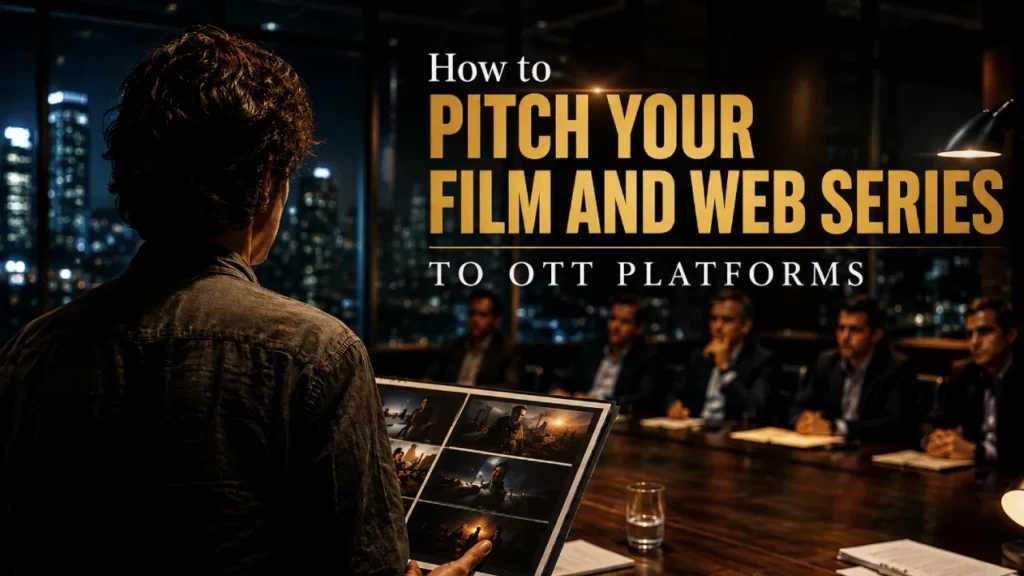
How to Pitch Your Film or Web Series to OTT Platforms: Getting a film or web series onto an OTT platform feels like climbing a mountain with no map. You have the idea, you have the passion, and maybe you even have pages. But the industry works in ways that most first-time creators do not fully understand until they have already made the wrong moves.
This guide is written for filmmakers, writers, and production houses who want a real shot at platforms like Netflix India, Prime Video, Zee5, JioHotstar, SonyLIV, and ALTBalaji. Not a fantasy shot. A real one.
The Market You Are Walking Into
Before you write a single slide of your pitch deck, you need to understand the landscape you are entering.
According to the IMARC Group, the Indian OTT market was valued at USD 5.4 billion in 2025 and is projected to reach USD 28.1 billion by 2034, growing at a CAGR of 19.09%. The FICCI-EY Media and Entertainment Report 2026 confirmed that India’s media and entertainment sector grew 9% year-on-year to INR 2.78 trillion in 2025, with digital media crossing the INR 1 trillion mark for the very first time.
That is a massive number. And it tells you one thing clearly: there is money on the table for content creators. But here is what the headline number does not say.
According to the same FICCI-EY 2026 report, the total volume of OTT content in India actually dipped by about 7% compared to 2024. Platforms are no longer throwing money at every decent idea that lands on their desk. They are getting selective. They want profitable bets, not experimental gambles. As an IBEF report notes, OTT platform revenues in India are projected to grow at a CAGR of 14.9%, the highest among the top 15 countries globally, reaching Rs. 35,061 crore by FY28.
What this means for you as a creator: the window is open, but the bar has risen. A loose idea with vague characters will not cut it anymore. The platforms want projects that look ready, feel considered, and have a clear audience in mind.
Why You Cannot Just Email Netflix
This is the first thing you need to accept.
How to Pitch Your Film or Web Series to OTT Platforms: Netflix, Amazon Prime Video, and most of the major OTT platforms in India do not accept unsolicited pitches from individuals. They have a closed submission process. If you send your script or your pitch deck to a general contact email, it will either bounce or disappear into a folder that nobody reads.
This is not gatekeeping for the sake of it. It is a legal protection for the platforms and a quality filter for the industry. The only way in is through one of these routes:
A registered production house that already has a relationship with the platform. A literary agent or manager who represents you and can make introductions on your behalf. A film festival or content market where platforms actively look for projects to acquire or commission. A sales agent who handles OTT licensing and can take your finished or nearly finished project directly to acquisition teams.
If you are a solo writer or a first-time director, your most practical path is to partner with an established production company before you approach any platform. Not after. Before.
Understanding Each Platform Before You Pitch
Every OTT platform in India has its own personality, its own audience, and its own content strategy. Pitching the same deck to every platform is a rookie mistake.
Netflix India is chasing prestige. They want stories with cinematic scale, complex characters, and the kind of narrative that gets people talking internationally. Sacred Games and Delhi Crime shaped what the Netflix India brand means. If your project does not have that kind of weight, Netflix is probably not your first door. By early 2026, Netflix India had around 20 million paying subscribers, and the platform is investing heavily in original Indian content across multiple languages.
Amazon Prime Video India has roughly 65 million paying subscribers and has built its reputation on shows like Mirzapur and The Family Man. They want commercial storytelling with scale and rewatchability. Importantly, in a landmark move in May 2026, Amazon announced the full integration of Amazon MX Player into Prime Video, creating what they are calling India’s largest streaming service. This means creators now have a single pipeline that spans free, ad-supported content and premium subscriptions, which dramatically expands the kinds of projects Prime Video will consider.
JioHotstar (the merged entity of Disney+ Hotstar and JioCinema) sits at a massive subscriber base thanks to its sports rights and regional content. If you have a Hindi mass-market story, a regional language thriller, or something that works for families across India’s smaller cities, JioHotstar is worth considering.
Zee5 commissions content through established partnerships and production houses. They have a strong appetite for Hindi GEC-style stories that work on both urban and semi-urban audiences, and they are also investing in regional originals.
SonyLIV leans toward sports content and crime thrillers. Scam 1992 was their watershed moment and defined their premium originals identity.
ALTBalaji has a broader content mandate and has historically been more accessible to new production houses. They actively look for relationship-driven stories, bold comedies, and drama with mass appeal.
MX Player, now fully under the Amazon umbrella, was built on free content reaching over 250 million monthly users. With the Prime Video integration complete, content that would have gone to MX Player is now part of a larger, more prestigious distribution umbrella.
Building a Pitch Deck That Gets Read
Your pitch deck, also called a series bible when it comes to web series, is the most important document you will create. It is the first thing a platform executive or their development team will see, and it needs to do a lot of work in a short time.
Here is what every professional pitch deck needs to contain:
The Logline. One sentence. One idea. No more than 25 words. It should tell the reader who the story is about, what they want, and what stands in their way. If you cannot write your logline in one sentence, you do not yet understand your own story.
The Premise and Synopsis. A short premise paragraph (three to five sentences) followed by a longer synopsis that covers the full arc of your story. For a feature film, this is a two-page document. For a web series, you need to cover the season arc clearly.
The Series Bible (for web series only). This goes deeper than the synopsis. It includes episode-by-episode outlines for a minimum of six episodes, the world your story inhabits, rules of that world, long-term arcs beyond season one, and thematic intent. Platforms are investing in IP, not just one season. They want to see that you have thought ahead.
Character Breakdowns. Main characters need detailed personality profiles. Not just names and descriptions. The platform needs to understand motivations, contradictions, and how each character pushes the story forward.
The Visual Mood Board. This is where most Indian pitches fall short. You need a visual identity for your project. Tone references, colour palettes, comparable shows. Netflix executives have limited attention. Your deck needs to show them what your series looks or feels like before a single frame is shot. In 2026, many production houses are using AI tools like Midjourney or Runway to generate character concept art and scene visuals that give the deck a cinematic feel.
Budget Estimate. You do not need a fully locked budget at the pitch stage, but you need a range. Saying “budget TBD” signals that you have not thought this through. A reasonable range, broken down by episode or by film, shows that you understand the production reality of your own project.
Talent Attachments. If you have a director, a lead cast member, or a known DOP attached, mention it. Even a letter of intent from a notable talent dramatically improves your pitch’s credibility.
Comparable Titles. List two or three shows or films that are similar in tone or audience to your project. This helps the platform understand where your content fits in their library.
The Routes That Actually Work in India
Let us be honest about the practical reality.
Route 1: Partner with a production house. This is the most reliable path. Find a production company that already has relationships with OTT platforms and approach them with your project. Yes, you will share creative credit and potentially some rights. But you will actually get in the room. Companies like Excel Entertainment, Phantom Films, Banijay Asia, and hundreds of mid-size Bollywood-adjacent production houses work as intermediaries between creators and platforms.
Route 2: Go through a talent agency or literary agent. Agents who represent writers and directors in Mumbai have direct lines to platform acquisition teams. Getting repped is its own challenge, but a good agent can get your project seen within weeks rather than months.
Route 3: Film festivals and content markets. Festivals like the Mumbai Film Festival (MAMI), IFFK, BAFF, and international markets like MIPCOM and Series Mania are places where platform commissioning editors actively scout for projects. A strong short film or a world premiere at a respected festival opens conversations. This is how many independent Indian filmmakers have broken through.
Route 4: Sales agents for finished content. If your film or series is already produced, a sales agent who specialises in OTT licensing can approach platforms directly. For a finished film, this is actually a cleaner process because the platform can evaluate what they are actually buying.
Route 5: Direct application portals (limited, but real). Some platforms like Zee5 and ALTBalaji have had periods where they accepted producer submissions through dedicated portals. These windows open and close based on the platform’s content acquisition cycles. Always check their official websites for current submission guidelines.
What Platforms Are Actually Looking For in 2026 & How to Pitch Your Film or Web Series to OTT Platforms
The OTT market in India has matured. The era of “just make it edgy and put it on the internet” is over.
Here is what commissioning editors are actually evaluating when they look at your pitch:
A clearly defined audience. Not “everyone.” Not “18 to 35 urban Indians.” They want specificity. Who exactly watches this? What other shows do those people watch? What problem does your series solve for them on a Friday night?
Story that travels. Platforms with global ambitions, especially Netflix and Prime Video, want stories that can cross language and cultural barriers. A local story told with universal themes is more valuable than a story that only works if you grew up in one city.
Scalable IP. Can this become season two? Can it become a franchise? Platforms are thinking about IP, not just individual shows. If your idea only works as one season of eight episodes, you are pitching a limited series. That is fine, but be upfront about it.
Original voice. The 2026 FICCI-EY report notes that platforms are now choosing quality over quantity. They are not looking for derivative content. They want something that does not already exist on their platform.
Production-ready credibility. A pitch that looks like someone sat with it for two weeks lands differently than a pitch that looks like someone sat with it for two years. The level of detail in your deck signals your seriousness.
Common Mistakes That Kill Good Pitches
You can have a brilliant idea and still blow the pitch. Here are the mistakes that happen most often:
Sending an incomplete deck. If your synopsis has gaps, if your characters are thin, if there is no visual reference, the deck goes into the “not ready” pile.
No audience clarity. “This is for everyone” is the same as saying “this is for no one.” You need to know who your viewer is.
Unrealistic budget estimates. Quoting a number that is either too low (signals inexperience) or too high (signals you have not thought about return on investment) will raise red flags.
Copying the format of existing shows. Pitching “it is like Sacred Games but set in Chennai” is not a pitch. It is a reference. The platform already has Sacred Games. Tell them what they do not have.
Weak character development. Character is story. If your characters do not feel real on the page, nothing else matters.
Approaching the wrong platform. A slow, literary arthouse film is not for ALTBalaji. A mass-market rural love story is probably not Netflix India’s first call in 2026. Do your homework before you spend months building a relationship with the wrong team.
A Note on Rights, Deals, and What to Expect
When a platform commissions original content, they typically seek exclusive rights for a fixed term, anywhere from 12 to 36 months, and sometimes globally depending on the deal structure.
If your project is a co-production, you may retain certain ancillary rights depending on how the deal is structured. Always have a lawyer review any term sheet before you sign anything. An entertainment lawyer with OTT experience is worth every rupee.
For Indian creators, it is also worth knowing that platforms often retain rights to sequels or spin-offs when they commission original IP. If your story has franchise potential, negotiate those terms before the deal closes.
How Cybertize Media Productions Can Help
How to Pitch Your Film or Web Series to OTT Platforms in India: Building a pitch that actually gets read is a craft in itself. It sits right at the intersection of storytelling, marketing, and production strategy.
At Cybertize Media Productions Private Limited, we work with filmmakers, writers, and production companies at the development stage to build pitch materials that are professional, visually compelling, and strategically positioned for the right platforms. We understand what Indian OTT platforms are looking for in 2026 because we are in this industry every day.
If you have an idea that you believe deserves to be seen, the question is never just “is this a good story?” The question is: “Does this pitch make a platform executive sit up and want to greenlight it?” That answer lives in the quality of your deck, the clarity of your concept, and the relationships you build to get into the room.
Cybertize Media Productions is a full-service video production company working with brands, filmmakers, and content creators across India. Our work spans ad films, corporate videos, web series development, and content strategy for digital platforms.