
Table of Contents
How to Shoot a Professional Ad Film on a Budget: The Lie You’ve Been Sold About Budget Film Production
Somewhere along the way, the Indian advertising industry convinced business owners that you need a minimum of ₹20–25 lakh to produce an ad film that doesn’t embarrass you. That you need a celebrity, a Mumbai film crew, a red-and-black clapperboard with someone’s name on it, and a DOP who’s shot three Bollywood features.
That’s not true. And frankly, it never was.
What you need is a clear brief, a disciplined pre-production process, the right three to five crew members, and a director who knows how to get every shot on the list without improvising on set at ₹5,000 per hour.
How to Shoot a Professional Ad Film on a Budget: At Cybertize Media Productions, we’ve produced ad films for brands at every budget level — from first-time regional advertisers working with ₹3 lakh to established national brands with eight-figure production budgets. The most consistent thing we’ve observed across all of them is this: the quality gap between a ₹4 lakh film and a ₹40 lakh film is almost never the money. It’s the preparation, the discipline, and the decision-making.
This guide is everything we know about making that gap work in your favour. Every technique, every trade-off, every category of cost you can compress without the audience ever knowing you did.
1. What Actually Makes an Ad Film Look Professional?
Before we talk about how to save money, we need to agree on what we’re trying to protect. Because ‘professional’ is not a vague aesthetic standard — it’s a specific set of technical and creative qualities that viewers respond to, even when they can’t articulate why.
The Pillars of Visual Professionalism
Stable, composed frames: Shaky, poorly framed shots signal amateur production faster than any other visual element. A ₹3,000 tripod with a fluid head does more for professional appearance than a ₹50,000 camera upgrade.
Controlled, intentional lighting: Harsh, flat, or inconsistent light is the second-fastest signal of an under-resourced production. You don’t need a large lighting rig — you need a planned lighting setup. Three-point lighting executed correctly with modest gear looks better than twelve lights placed randomly.
Clean, broadcast-quality audio: Poor audio is the single most effective way to destroy a well-shot ad film. Viewers tolerate imperfect visuals. They do not tolerate muffled, echoey, or wind-damaged audio.
Colour consistency: Footage with inconsistent white balance or exposure across shots feels disconnected and unfinished. Basic colour grading — even a simple correction pass — creates visual cohesion that transforms the perceived production quality.
Confident, purposeful direction of talent: Actors or spokespersons who look uncertain, over-rehearsed, or visibly uncomfortable tell the viewer your production was disorganised. This is a pre-production problem, not a budget problem.
The Core Principle: Professional production quality is not primarily a function of equipment spend. It is primarily a function of preparation, discipline, and craft. Every rupee you invest in preparation returns ten in production quality.
A ₹5 lakh ad film in India would cost the equivalent of ₹40 lakh or more in the US or UK — without any sacrifice in technical quality. — ARD Digital Media / Industry Benchmark, 2025
2. The Honest Budget Reality — What Your Money Actually Gets You | How to Shoot a Professional Ad Film on a Budget
Let’s establish realistic expectations at each budget level so you know exactly what is and isn’t achievable before a single rupee is committed:
| Budget Range | What’s Realistic | What’s Not Possible | Best Use Case |
|---|---|---|---|
| ₹50,000 – ₹1.5 Lakh | Single location, 1 talent, minimal crew, basic edit | Celebrity, VFX, multi-scene storytelling | Social media content, testimonial, product reel |
| ₹1.5 Lakh – ₹4 Lakh | Professional crew of 3–4, quality camera/lens rental, basic grade, decent sound | Multi-day shoot, complex sets, broadcast TVC quality | Digital ad film, YouTube/OTT pre-roll, brand intro |
| ₹4 Lakh – ₹10 Lakh | Broadcast-ready 30-sec TVC, professional cast, full post-production | Celebrity talent, heavy VFX, 3+ locations | Regional TV TVC, national digital campaign ad |
| ₹10 Lakh – ₹25 Lakh | Multi-location story-driven ad film, director + full crew, high-end post | A-list celebrity, international locations | National TV campaign, OTT ad film, brand film |
| ₹25 Lakh+ | Full-scale production, any format, any cast, any platform | Nothing — this budget has no ‘nots’ | All platforms, all formats, all audiences |
Cybertize Benchmark: For most small and regional Indian businesses, the ₹4–10 lakh range is the sweet spot for a broadcast-ready ad film that looks professional and can be distributed across TV, YouTube, and social platforms. Below ₹4 lakh, you’re producing for digital only. Above ₹10 lakh, you have access to every format and platform in India.
3. Phase 1: Pre-Production — Where Budget Ad Films Are Won or Lost
If you take one thing from this entire guide, make it this: the quality of your budget ad film is determined almost entirely in pre-production. Not on shoot day. Not in the edit. In the weeks before a camera is switched on.
The reason is simple: every creative decision made in pre-production is free. Every creative decision made on set costs crew time, equipment time, and often reshoots. Here’s how to make pre-production your biggest budget advantage:
a. Write a Tight, Specific Brief — Before Anyone Is Hired
How to Shoot a Professional Ad Film: Your brief is the single most important document in the entire production. It should answer seven questions with zero ambiguity:
- What is the one thing this ad film must make the viewer think, feel, or do?
- Who exactly is the viewer — age, city, income, mindset, problem they’re solving?
- Where will this film be shown — TV, YouTube, Instagram, all three?
- How long should the film be — 15 seconds, 30 seconds, 60 seconds?
- What is the brand tone — serious, warm, energetic, aspirational, humorous?
- What is the one call to action — visit our site, call this number, visit this store?
- What is the hard delivery deadline — and what is the shoot window?
A brief that answers all seven questions clearly reduces revision cycles by 60–70%. Every revision round in post-production costs ₹5,000–₹15,000 and adds 1–3 days. Your brief is your budget protection document.
b. Script for Duration — Every Word Costs Money
How to Shoot a Professional Ad Film on a Budget: A 30-second ad film at comfortable speaking pace contains approximately 65–75 words of dialogue or voiceover. A 60-second film contains 130–150 words. Every word beyond your target duration is a word that will be cut in the edit — which means time was spent shooting it on set, which means money was spent that produced nothing in the final film.
Write your script. Time it out loud. Three times. If it consistently runs 10% over your target duration, cut it now — not on set, not in the edit. Cut it now, when cutting is free.
Pro Tip: Write your script to 90% of your target duration. The remaining 10% will be filled naturally by pauses, breathing, and performance rhythm on the day. A script written to exactly 30 seconds will run 33–35 seconds on set.
c. Storyboard Every Shot — Without Exception
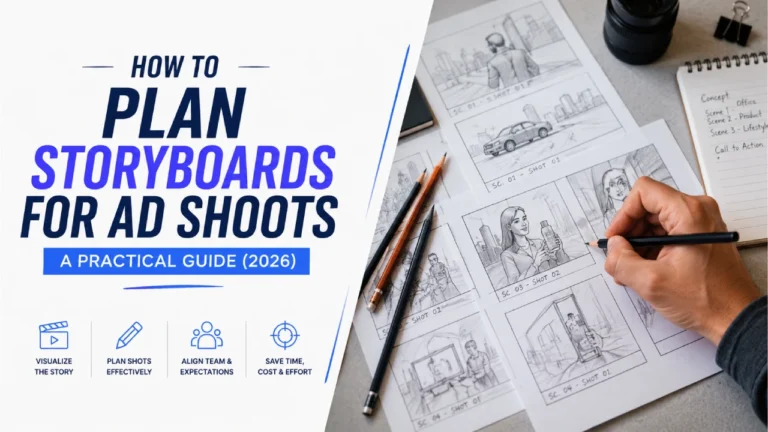
A storyboard does not require artistic skill. It requires clarity of vision. Stick figures and labelled boxes are entirely adequate. What matters is that every shot in your film is defined before the shoot begins — camera angle, subject position, movement (if any), and approximate duration.
For a 30-second ad film, you will typically have 8–15 shots. For each shot, your storyboard should note: is this a wide shot, medium, or close-up? Is the camera static or moving? What is the subject doing? What is in the background?
This document costs nothing to produce and prevents the most expensive problem in budget productions: directors improvising shots on set because the creative wasn’t locked before the cameras arrived.
Industry Fact: Productions that skip storyboarding are 3x more likely to require costly reshoots. A two-day storyboarding investment eliminates what would otherwise be an additional full shoot day.
d. Location Scout and Lock Early — Permit Surprises Destroy Budgets
How to Shoot a Professional Ad Film on a Budget: Visit every location you plan to shoot at least one week before the shoot. Evaluate: the natural light at your planned shoot time, background noise levels (traffic, HVAC, construction), power availability for equipment, permission status and NOC requirements, and parking/loading access for crew vehicles.
Studio hire in Delhi NCR, Mumbai, or Bengaluru typically ranges from ₹8,000 to ₹25,000 for a full shoot day. For many budget productions, a well-chosen studio with built-in lighting infrastructure is more cost-effective than an outdoor location that requires permits, is exposed to weather, and carries uncontrollable audio challenges.
Pro Tip: If your concept allows for it, a neutral-background studio shoot with strong prop styling almost always looks more polished than an outdoor location shoot on a tight budget — because you control every variable.
e. Build a Shot List and Call Sheet
How to Shoot a Professional Ad Film: Your shot list is the production sequence — every shot ordered not by story sequence but by location and lighting setup. You shoot all shots requiring Setup A before moving to Setup B, regardless of where they fall in the final film. This eliminates the most common budget drain: unnecessary lighting reconfigurations caused by poor planning.
Your call sheet is the document that tells every person on set exactly where to be, when to arrive, what to bring, and what happens in what sequence. A crew that receives a clear call sheet the night before a shoot arrives prepared, starts on time, and finishes on schedule. A crew briefed informally the morning of the shoot spends the first two hours of your shoot day figuring out what they’re doing.
4. Building the Right Crew — Lean, Skilled, and Aligned
How to Shoot a Professional Ad Film on a Budget: On a budget ad film, crew is the line item where the most strategic decisions are made. Too few people and the shoot grinds to a halt at every obstacle. Too many and you’re paying for people who stand around waiting for direction. Here’s the honest lean crew structure for a budget professional ad film:
| Role | Day Rate (India 2026) | Essential? | Notes |
|---|---|---|---|
| Director | ₹15,000 – ₹60,000 | Non-negotiable | Sets the creative standard. Cannot be replaced by the DOP. |
| DOP / Cinematographer | ₹12,000 – ₹50,000 | Non-negotiable | Owns lighting and camera. On lean shoots, also operates. |
| Sound Recordist | ₹5,000 – ₹15,000 | Non-negotiable (if dialogue) | Bad audio cannot be fixed in post without expensive ADR. |
| Production Assistant (PA) | ₹1,500 – ₹3,500 | Strongly recommended | Keeps shoot moving. Worth every rupee on a tight schedule. |
| Makeup Artist (MUA) | ₹3,000 – ₹10,000 | Yes if talent on screen | On-camera talent without MUA reveals itself in every close-up. |
| Gaffer / Lighting Assistant | ₹4,000 – ₹10,000 | Optional (lean shoots) | DOP can handle a 3-light setup solo on simple productions. |
| Camera Assistant (AC) | ₹3,000 – ₹8,000 | Optional | For multi-cam or complex lens changes. Skip on single-cam. |
| Art Director / Set Dresser | ₹8,000 – ₹25,000 | Only for complex sets | Skip for natural-location or minimal-set shoots. |
| Video Editor (post) | ₹15,000 – ₹60,000/project | Non-negotiable | Editing is where footage becomes your ad film. |
For a lean budget production, your core crew is: Director + DOP + Sound Recordist + 1 PA + MUA (if talent is on screen). Five people. This is the minimum viable professional crew and it is entirely sufficient for a well-planned single-location ad film shoot.
The Golden Rule: Three experienced people who know exactly what they’re doing outperform eight people improvising every decision. Hire for experience, brief thoroughly, and keep the crew small.
Where to Find Affordable Professional Crew in India | How to Shoot a Professional Ad Film on a Budget
- Film institutes (FTII Pune, SRFTI Kolkata, Whistling Woods Mumbai, ZIMA) — talented recent graduates at below-market rates in exchange for quality portfolio work
- Facebook production groups in Delhi, Mumbai, Bengaluru, Hyderabad — active sourcing communities for freelance crew
- LinkedIn — especially for editors and DOPs building their commercial portfolio
- Production communities on Instagram — many skilled DPs and directors actively seek brand commercial work
- Recommendations from other businesses in your sector who’ve recently shot ad films
Pro Tip: Always ask for showreel or portfolio work before booking. Day rate is not correlated with quality in either direction. A ₹20,000/day DOP can be substantially better or worse than a ₹8,000/day DOP. Watch their work, not their invoice.
5. Equipment — What You Actually Need vs. What Sounds Impressive
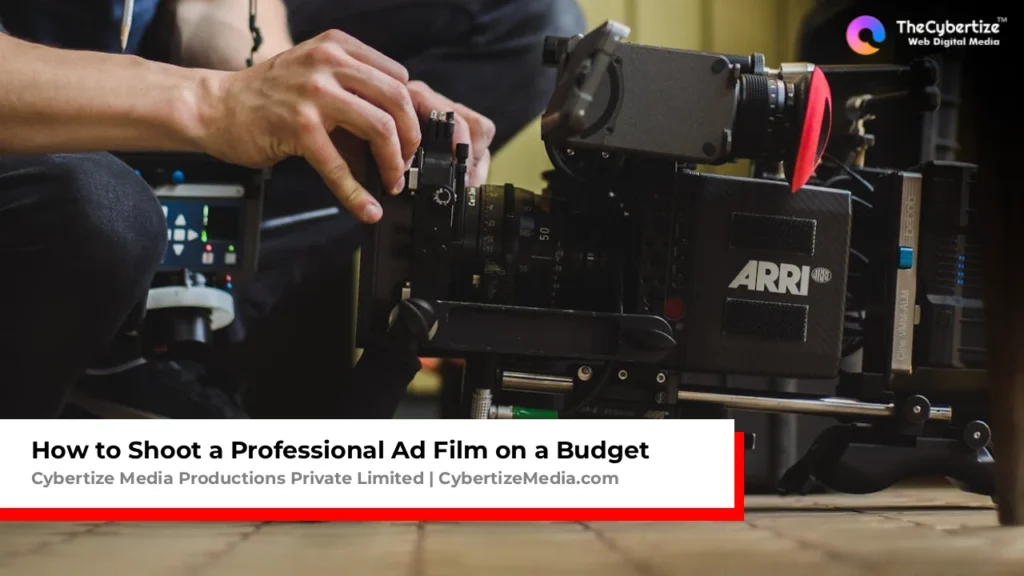
How to Shoot a Professional Ad Film on a Budget: Equipment is the category where budget productions most frequently over-spend and under-spend simultaneously. Renting an ARRI Alexa Mini for a YouTube ad that will be watched at 1080p on a phone is over-spending. Using a ₹2,500 no-name tripod that vibrates in every shot is under-spending. Here’s the honest equipment guide:
Camera — Match the Operator, Not the Spec Sheet | How to Shoot a Professional Ad Film
The camera that your DOP knows intimately is more valuable than the most expensive camera they’ve never used before. On a budget shoot, the best camera is the best camera your cinematographer is proficient with — period.
| Camera Category | Rental Cost (India/Day) | Best For | Avoid If |
|---|---|---|---|
| Entry Cinema (Sony FX3, Canon C70, Blackmagic Pocket 6K) | ₹4,000 – ₹8,000/day | Digital ad films, social video, YouTube | You need raw broadcast spec for major national TV |
| Mid Cinema (Sony FX6, Canon C300, RED Komodo) | ₹8,000 – ₹18,000/day | TVC, regional TV, OTT pre-roll | Budget is under ₹3 lakh total production |
| High Cinema (ARRI Mini LF, RED Monstro, Sony VENICE) | ₹20,000 – ₹60,000/day | National brand TVC, cinematic brand film | Any budget under ₹15 lakh — overkill at this level |
| Mirrorless/DSLR (Sony A7S III, Canon R5) | ₹1,500 – ₹4,000/day | Social-first content, behind the scenes | Primary camera for broadcast TV placement |
Lighting — Less Is More When Placed With Intention | How to Shoot a Professional Ad Film
How to Shoot a Professional Ad Film on a Budget: The most expensive lighting mistake on budget productions is renting a large quantity of average fixtures and placing them randomly. The most valuable lighting decision is choosing three good sources, placing them with purpose, and modifying them with basic softboxes and reflectors.
- Key Light: Your primary light source. A 200W LED panel with a softbox creates a natural, flattering look for interview and spokesperson shots. Rental: ₹800–₹2,500/day.
- Fill Light: Reduces shadows on the opposite side of the face. A large white reflector (cost: ₹500–₹1,500 to own) can replace a fill light fixture entirely in many situations.
- Back Light / Hair Light: Separates subject from background and adds depth. A small LED panel behind and above the subject. Rental: ₹500–₹1,500/day.
This three-source setup costs ₹3,000–₹6,000/day to rent and, when placed by a skilled DOP, produces images that are indistinguishable from those lit with a ₹50,000/day rig. The difference is craft, not kit.
Pro Tip: Shoot during golden hour (7–9 AM or 4–6 PM) for outdoor scenes. Natural directional light during these windows is the most flattering, cinematic light available — and it costs nothing. Midday direct sun is the enemy of budget outdoor production.
Audio — Never Compromise Here
How to Shoot a Professional Ad Film: We say it in every guide we write because it remains the most violated rule in budget production: bad audio destroys good video. It cannot be fixed in post without ADR recording, which costs more than a proper sound setup on shoot day. Budget at minimum ₹1,500–₹5,000 for a proper audio setup:
- Wireless lavalier (lav) mic for every speaking subject: Clean, body-close audio that captures dialogue without room echo. Rental: ₹800–₹2,000/day per unit.
- Directional shotgun mic on a boom pole: For coverage of scenes where a body mic isn’t practical. Rental: ₹600–₹1,500/day.
- Audio recorder (Zoom H5/H6 or Tascam DR): Standalone audio recording independent of camera. Rental: ₹500–₹1,500/day.
Non-Negotiable Rule: If anyone speaks on camera in your ad film, you need a dedicated sound person with dedicated sound equipment. Asking the DOP to monitor audio while operating the camera on a budget production results in either poor audio or poor visuals — usually both.
Stabilisation — This Is Not Optional
- Professional fluid-head tripod: The single most impactful equipment upgrade for perceived production quality. A smooth pan and tilt costs ₹800–₹2,000/day to rent and signals professional intent in every static and moving shot.
- Gimbal (Ronin RS3 / DJI RS3 Pro): For smooth moving shots — walking reveals, product tracking, dynamic b-roll. Rental: ₹1,000–₹2,500/day.
- Slider: For smooth horizontal movement — product reveals, establishing shots. Rental: ₹800–₹1,500/day.
The Equipment Budget Rule
Cybertize Formula: Equipment rental should be 15–25% of your total production budget. For a ₹5 lakh production, that’s ₹75,000–₹1.25 lakh in equipment. Below 10% and you’re under-resourced on audio or lighting. Above 35% and you’ve over-specced the kit at the expense of crew quality or post-production.
6. On-Set Direction — How to Get Film-Quality Performances Without a Film Budget
How to Shoot a Professional Ad Film: The most invisible budget advantage is a director who can guide non-professional talent to a natural, compelling performance without burning three hours of shoot time doing it. Here’s what that looks like in practice:
Brief Talent Before the Shoot — Not On the Day
How to Shoot a Professional Ad Film on a Budget: Every person appearing on camera should receive a talent brief 48 hours before the shoot. This brief includes: the script or key messages they need to communicate, reference examples of the tone and delivery you’re looking for, a description of the wardrobe and look you expect, and the shoot schedule so they arrive knowing what to expect. Talent who are surprised by the production environment on shoot day take longer to settle and produce fewer usable takes.
Run a Rehearsal Before Rolling Camera
Before the camera rolls on any significant scene, run the scene at least twice as a rehearsal with your director working the talent through blocking, delivery pace, and eyeline. This takes 10–15 minutes and typically reduces the number of takes required to capture a usable performance from 8–12 to 3–5. On a tight budget, each unnecessary take consumes crew time, battery life, and card space — but more importantly, it consumes the performer’s energy and concentration.
Direction Language That Works for Non-Actors
How to Shoot a Professional Ad Film: Most on-camera talent in budget ad films are not professional actors. They’re business owners, brand representatives, real customers, or entry-level commercial performers. Directing them with theatrical terminology confuses and frustrates. Instead, use functional direction that creates the same result:
Instead of ‘Be more authentic’: Say ‘Imagine you’re telling your best friend about this product — not a camera.’
Instead of ‘Show more energy’: Say ‘Speak 20% faster and let your face react before your words do.’
Instead of ‘Look more natural’: Say ‘Drop your shoulders, take one breath, then start — like you just remembered something important.’
Instead of ‘You’re too stiff’: Give them something to do with their hands — hold a product, point at something, gesture naturally — and stiffness resolves itself.
The ‘Walk to Mark’ Trick for Natural Arrivals | How to Shoot a Professional Ad Film 2026 Guide
How to Shoot a Professional Ad Film on a Budget: For shots where talent needs to enter frame naturally, have them start 3–4 metres outside the frame and walk into their mark as you call action. The transition from walking to standing to speaking is far more natural on camera than starting from a static position and then beginning to speak. It eliminates the rigid ‘I’m about to say my line’ body language that kills budget productions.
Pro Tip: Your best take is rarely the first take and rarely the eighth take. It’s usually the third or fourth, after the performer has the technical requirements in muscle memory but hasn’t yet over-thought the performance. Call cut before they plateau. Call action before they peak. Trust the third take.
7. Shoot Day Management — How to Get ₹15 Lakh Quality From a ₹5 Lakh Schedule
How to Shoot a Professional Ad Film: Everything in this section is about protecting your most finite resource on shoot day: time. Because on a budget production, time is the one thing you cannot buy more of at any price.
The Non-Negotiable 30-Minute Rule
Begin every shoot with a 30-minute setup window before talent arrives on set. Use this time for lighting placement and balance check, camera mount and lens test frame, audio levels test with a stand-in, and a walk-through of the shot list between director and DOP. This 30 minutes consistently saves 2–3 hours of on-set problem-solving done in the presence of expensive talent, waiting crew, and a ticking clock.
Block-Shoot by Setup, Never by Story
How to Shoot a Professional Ad Film on a Budget: This principle cannot be overstated for budget productions. You always shoot every shot that requires the same lighting setup and location before you change anything. If shots 1, 4, 7, and 11 in your script all happen in the same space with the same lighting — you shoot all four consecutively, regardless of their story position. Then you move. Every unnecessary setup change on a budget shoot wastes 30–90 minutes of crew time.
The ‘3 Takes and Move’ Discipline
For most shots, three quality takes are sufficient. Take 1 is technical — everyone finds their position, the director identifies any blocking issues, sound checks levels. Take 2 is performance — talent and crew are settled, this is usually the best take. Take 3 is insurance — a backup for the edit. Beyond take 3 without a specific reason to continue, you’re draining performer energy and accumulating footage your editor won’t use.
The exception: master shots (wide establishing shots that cover an entire scene) warrant more coverage. Single-take close-ups with specific reactions may need 4–5 attempts. But the discipline of 3-takes-and-move as the default keeps a budget shoot on schedule.
Protect the Sound Environment
Before any dialogue or voiceover is recorded on location: turn off all air conditioning and HVAC units, ask adjacent team members to pause any noisy activities, close windows and doors to traffic noise, and have your sound recordist conduct a room tone recording (30 seconds of silence in the location). Room tone is used by your editor to fill gaps between dialogue cuts seamlessly — its absence is an amateur oversight that costs money to rectify in post.
Capture B-Roll With Purpose
How to Shoot a Professional Ad Film: B-roll (supplementary cutaway footage — product close-ups, location details, hands in action, environmental context) is the footage that makes an edit feel rich and professional without requiring additional talent time. Plan your b-roll shots specifically — don’t just ‘get some extra footage.’ Each b-roll shot should serve a defined purpose: a product detail, a location establishing shot, a reaction close-up, or a visual metaphor for the ad’s core message.
Pro Tip: Capture 3x more b-roll than you think you’ll need. B-roll is fast to shoot (a good DOP can capture 15–20 quality b-roll shots in 30–45 minutes), it costs nothing in talent time, and it gives your editor the raw material to make your ad feel larger and more cinematic than the shoot itself might suggest.
8. Post-Production — Where Budget Films Become Broadcast Films
Post-production is the phase where a disciplined budget shoot either becomes a polished professional film or reveals every shortcut that was taken. Here’s how to manage each stage correctly:
Editing — Brief Your Editor Like a Director
Your editor is not a technician who assembles footage according to instructions. A good editor is a storyteller with a timeline. The better your brief to your editor, the better your edit will be — and the fewer revision rounds you’ll need.
How to Shoot a Professional Ad Film on a Budget: Your editing brief should include: the approved script and storyboard, reference cuts (existing ads whose pacing and style match your target), a clear indication of which takes were preferred on set, the target duration(s), and a defined list of deliverables (30-sec cut, 15-sec cut, vertical version, etc.). Providing all of this before editing begins typically reduces revision cycles from 4–5 rounds to 1–2.
| Post-Production Stage | What It Does | Typical Cost (India 2026) | Can You Skip It? |
|---|---|---|---|
| Offline Edit (Assembly + Fine Cut) | Selects best takes, builds story, creates pacing | ₹15,000 – ₹50,000 project rate | No — this is the foundation of everything |
| Colour Grading | Creates visual tone, fixes exposure inconsistencies, adds cinematic quality | ₹5,000 – ₹25,000 | No — ungraded footage looks flat and unfinished |
| Sound Design + Mix | Balances dialogue, adds ambient sound, creates final audio track | ₹5,000 – ₹20,000 | No — bad audio cannot be forgiven by good visuals |
| Music (Royalty-Free) | Provides emotional underscore for the film | ₹3,000 – ₹15,000/yr (Artlist, Epidemic Sound) | Only if the film works without music — most don’t |
| Motion Graphics / Titles | Logo, end card, lower-thirds, legal supers | ₹5,000 – ₹20,000 | No for TV/broadcast — yes for raw social content |
| Platform Reformatting | Creates 16:9, 9:16, 1:1 versions for multi-platform | ₹5,000 – ₹15,000 | Only if single-platform distribution |
| Subtitles / Captions | 85%+ mobile video watched without sound in India | ₹2,000 – ₹8,000 | No for social platforms — it’s a conversion tool |
Colour Grading — The Cheapest High-Impact Investment
How to Shoot a Professional Ad Film: Of all post-production investments, colour grading delivers the highest visible quality uplift per rupee. Flat, grey, or inconsistently coloured footage is immediately identifiable as under-resourced production. A professional colour grade in 4–8 hours of a colourist’s time transforms the same footage into something that feels warm, intentional, and polished.
For a budget ad film, a basic grade (colour correction + consistent look application) typically costs ₹5,000–₹12,000 for a 30-second film. This is not a line item to remove. It is the single most cost-effective post-production investment available.
Music — Royalty-Free Done Right
Original music composition for ad films starts at ₹30,000 and quickly escalates. For budget productions, royalty-free music licensing through platforms like Artlist.io, Epidemic Sound, or Musicbed provides access to professional-quality tracks for ₹5,000–₹15,000 per year — not per film. The annual cost amortised across multiple projects makes this one of the most affordable production investments available.
Pro Tip: Choose your music track before the final edit begins, not after. Editing to music — letting the track’s rhythm and emotional arc guide your pacing decisions — produces a fundamentally more cohesive film than editing on silence and dropping music in afterwards.
How to Shoot a Professional Ad Film: The Repurposing Dividend
Every ad film produced for broadcast or YouTube can be repurposed into multiple additional formats with minimal incremental cost — typically ₹5,000–₹15,000 for reformatting and minor re-editing. From a single 30-second ad film shoot, you can produce:
- Full 30-second cut — TV / YouTube / OTT
- 15-second cut — Instagram Reels / YouTube Shorts / pre-roll
- Vertical 9:16 version — Instagram Stories / Reels / WhatsApp Status
- Square 1:1 version — Facebook and LinkedIn feeds
- Silent version with caption overlays — all mobile social platforms
- Extended 60-second director’s cut — YouTube / LinkedIn brand content
Planning these deliverables from the start of the brief — and briefing your DOP to capture coverage that supports all formats — costs nothing additional in production. The editing investment is modest. The result is 5–6 distinct campaign assets from a single shoot day.
9. The 10 Budget Secrets That Make Low-Cost Ad Films Look Expensive
How to Shoot a Professional Ad Film on a Budget: These are the techniques that professional production teams use when constraints force creativity. They work. Use them:
Secret 1 — Dress One Location Beautifully. One location dressed with props, colour-matched backgrounds, and intentional set styling looks more expensive than three mediocre locations stitched together. Location variety is overrated. Depth of craft at a single location is underrated.
Secret 2 — Use Macro Lenses for Product Shots. Close-up product photography with a macro or 85mm lens at shallow depth of field immediately signals premium production quality. It costs nothing extra if your DOP has the lens (most do) and takes 20 minutes to shoot. The result looks like a fragrance commercial.
Secret 3 — Natural Light + 1 Reflector = Cinema. A subject positioned near a large window with a white reflector on the opposite side creates a two-source light setup that is naturally soft, directional, and flattering. Zero equipment cost. Looks like a studio.
Secret 4 — Shoot Twice as Fast as You Think. Budget shoots that run long almost always run long because of unnecessary second-guessing on set. Decisions made in pre-production should not be remade on set. When in doubt, shoot the planned shot. Move forward.
Secret 5 — Cast Authentic People, Not Generic Models. A real customer speaking genuinely about a product creates more trust and purchase intent than a polished model reading a script. Authenticity in casting eliminates the need for heavy direction and reduces take counts significantly.
Secret 6 — Use Colour-Matched Wardrobe. Brief talent on wardrobe colours that complement your brand palette and set design. A subject wearing a colour that clashes with the background creates a post-production problem. A subject wearing colours that harmonise creates a visual story without any additional cost.
Secret 7 — Record Voiceover in a Dedicated Studio Session. For ad films with narration, recording voiceover separately in a proper recording studio (₹2,000–₹8,000 for a 2-hour session) produces dramatically cleaner audio than attempting to capture it on location. Location audio always carries some environmental character. Studio voiceover is clinically clean and sits perfectly in the mix.
Secret 8 — Consistent Grade = Perceived Production Value. Matching your colour grade to a consistent, intentional look — even a modest one — signals that someone with craft was in the edit suite. Inconsistent grades tell the viewer that the footage was assembled, not crafted.
Secret 9 — Begin and End With Your Strongest Shot. The first 3 seconds and the last 5 seconds of your ad film are watched by everyone. The middle is watched by people who were engaged enough to continue. Open with your most visually compelling or emotionally resonant shot. End with your clearest brand moment. Everything else is connective tissue.
Secret 10 — Cut to the Music’s Energy, Not the Script’s Logic. The most common reason budget ad films feel slow is that editors cut on dialogue beats instead of music beats. Let the track guide the rhythm of your edit. When music and visuals move together, the film has energy that no amount of script logic can manufacture.
10. Sample Budget Allocation — ₹6 Lakh Professional Ad Film
Here’s how Cybertize Media would allocate a ₹6 lakh budget for a broadcast-ready 30-second ad film with full digital repurposing:
| Line Item | Budget (INR) | % of Total | Notes |
|---|---|---|---|
| Script + Storyboard | ₹18,000 | 3% | 2 revision rounds, final lock before booking |
| Director’s Fee | ₹45,000 | 7.5% | Half-day rate, experienced brand director |
| DOP + Camera Kit | ₹40,000 | 6.7% | Mid-cinema camera + prime lens kit |
| Lighting Equipment | ₹15,000 | 2.5% | 3-light LED setup + modifiers |
| Sound Recording | ₹12,000 | 2% | Lav mic + shotgun + recorder, full day |
| Studio Hire (Gurugram/Delhi) | ₹20,000 | 3.3% | Full day, includes basic infrastructure |
| Talent / Actors | ₹25,000 | 4.2% | 2 non-celebrity professional actors |
| Makeup Artist | ₹8,000 | 1.3% | Half-day, 2 subjects |
| Production Assistant | ₹6,000 | 1% | 1 PA full shoot day |
| Set Styling / Props | ₹10,000 | 1.7% | Pre-dressed location, rented/owned props |
| Editing (Fine Cut + 2 revisions) | ₹30,000 | 5% | Project rate, 30-sec with 2 revision rounds |
| Colour Grade | ₹12,000 | 2% | Full grade, 30-sec film |
| Sound Design + Music | ₹12,000 | 2% | Mix + royalty-free annual licence (Artlist) |
| Motion Graphics (logo, end card) | ₹10,000 | 1.7% | Simple branded close with animation |
| Platform Versions (5 formats) | ₹12,000 | 2% | TV, YouTube, Reels, Stories, Square |
| Subtitles / Captions | ₹5,000 | 0.8% | All digital platform versions |
| Contingency (15%) | ₹60,000 | 10% | Non-negotiable — always budget this |
| Agency Production Management | ₹60,000 | 10% | Cybertize end-to-end management fee |
| TOTAL PRODUCTION | ₹4,00,000 | 66.7% | Remaining ₹2L reserved for media distribution |
The 70/30 Rule: Spend 70% of your campaign budget on production + post. Reserve 30% for distribution — because a perfect ad film that nobody sees is a failed investment. Always budget both together.
Final Thought: Professional Quality Has Always Been a Craft Decision, Not a Budget Decision | How to Shoot a Professional Ad Film
The ad films that make Indian consumers stop scrolling, trust a brand, and reach for their wallets are not always the most expensive ones ever made. They are almost always the most intentional ones.
How to Shoot a Professional Ad Film on a Budget: Intentional framing. Intentional lighting. Intentional casting. Intentional sound design. Intentional pacing in the edit. Intentional colour that makes the viewer feel a specific way before they can articulate why.
Every single one of those intentions is decided in pre-production. Every single one can be executed on a budget that would make a Mumbai production house laugh — if the brief is clear, the crew is experienced, and the discipline to follow the plan doesn’t break down under shoot-day pressure.
That’s the discipline Cybertize Media Productions brings to every production we make, at every budget level. If you’re ready to make an ad film that looks like it cost more than it did — we’re ready to make that happen for you.