
Table of Contents
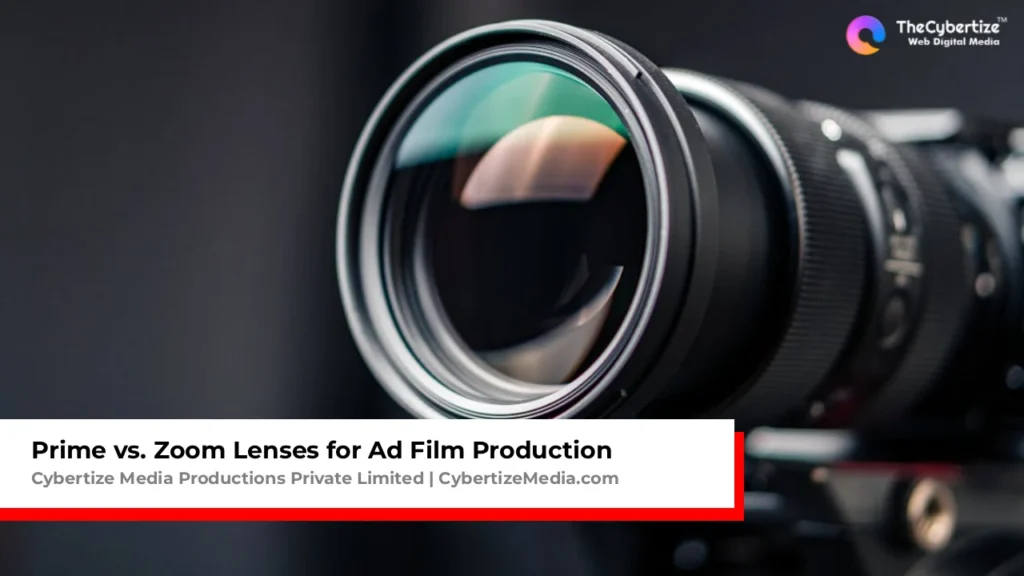
Prime vs zoom lenses: The Real-World Guide for Brands, Agencies & Filmmakers
In ad film production, the camera body gets the spotlight—but lenses do the storytelling. The choice between prime and zoom lenses isn’t just technical; it shapes how your brand feels on screen. Whether you’re shooting a luxury perfume ad, a high-energy FMCG spot, or a clean corporate film, the lens defines mood, depth, and emotional impact.
Let’s cut through the noise and talk about what actually matters on set.
Prime vs zoom lenses: Why Lens Choice Matters More Than You Think
A great lens doesn’t just capture an image—it directs attention, controls emotion, and elevates production value. In advertising, where every frame is designed to persuade, your lens choice can subtly influence how premium, dynamic, or intimate your brand appears.
What Are Prime Lenses?
Prime vs zoom lenses: Prime lenses have a fixed focal length—like 35mm, 50mm, or 85mm. No zooming. No shortcuts.
Why Filmmakers Love Primes
1. Cinematic Image Quality
Primes are sharper, cleaner, and often produce richer contrast. If you’re aiming for that “high-end ad film look,” primes deliver it naturally.
2. Beautiful Background Blur (Bokeh)
Wide apertures (like f/1.4 or f/1.8) create that soft, dreamy background separation—perfect for product shots, beauty ads, and emotional storytelling.
3. Low-Light Performance
Shooting indoors or in controlled lighting? Primes let in more light, reducing noise and maintaining detail.
4. Intentional Framing
Since you can’t zoom, you move the camera instead. That forces better composition and more deliberate storytelling.
Where Primes Shine in Ad Films
- Luxury & fashion commercials
- Product close-ups (perfume, jewelry, gadgets)
- Emotional storytelling shots
- Hero frames that define the brand
What Are Zoom Lenses?
Prime vs zoom lenses: Zoom lenses cover a range of focal lengths—like 24–70mm or 70–200mm—giving you flexibility without changing lenses.
Prime vs zoom lenses: Why Production Teams Rely on Zooms
1. Speed on Set
Time is money in ad production. Zooms let you reframe instantly without swapping lenses.
2. Versatility
From wide shots to medium close-ups in seconds—ideal for fast-paced shoots.
3. Run-and-Gun Efficiency
For outdoor shoots, brand films, or tight schedules, zooms reduce downtime.
4. Consistency Across Shots
Maintaining visual continuity is easier when you don’t constantly switch lenses.
Where Zooms Win in Ad Films
- Automotive commercials
- Food & beverage shoots with multiple setups
- Corporate videos
- Outdoor/location-heavy shoots
- Tight production timelines
Prime vs Zoom Lenses: The Real Trade-Off
| Factor | Prime Lens | Zoom Lens |
|---|---|---|
| Image Quality | Superior, cinematic | Very good, slightly softer |
| Aperture | Wider (better bokeh) | Narrower (in most cases) |
| Flexibility | Limited | High |
| Speed on Set | Slower (lens swaps) | Faster |
| Creative Control | High | Balanced |
What Top Production Houses Actually Do | Prime vs zoom lenses
Here’s the truth: it’s not Prime vs Zoom—it’s Prime and Zoom.
Professional ad shoots rarely stick to one. A typical workflow looks like this:
- Primes for hero shots (product beauty, emotional scenes)
- Zooms for coverage (wide shots, transitions, quick setups)
This hybrid approach ensures both creative excellence and production efficiency.
Choosing the Right Lens for Your Ad Film
Instead of asking “Which is better?”, ask:
1. What’s the Brand Positioning?
- Premium, luxury → Primes
- Fast, dynamic, energetic → Zooms
2. What’s the Shooting Style?
- Controlled studio shoot → Primes
- Outdoor or fast-moving shoot → Zooms
3. What’s the Timeline?
- Flexible schedule → Primes
- Tight deadlines → Zooms
4. What’s the Budget?
- Higher-end production → Mixed (Primes + Zooms)
- Cost-efficient shoot → Zoom-heavy setup
Prime vs zoom lenses: The Cybertize Approach to Lens Selection
At Cybertize Media Productions, we don’t treat lenses as gear—we treat them as storytelling tools.
Every project begins with one question:
“What should the audience feel?”
From there, we build the visual language:
- Crisp primes for premium storytelling
- Versatile zooms for efficiency and scale
- A balanced combination to maximize both quality and speed
Because in advertising, it’s not about what you shoot with—it’s about how your audience remembers it.
Final Verdict
If you want perfection, go prime.
If you want speed, go zoom.
If you want results—use both strategically.
The best ad films aren’t shot with one lens.
They’re crafted with intention.