
Table of Contents
How to Write a Script for a 30-Second Ad: Thirty Seconds. Every Word Counts. Here’s How to Use Them.
Thirty seconds sounds like nothing — until you sit down to write an ad script and realise you’re trying to make a stranger trust your brand, understand your offer, and take action before they’ve finished reaching for the remote.
A 30-second TV or digital ad is the most compressed form of commercial storytelling that exists. At a comfortable voiceover pace, you have roughly 65 to 80 words to hook the viewer’s attention, communicate a single compelling idea, prove it briefly, and tell them exactly what to do next. That’s fewer words than this introduction. Every single one has to work.
At Cybertize Media Productions, we write scripts before we plan shoots, budget cameras, or book crew — because the script is the foundation of everything that follows. A great script with a modest production budget consistently outperforms a lazy script with a lavish one. The creative idea, expressed with precision and craft, is where an ad film earns its results.
How to Write a Script for a 30-Second Ad: This is the complete guide to writing a 30-second ad script in 2026 — for TV, OTT, YouTube pre-roll, and social platforms. We’ll cover structure, word count, hooks, dialogue, voiceover writing, the CTA, real examples, script formatting, and every mistake that separates commercials that convert from commercials that just air.
1. Before You Write a Word — The Three Questions You Must Answer
The most common script-writing mistake isn’t poor dialogue or a weak CTA. It’s starting to write before the brief is clear. A script without a clear brief becomes a script about everything — which is a script about nothing. These three questions must be answered before your fingers touch the keyboard:
Also Read:
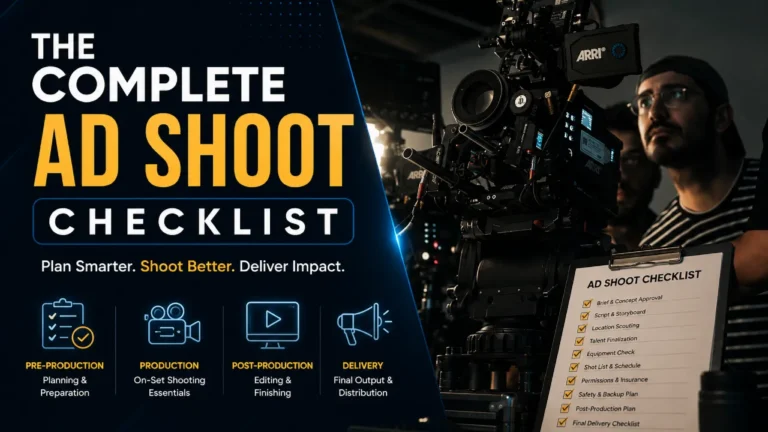
Prime vs Zoom Lenses for Ad Film Production: The Complete Guide
Question 1: What is the ONE thing this ad must make the viewer do?
Not think. Not feel. Not know. Do. A 30-second ad cannot accomplish five objectives. It can barely accomplish one well. Pick the single most important action you want from the viewer at the end of 30 seconds:
- Call this number
- Visit this website
- Walk into this store
- Remember this brand name for next time they need it
- Download this app
Write that action at the top of your script document before anything else. Every line you write will be judged against whether it serves that single objective.
Avoid: Writing an ad that tries to communicate your product features, your brand values, your origin story, a seasonal offer, AND your contact details in 30 seconds. Choose one. The others can have their own ads.
Question 2: Who is watching — and what do they already believe?
How to Write a Script for a 30-Second Ad: The person watching your ad is not a blank slate. They have existing beliefs about your product category, your competitors, your price point, and your brand. Your script doesn’t start from zero — it starts from where the viewer already is.
A viewer who has never heard of your brand needs a different script than a viewer who has used a competitor’s product for five years. A viewer who already trusts your category needs a different message than a viewer who is skeptical that any product in your category can help them.
Before writing, write one sentence that describes your viewer’s current emotional state regarding your product: ‘They currently think ___. We want them to think ___ instead.’
The Empathy Test: Read your first draft and ask: ‘Is this about my brand or about my viewer?’ The best 30-second scripts are almost entirely about the viewer — their problem, their aspiration, their life — until the last 8–10 seconds when the brand steps in as the answer.
Question 3: What is the one truth that makes your brand the right answer?
Not ten features. Not a list of benefits. One truth. The single most compelling, specific, and defensible reason why your brand — and not a competitor — is the right choice for this viewer’s specific problem.
Also Read:
Video Ads vs Static Ads: Which Performs Better? Complete 2026 Guide
This truth becomes the spine of your 30-second script. Everything else — the hook, the visual storytelling, the CTA — exists to frame, prove, and amplify this single truth.
Pro Tip: Write your single brand truth as a one-sentence claim that could appear at the end of the ad as a brand line. If you can’t summarise it in one sentence, you don’t know it clearly enough to write a script around it.
2. The Word Count Reality — How Many Words Fit in 30 Seconds?
This is the first technical question every scriptwriter needs to answer, and the answer is more specific than most people expect. The industry consensus from voiceover studios and production houses is consistent:
| Ad Duration | Word Count (Comfortable) | Word Count (Fast) | Notes |
|---|---|---|---|
| 10 seconds | 20 – 25 words | 28 – 30 words | Bumper format — single idea only |
| 15 seconds | 35 – 42 words | 45 – 50 words | Awareness format — hook + brand name + CTA |
| 30 seconds | 65 – 80 words | 85 – 95 words | Standard TVC — full story arc possible |
| 45 seconds | 100 – 115 words | 120 – 130 words | Extended format — emotion + story + CTA |
| 60 seconds | 130 – 150 words | 160 – 175 words | Brand film format — full narrative possible |
How to Write a Script for a 30-Second Ad: For a 30-second ad, the professional target is 65–80 words at a comfortable, natural delivery pace. Write your script to 70 words and time it — if it runs 27–28 seconds at a natural pace, you’re in the ideal window. That 2–3 second buffer allows for dramatic pauses, breath, music builds, and natural emphasis that make a voiceover sound human rather than rushed.
The 75-Word Rule: Write to 75 words. Read it aloud — slowly and naturally, the way a professional voiceover artist would deliver it. Time yourself. If it’s under 27 seconds, add one thought. If it’s over 31 seconds, cut ruthlessly until it fits. Never adjust the pace to fit the word count. Adjust the word count to fit a natural pace.
Pro Tip: A famous piece of industry advice: ‘Write a good 30 as if it were a 15.’ Forcing your concept to work in half the time sharpens every word and exposes the filler. The discipline of that compression produces better scripts.
3. The Three-Part Structure — How Every Effective 30-Second Ad Is Built
A 30-second commercial is a compressed story. And like all effective stories, it follows a specific arc that moves the viewer from one emotional state to another. The three-part structure that professional advertising scriptwriters use is consistent across TV, digital, and OTT formats:
| Section | Time Window | Word Allocation | Function |
|---|---|---|---|
| THE HOOK | 0 – 5 seconds | 10 – 15 words | Capture attention. Stop the scroll. Create a question the viewer needs answered. |
| THE MESSAGE | 5 – 22 seconds | 40 – 50 words | Present the problem clearly. Introduce your brand as the answer. Prove the claim briefly. |
| THE CTA | 22 – 30 seconds | 10 – 15 words | Tell the viewer exactly what to do next. Make it specific, simple, and memorable. |
Section 1: The Hook (Seconds 0–5) — The Most Important 5 Seconds You’ll Ever Write
How to Write a Script for a 30-Second Ad: Your hook is the one part of your ad that must earn the viewer’s attention before they can be influenced by anything else you’ve written. In a TV commercial break, viewers are already mentally preparing to leave the room, check their phone, or tune out. In a digital pre-roll, their finger is hovering over the ‘Skip’ button.
The hook’s job is to create a pattern interrupt — something that is unexpected, relatable, or provocative enough that the viewer’s brain stops its current activity and pays attention. There are four hook types that work consistently:
Hook Type 1 — The Relatable Problem: Open with a situation the viewer immediately recognises from their own life. No introduction, no preamble — start in the middle of the moment.
Example: “You’ve rewritten that email six times and it still sounds wrong.”
Also Read:
Does Video Advertising Increase Sales? Complete Data-Backed Guide 2026
Hook Type 2 — The Provocative Question: Ask something the viewer doesn’t immediately know the answer to, but feels compelled to discover.
Example: “What if the reason your ad campaign isn’t working has nothing to do with the media budget?”
Hook Type 3 — The Bold Statement: Make a claim that is surprising enough to stop the viewer — but credible enough not to trigger immediate scepticism.
Example: “Every day you wait costs you six potential customers.”
Hook Type 4 — The Visual Hook: Sometimes the hook is entirely visual — an unexpected image, an action that defies expectation, or a visual metaphor that creates curiosity without a word being spoken.
Example: A hand pouring sand into an hourglass. No words for the first 3 seconds. Then: “Time isn’t the problem. Priorities are.”
Avoid: Starting your script with your brand name, your tagline, or a description of your product. ‘XYZ Brand is the leading provider of…’ is not a hook. It is a reason for the viewer to leave.
Section 2: The Message (Seconds 5–22) — Problem, Solution, Proof
How to Write a Script for a 30-Second Ad: The message section of your 30-second ad carries the heaviest creative load. In 40–50 words and approximately 17 seconds, you need to:
- Name the problem clearly enough that the viewer recognises it as their own
- Introduce your brand or product as the specific solution to that problem
- Provide one piece of proof, evidence, or demonstration that the solution works
The most common mistake in this section is attempting all three without sufficient depth on any of them — which produces an ad that feels rushed and fails to land the core idea. The second most common mistake is spending all 17 seconds on the problem without enough time to establish the solution and proof.
A useful allocation: 6–7 seconds on the problem, 6–7 seconds introducing the solution, 4–5 seconds on the proof or demonstration. This is not a rigid formula — it bends based on your specific creative concept — but it protects against the common imbalances that weaken message sections.
Pro Tip: The message section should answer one unspoken viewer question: ‘Why should this product work for someone like me?’ Answer that question specifically — not generically. ‘Trusted by millions’ answers it weakly. ‘Reduces kitchen prep time by 40 minutes daily for home cooks in their 30s’ answers it strongly.
Section 3: The CTA (Seconds 22–30) — What Happens If You Don’t Tell Them
How to Write a Script for a 30-Second Ad: The call to action is the most consistently underwritten section of 30-second ad scripts. Scriptwriters spend 27 seconds crafting a compelling story and then append ‘Visit our website’ as the CTA — which is the conversational equivalent of cooking an excellent meal and serving it in a plastic bag.
Also Read:
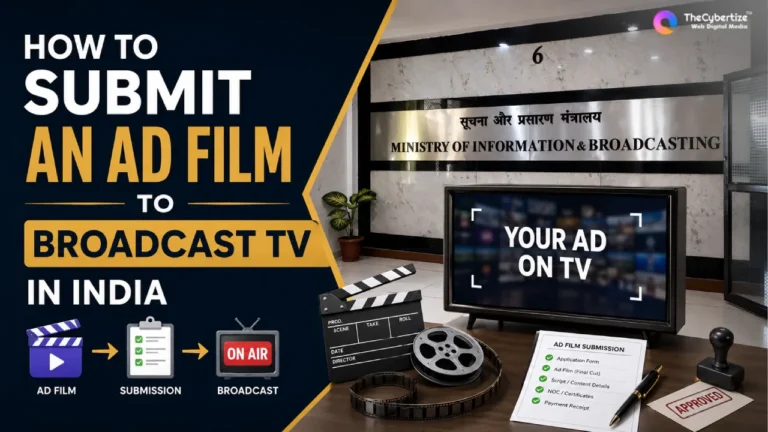
How Long Does It Take to Make a TV Commercial? Full Timeline Guide (2026)
A powerful CTA has three components: the action, the destination, and the incentive (where applicable). It should be specific enough to be acted on immediately and simple enough to be remembered after the ad ends.
Weak CTA: “Visit our website for more information.”
Stronger CTA: “Go to cybertizemedia.com/offer — your first consultation is free.”
Even Stronger: “Call 1800-XXX-XXXX right now — we answer within 60 seconds, guaranteed.”
The best CTAs create a sense of completeness — the viewer understands exactly what the next step is and why taking it makes sense. They don’t have to think. Thinking is where conversion dies.
Avoid: Ending with your brand name and tagline as the CTA. ‘Cybertize Media. We create. We deliver.’ is a sign-off, not a call to action. Sign-offs and CTAs can coexist in 30 seconds — but the CTA must come first and be specific.
4. Writing Dialogue and Voiceover — The Language Rules That Separate Good Scripts From Great Ones
A 30-second ad script can use dialogue (actors speaking to each other or the camera), voiceover (narrator speaking over visuals), or a combination of both. Each has specific writing rules that determine whether the final delivery sounds natural or stilted.
Write for the Ear, Not the Eye
Ad scripts are written to be heard, not read. This distinction changes every craft decision you make. Language that looks clean and professional on the page often sounds stiff and unnatural when spoken at a commercial delivery pace. Test every line by speaking it aloud — not reading it silently.
- Short sentences land harder than long ones. ‘This changes everything.’ hits differently than ‘This product fundamentally changes the way you interact with the world around you.’
- Contractions are your friend. ‘Don’t’ sounds natural. ‘Do not’ sounds like a legal disclaimer.
- Active verbs over passive constructions. ‘Our team builds it.’ not ‘It is built by our team.’
- Conversational rhythm. Write in the rhythm of how people actually speak — incomplete sentences, natural pauses, emphasis on unexpected words.
The One-Idea-Per-Sentence Rule | How to Write a Script for a 30-Second Ad
In a 30-second script, each sentence should carry one idea and one idea only. Compound sentences (ideas joined by ‘and’, ‘but’, ‘because’, ‘which’) slow the pace and ask the listener to hold two thoughts simultaneously while processing new visual information. Break them apart.
Before: “Our product is designed for busy professionals who want quality results without spending hours in the kitchen and it comes in three flavours.” (Two ideas, slow pace)
After: “Designed for busy professionals. Quality results in minutes. Three flavours to choose from.” (One idea each, strong rhythm)
The Specificity Rule — Specific Beats Generic Every Time
Generic claims feel like advertising. Specific claims feel like truth. The brain responds differently to specificity — it creates a mental image, it triggers recall, it signals credibility.
Generic: “Our skincare products are trusted by thousands of customers across India.”
Specific: “Used by 47,000 women in Delhi alone — and their skin proves it.”
Generic: “We’ve been in business for many years and have a strong track record.”
Specific: “Seventeen years. Over 800 campaigns. Zero missed broadcast deadlines.”
Silence Is a Word
The most underused technique in ad scriptwriting is deliberate silence — a moment where no words are spoken and a visual or sound does the emotional work. In a 30-second script, a 2-second pause after a powerful statement can be worth 10 words of explanation. It gives the viewer space to feel what you just said before moving to the next beat.
In your script, mark intentional pauses explicitly: [PAUSE — 2 seconds] or [Music builds]. Don’t leave them to chance on set or in the edit. A pause that isn’t written into the script is a pause that gets cut.
Rhythm and Pacing — The Rule of Three
The human brain has a strong aesthetic preference for patterns of three. Three-part sentences, three-word brand lines, three examples — they feel complete and satisfying in a way that two or four never quite do. Use this deliberately in your script:
“Faster. Simpler. Better.” — brand claim in three.
“One call. One hour. One solution.” — process in three.
“Your food. Your schedule. Your terms.” — value proposition in three.
5. Script Format — How to Write a Professional Ad Script
The standard professional format for a TV or digital ad script in India is the AV (Audio-Visual) two-column format. The left column describes what is seen (visuals, camera direction, on-screen text), and the right column describes what is heard (dialogue, voiceover, music cues, sound effects). Each row represents one scene or beat.
How to Write a Script for a 30-Second Ad: This format ensures that every production team member — director, DOP, editor, composer — can read the script and immediately understand what is happening visually and aurally at each moment, without interpreting or improvising.
SAMPLE AV SCRIPT FORMAT — 30-SECOND AD
Title: [Brand Name] — ‘Better Every Morning’ | Duration: 30 seconds | Platform: TV + Digital
| SEC | VISUAL | AUDIO / VO |
|---|---|---|
| 0–3s | Alarm clock ringing. Close-up of groggy face. Dark bedroom. | SFX: Alarm tone, abrupt. Music fades in softly. |
| 3–6s | Hand slaps alarm off. Person sits up slowly, eyes half-open. | VO: “Every morning starts the same way.” |
| 6–10s | Kitchen. Fumbling with kettle. Water splashing. Chaos. | VO: “Rushed. Scrambled. Never quite ready.” |
| 10–15s | Cut to same person — same morning — but now calm. Coffee in hand. Sunlight. | VO: “Until we changed one thing.” |
| 15–20s | Product on kitchen counter. Close-up of label. Person smiling. | VO: “[Brand] — designed around how your morning actually works.” |
| 20–24s | Montage: person leaving home on time, confident stride, bright day. | VO: “Three minutes. That’s all it takes.” |
| 24–28s | Brand logo appears. Clean white background. | VO: “[Brand]. Start better.” |
| 28–30s | CTA on screen: “Order at [website] — free delivery today only” | VO: “Order online. Free delivery today.” |
TOTAL VO WORD COUNT: 47 words | TOTAL RUNTIME: 30 seconds | PACING: Moderate
How to Write a Script for a 30-Second Ad: Notice the structure of this example: the hook is entirely visual (no voiceover) for the first 3 seconds, letting the image create the relatable problem before words confirm it. The message is built through contrast (chaos vs calm) rather than feature listing. The CTA is spoken AND visible on screen simultaneously — maximising retention and response.
6. Writing for Different Platforms — TV, OTT, YouTube Pre-Roll, and Reels
The same 30-second script does not perform equally across every platform. The medium shapes the message — and a script that works perfectly as a TV commercial may need structural adjustment for YouTube pre-roll or social. Here’s what changes:
| Platform | Hook Timing | Key Script Difference | CTA Format |
|---|---|---|---|
| TV (National / Regional) | 0–5 seconds | Viewer is captive — hook can build over 5 seconds. Music and silence more effective. Emotion earns attention. | Spoken VO + on-screen super |
| OTT Pre-Roll (JioHotstar/Netflix) | 0–3 seconds | Skip button at 5 seconds — hook must land in first 3. Visual impact + spoken hook simultaneously. | Clickable CTA overlay + spoken |
| YouTube Pre-Roll | 0–5 seconds | ‘Skip Ad’ at 5 seconds. Brand name should appear in first 3 seconds minimum, in case they skip. | URL + spoken CTA before skip point |
| Instagram Reels / Shorts | 0–2 seconds | No skip button but scroll is immediate. First frame is the hook. Caption + visual do heavy lifting (85% watched muted). | On-screen text CTA + spoken |
| TV + Digital (same cut) | 0–3 seconds | Shared version must front-load hook. Visually-driven opening works across all platforms. | Spoken + on-screen super (both) |
The OTT Pre-Roll Rule: Name the Brand Before the Skip
How to Write a Script for a 30-Second Ad: For YouTube and OTT pre-roll specifically, your brand name must appear — either visually on screen or in the voiceover — within the first 3 seconds. If the viewer skips at the 5-second mark without your brand registering, you’ve spent production and media budget for zero brand awareness impact. This single discipline change significantly improves pre-roll campaign performance for brands that previously opened with scene-setting before the brand reveal.
Pro Tip: For pre-roll, write two versions of your hook: one for viewers who stay through the full 30 seconds, and one that works as a 5-second standalone impression for the 60% who will skip. Both must be embedded in the same script structure.
The Silent Script — Writing for Mobile Muted Viewing
Research consistently shows that over 85% of social media video is watched without sound in India. For Instagram Reels, YouTube Shorts, and Facebook video ad placements, your script must work completely without audio — or fail to communicate with the majority of viewers.
This doesn’t mean removing the voiceover — it means writing the visual action and on-screen text so the story is fully communicated without sound, and then layering audio as an enhancement rather than a requirement. Every key message in the voiceover must have a visual equivalent or on-screen text equivalent.
7. Three Complete 30-Second Script Templates for Indian Brands
How to Write a Script for a 30-Second Ad: Here are three complete, ready-to-adapt 30-second script templates for different brand categories — each demonstrating a different structural approach.
Template 1: The Problem-Solution (FMCG / Consumer Product)
[0–4s] VISUAL: Frustrated mother staring at pile of dishes after dinner. Children’s noise in background.
VO: (Sigh.) “After a long day, the dishes are the last thing you need.”
[4–12s] VISUAL: Product introduced. Close-up of pour. Dishes glistening clean. Quick and effortless.
VO: “[Brand] cuts through grease in one pass — so you’re done before the kettle boils.”
[12–22s] VISUAL: Same mother — relaxed, sitting at table, cup of tea. Family moment.
VO: “Tougher on grease. Gentler on your evening.”
[22–26s] VISUAL: Product shot. Brand logo.
VO: “[Brand]. Your evenings belong to you.”
[26–30s] VISUAL: CTA super — ‘Available at Big Bazaar and online’ VO: “Now at Big Bazaar and online.”
Word count: 62 words | Structure: Problem (empathy hook) → Solution → Benefit → Tagline → CTA
Template 2: The Aspirational (Real Estate / Premium Service)
[0–5s] VISUAL: Aerial shot, Delhi at sunrise. Golden light. Silence. Then a door opens.
VO: “Every morning should feel like this.”
[5–14s] VISUAL: Interior — spacious, sunlit, modern. Family moving through home naturally. No rush.
VO: “At [Brand], we don’t build apartments. We build the space your family actually lives in.”
[14–22s] VISUAL: Key handover moment. Family smiling. Not forced — genuine.
VO: “Twelve years. Four thousand families. Zero delays. That’s the [Brand] promise.”
[22–27s] VISUAL: Brand logo. Tagline: ‘Built on Trust’
VO: “[Brand]. Built on trust.”
[27–30s] VISUAL: CTA — website, phone number VO: “Book your site visit this weekend. Call [number].”
Word count: 70 words | Structure: Aspirational hook → Brand promise → Social proof → Tagline → CTA
Template 3: The Direct Response (Offer-Driven / E-Commerce)
[0–4s] VISUAL: Price slashing graphic. Bold red. ‘50% OFF’.
VO: “Fifty percent off. Not a typo.”
[4–14s] VISUAL: Rapid product montage — 8 products in 10 seconds. Each with original and sale price.
VO: “Electronics, fashion, home, beauty — everything at [Brand] is half price this week only.”
[14–22s] VISUAL: Happy customer unboxing. Clean, quick delivery. Smile.
VO: “Order before midnight tonight — free delivery to your door by tomorrow morning.”
[22–28s] VISUAL: Countdown timer graphic. Urgency. CTA website URL large on screen.
VO: “[Brand].in. Fifty percent off. Ends tonight.”
[28–30s] VISUAL: Brand logo. Final URL reinforced.
Word count: 68 words | Structure: Attention hook (offer) → Scope → Incentive (urgency) → CTA × 2
8. The 8 Scriptwriting Mistakes That Kill 30-Second Ads
How to Write a Script for a 30-Second Ad: These are the patterns that consistently separate TV commercials that produce measurable results from those that simply air and disappear:
Mistake 1 — Writing for the client, not the viewer. Ad scripts that begin with ‘We are proud to announce…’ or ‘At [Brand], we believe…’ are written from the brand’s perspective. Viewers do not care about your pride or your beliefs. They care about their own problems. Write from the viewer’s perspective first.
Mistake 2 — Too many messages. A 30-second script that tries to communicate the product’s five key features, the brand’s heritage, a seasonal offer, and the contact details communicates nothing memorably. One message. One proof. One action.
Mistake 3 — Never reading it out loud. A script that looks clean on screen can be completely undeliverable when spoken at pace. Read every draft aloud, timed with a stopwatch. If you stumble on a word or phrase, the voiceover artist will too — and it will make it onto your broadcast.
Mistake 4 — Generic proof. ‘Trusted by customers across India’ is not proof. It is a generic claim that any brand can make. Specific proof — numbers, timelines, named outcomes — converts viewers. Generic claims confirm their scepticism.
Mistake 5 — Weak opening 5 seconds. The hook is written last, as an afterthought, after the scriptwriter has spent all their creative energy on the message. Write the hook first. Or write it last and cut everything else to serve it. The first 5 seconds determine whether the next 25 are ever heard.
Mistake 6 — The afterthought CTA. A CTA that is added after the script is otherwise complete, without the same craft attention as the rest of the ad, is a CTA that doesn’t convert. The CTA should be written at the same time as the hook — both are the two most important lines in the entire script.
Mistake 7 — Forgetting silence. Scripts that fill every second with voiceover or dialogue leave no room for the viewer to feel anything. Emotion lives in silence — in the pause after a powerful statement, in the visual that speaks without words. Write silence into your scripts deliberately.
Mistake 8 — Not timing it properly. A script that reads correctly in 28 seconds in the writer’s head runs 34 seconds when delivered by a professional voiceover artist at a natural, broadcast-appropriate pace. Always time your scripts with a stopwatch, reading aloud at the cadence you’d expect from the final delivery — not at the pace of someone trying to prove their script fits.
9. The 30-Second Script Final Checklist
Before any script leaves your desk for production, run it through this checklist:
| Checklist Item | Status | Notes |
|---|---|---|
| Word count: 65–80 words (comfortable pace) | [ ] Yes [ ] No | Count every spoken word including CTA |
| Timed out loud at natural pace: 27–30 seconds | [ ] Yes [ ] No | Use a stopwatch. No exceptions. |
| Hook lands in first 5 seconds | [ ] Yes [ ] No | Does it stop a scrolling viewer or distracted TV watcher? |
| Single core message — not multiple claims | [ ] Yes [ ] No | Can you summarise the message in one sentence? |
| Brand name appears in first 15 seconds | [ ] Yes [ ] No | Critical for pre-roll where viewers may skip |
| Specific proof — not generic claims | [ ] Yes [ ] No | Numbers, outcomes, testimonials — not ‘trusted by many’ |
| CTA is specific (action + destination) | [ ] Yes [ ] No | Viewer knows exactly what to do after watching |
| Written in conversational language | [ ] Yes [ ] No | Contractions, short sentences, active verbs |
| Visual direction included for each scene | [ ] Yes [ ] No | AV format with visual cues for each audio beat |
| Silent version works without audio | [ ] Yes [ ] No | On-screen text covers key messages for muted viewing |
| No corporate jargon or passive voice | [ ] Yes [ ] No | If it sounds like an annual report, rewrite it |
| Read aloud three times without stumbling | [ ] Yes [ ] No | If you stumble, the talent will too |
Final Word: The Script Is the Most Important Thing You’ll Make
How to Write a Script for a 30-Second Ad: In every ad film production — regardless of budget, camera, crew, or distribution platform — the script is the foundation on which everything else is built or falls. A poor script with an excellent DOP produces a beautifully shot film that communicates nothing. An excellent script with a modest production budget produces an ad that changes how people think about your brand.
Thirty seconds is not a constraint. It is a discipline. The discipline of finding the single most important thing your brand needs to say, the single most relatable human truth that surrounds it, and the single clearest action the viewer can take — and expressing all three with precision, craft, and economy of language.
That discipline is where advertising becomes art. And it starts with a blank page, a clear brief, a stopwatch, and the willingness to cut every word that isn’t earning its place.
How to Write a Script for a 30-Second Ad: At Cybertize Media Productions, scriptwriting is where we begin every production. If you have a brief and need a script — or a script and need a production — we’re ready to start from wherever you are.