
Table of Contents
What Nobody Tells You When They Say “Just Use AI for Ideation”
There is a version of this conversation happening in every production house, every agency, and every brand marketing team right now.
Prompt Engineering for Ad Film Concepts: Someone has used ChatGPT or Claude to generate an ad concept. It came back with something technically competent, structurally correct, and completely generic. They showed it in a review meeting. Someone said “it is okay but it does not feel like us.” Everyone nodded. The document was closed. The AI tool was quietly set aside.
And the conclusion drawn was: AI cannot do creative work.
That conclusion is wrong. But the experience that led to it is completely understandable, because the output of an AI tool is only as good as the input it received. If you give a language model a vague brief, it gives you a vague concept. If you give it a generic brief, it gives you a generic campaign. This is not a limitation of the technology. It is a skill gap in how the technology is being used.
Prompt engineering is that skill. And for creative directors, it is not a technical subject. It is a creative one.
The integration of generative AI into the advertising industry represents a foundational transformation reshaping not only operational dimensions of practice but also the conceptual frameworks that underpin creative and strategic processes across marketing and communications. And at the center of that transformation sits a skill that most creative directors have not yet named, let alone developed: the ability to communicate creative intent to an AI with enough precision that the output is actually useful.
Also Read: Prompt Engineering for Ad Film Concepts, A Creative Director’s Guide | Part 1
This guide is the working playbook. Real frameworks. Actual written prompts you can use today. Category-specific templates. And the honest account of where prompt engineering accelerates creative work and where human judgment still has no substitute.
Prompt Engineering for Ad Film Concepts: The Numbers That Make This Urgent
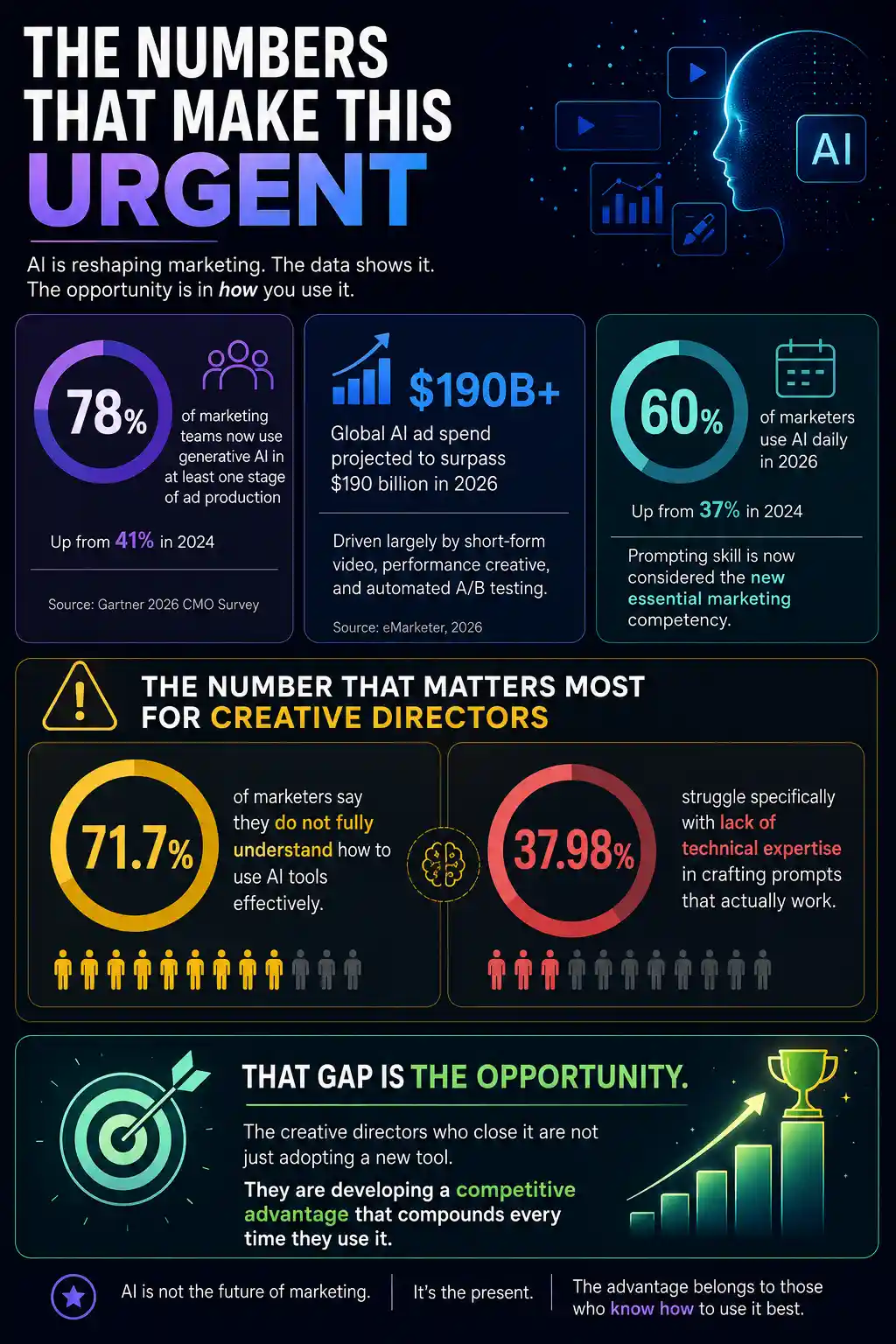
According to Gartner’s 2026 CMO Survey, 78 percent of marketing teams now use generative AI in at least one stage of ad production, up from 41 percent in 2024.
eMarketer projects global AI ad spend to surpass $190 billion in 2026, driven largely by short-form video, performance creative, and automated A/B testing.
60 percent of marketers use AI daily in 2026, up from 37 percent in 2024. Prompting skill is now considered the new essential marketing competency.
But here is the number that matters most for creative directors specifically: 71.7 percent of marketers say they do not fully understand how to use AI tools effectively, and 37.98 percent struggle specifically with lack of technical expertise in crafting prompts that actually work.
That gap is the opportunity. The creative directors who close it are not just adopting a new tool. They are developing a competitive advantage that compounds every time they use it.
Why Creative Directors Are Uniquely Positioned to Do This Well
Most of the conversation around prompt engineering focuses on technical users: coders, data scientists, operations teams. Creative directors are rarely mentioned. This is a mistake.
Prompt engineering for ad film concepts is, at its core, the discipline of translating a creative brief into language that a language model can act on with useful specificity. A creative director who has spent years writing briefs, giving creative feedback, directing talent, and communicating visual intent to a DOP already has every underlying skill this requires. The question is only how to apply those skills in a new context.
Companies like McCann and FCB New York have utilised AI tools to augment ideation and production, producing award-winning campaigns that blend algorithmic insight with human creativity.
The creative director who can brief an AI with the same clarity and specificity they would bring to briefing a writer or a director will consistently produce AI outputs that are genuinely useful. The one who treats the AI like a search engine, typing fragmented requests and hoping for a miracle, will consistently produce outputs that frustrate everyone in the review.
The Anatomy of a Good Ad Film Concept Prompt
Before getting into specific frameworks, you need to understand what a well-built prompt contains. There are six components. Every one of them matters. Leaving any of them out degrades the output.
Component 1: Role Assignment
Tell the AI who it is in this conversation. Not “you are an AI assistant.” That is the default. Give it a specific creative identity with relevant experience.
Weak: “Help me write an ad concept.”
Strong: “You are a senior creative director with fifteen years of experience directing emotionally-driven Indian FMCG campaigns. You have won at Cannes Lions twice for brand storytelling, and your signature style is finding the specific human truth inside a seemingly ordinary product category.”
The role assignment changes everything about what follows. It sets the creative register, the level of sophistication expected in the output, and the cultural context the AI should be working from.
Component 2: Brand and Product Context
Give the AI enough context to work with, but not so much that it buries the creative brief. The three things it always needs: what the product is, who it is for, and what makes it genuinely different from everything else in the category.
Weak: “The product is a protein bar.”
Strong: “The product is a protein bar called Forge, made for Indian men aged 22 to 35 who work out three to four times a week but are not competitive athletes. They work desk jobs, they squeeze gym time into their schedule, and they do not want to think too hard about nutrition. Forge is simpler than everything else on the market: one ingredient list short enough to read in five seconds, two flavours, and a price point that does not require a second thought. The brand personality is direct and unflashy. It does not talk about gains. It talks about showing up.”
Component 3: The Emotional Territory
This is the component most people skip, and it is the one that most determines whether the output feels like advertising or like a creative idea.
The emotional territory is not the product benefit. It is the human feeling that the product lives inside. A protein bar does not make someone feel strong. It makes someone feel like they are taking care of themselves without making a big deal of it. That is a specific and different emotional territory from strength, from ambition, from discipline.
Naming the emotional territory correctly is where the best creative briefs live, and it is where the best AI prompts live too.
Also Read: Free 30-Second Ad Film Script Template for D2C Brands
Weak: “The ad should make people feel motivated.”
Strong: “The emotional territory is quiet consistency. Not inspiration. Not transformation. The feeling a person has when they have been showing up for months and it has become just what they do. The ad should feel like a nod between two people who understand something without having to say it.”
Component 4: What the Ad Must Not Be
Constraints are as important as directions. They prevent the AI from defaulting to category conventions, which is what it will always do when left unconstrained, because category conventions are what the training data is full of.
Weak: No constraints stated.
Strong: “This ad should not feature a gym. It should not show someone completing a workout and feeling triumphant. It should not use motivational voiceover. It should not rhyme. It should not use the word ‘power’, ‘strength’, or ‘grind’. It should not feel like any other protein product campaign currently running in India.”
Component 5: Output Format
Tell the AI exactly what you want it to produce. A concept is not the same as a script. A scene description is not the same as a storyboard brief. A tagline is not the same as a brand line. Specify.
Weak: “Give me an ad concept.”
Strong: “Deliver: a one-paragraph concept description (the human truth and how the ad lives inside it), a three-scene visual structure (each scene described in two to three sentences), a suggested voiceover tone and one sample line, and three potential tagline options. Do not write a full script. Do not add additional context I did not ask for.”
Component 6: Cultural and Platform Context
An ad film concept for a national Hindi-belt television campaign is a fundamentally different creative brief from a concept for a Mumbai Instagram Reel. The cultural context, the language register, the visual grammar, the length, and the call to action all change depending on where the ad lives.
Weak: “This is a digital ad.”
Also Read: AI in VFX, Faster Turnarounds for Ad Films
Strong: “This film will run as a 30-second pre-roll on YouTube and as a 15-second cutdown on Instagram Reels. The primary audience is Hindi-speaking, Tier 2 city India. The ad must work without sound for the first three seconds because a significant portion of the audience watches on mute. The cultural reference points should be domestic, everyday Indian life, not aspirational or Western. The tone should feel like it was written by someone who grew up in Lucknow, not in a Mumbai agency.”
Seven Prompt Frameworks for Ad Film Concept Development

These are working frameworks used in live production and creative development. Each one is designed for a specific creative problem.
Framework 1: The Human Truth First Prompt
Use this when: You have a product but have not yet found the creative territory.
This framework asks the AI to work backwards from a human insight to a product idea, rather than forwards from a product feature to a creative execution.
The prompt structure:
“You are a strategic creative director specialising in [product category] campaigns for [target market].
Before writing a single ad concept, I want you to think through this sequence:
Step 1: What is a specific, non-obvious human truth about the life of [target audience description]? Not a demographic fact. A real emotional observation about how they live.
Step 2: What is the gap between what [product name] delivers and what [target audience] believes is available to them in this category?
Step 3: Where does that human truth and that gap intersect? That intersection is the creative territory.
Step 4: Now write two ad film concepts that live inside that creative territory. Each concept should have a scene structure (three scenes maximum), a tone description, and a sample opening line.
Product brief: [Insert product, audience, key differentiator, constraints]”
Why this works: Most generic AI ad concepts are generated by the AI jumping straight to execution from a thin brief. This framework forces it to reason through the brief before executing, which consistently produces more original and more accurate output.
Framework 2: The Category Challenger Prompt
Use this when: The brand is newer, smaller, or needs to disrupt a category dominated by established players.
Prompt Engineering for Ad Film Concepts | The prompt structure:
“You are a creative director known for challenger brand campaigns. You have directed work that has made category leaders nervous.
I am briefing you on a [product category] brand called [brand name]. Here is the category context:
What the three biggest brands in this category always do in their advertising: [List the category conventions: the type of shot, the type of person they show, the emotion they use, the music, the message]
What [brand name] is: [Product description and genuine differentiator]
Your task: Write three ad film concepts that deliberately break every one of the category conventions listed above. Each concept should be the opposite of what the category does by default. Be specific about what you are rejecting and what you are replacing it with.
For each concept, deliver: a one-paragraph concept description, visual treatment in three sentences, suggested talent direction, and the line that replaces the category cliche.”
Framework 3: The Cultural Specificity Prompt
Use this when: The campaign needs to feel genuinely rooted in Indian culture, a specific regional culture, or a very specific community.
The prompt structure:
“You are a creative director who grew up in [city/region/cultural context] and now directs advertising for brands trying to authentically connect with [cultural community].
You have a strong sense of what feels real to this community and what feels like it was written by someone who Googled the culture for twenty minutes.
I need a 30-second ad film concept for [product] targeting [cultural community description]. The film will air on [channel/platform].
Before writing the concept, list five specific cultural details about [community] that should either appear in the concept or inform its emotional logic. These should be specific enough that someone from outside the community would not have thought to include them.
Then write the concept using those five details as anchors. The concept should feel like it could only exist for this community. It should not work if you swapped in a different community.”
Framework 4: The Platform-Native Prompt
Use this when: The concept needs to be built specifically for digital platforms, not adapted from a television idea.
The prompt structure:
“You are a creative director who has directed over 100 digital-first ad films for [platform: Instagram Reels / YouTube / OTT pre-roll / CTV]. You understand how attention works differently on each platform.
I need three concept directions for a [duration]-second ad film for [product] on [platform]. The target viewer is [description].
Platform-specific constraints to build the concept around:
- [Platform]: The first [X] seconds must work without sound. The hook must be entirely visual.
- The concept must earn the viewer’s continued attention after the skip option appears at [X] seconds.
- The film must work at [aspect ratio].
For each concept, specify:
- The visual hook in the first three seconds (described in exact visual terms, not “something interesting happens”)
- Why this hook specifically works on [platform] for [target viewer]
- The scene structure
- The sound-off viewing experience
- The CTA and how it earns the ask”
Framework 5: The Stress Test Prompt
Use this when: You have a concept from another source (your team, a client, a previous AI generation) and need to pressure-test it before committing to production.
The prompt structure:
“You are acting as three different people in a creative review meeting. Each person has a specific perspective and a specific concern.
The concept being reviewed: [Insert concept description]
Person 1 is the brand manager. They are worried about ROI and whether the concept communicates the product’s core benefit clearly enough. Give their feedback.
Person 2 is the target consumer. Their life is [description]. They see this ad appear during [context: IPL match / Instagram scroll / morning commute stream]. Give their genuine reaction.
Person 3 is the creative director of the competitor brand. They have just seen this concept. What do they think? Are they worried? Do they think it will work? What would they do in response?
After all three perspectives, give your own summary: what is the concept’s biggest strength, what is its biggest vulnerability, and what one change would most improve it.”
Framework 6: The Iterate and Refine Prompt
Use this when: You have a concept that is directionally right but needs sharpening.
This is not a single prompt. It is a sequence.
Round 1: Generate the initial concept using any of the above frameworks.
Round 2: “The concept is good but the [scene 2 / opening line / resolution / brand close] is not working. It feels [generic / too long / emotionally flat / category-conventional]. Without changing the emotional territory or the overall structure, rewrite only [the specific element] in three different ways. Each version should try a different approach.”
Round 3: “Version 2 from the previous response is closest to what I need. Now make it more specific. Replace every general claim with a specific sensory or observed detail. Replace every abstract emotion word with a physical action or image that communicates that emotion without naming it.”
Round 4: “Now write the final version of the complete concept incorporating the work from rounds 1 through 3. This should be production-ready as a creative brief.”
Framework 7: The Multi-Format Concept Prompt
Use this when: The campaign needs to run across television, digital, and OTT simultaneously, and you need a coherent creative platform that works in all three environments.
The prompt structure:
“You are a creative director building a campaign platform, not a single ad. The brand is [name]. The campaign window is [e.g. Diwali / IPL / product launch].
The campaign needs to work across three environments simultaneously:
Environment 1: 30-second national television commercial. Broad audience. Passive viewing. Emotional storytelling is possible. Brand must register within the first five seconds.
Environment 2: 15-second YouTube pre-roll. Skippable at five seconds. Digital-native audience. Sound is usually on. The hook must earn the remaining ten seconds.
Environment 3: 6-second Instagram Reel bumper. Non-skippable. Mobile, vertical frame. Sound is often off. One idea. One image. One line maximum.
Write one creative platform concept, the core idea and emotional territory, and then show how it executes differently in each of the three environments. The visual language should feel unified. The emotional territory should be consistent. The execution should be completely different.”
Real Prompt Examples: Before and After Prompt Engineering for Ad Film
The fastest way to understand the quality gap between weak and strong prompts is to see them side by side.
Category: Premium Tea Brand, India
Weak prompt: “Write a 30-second ad concept for a premium Indian tea brand targeting adults.”
Output quality: Category-conventional. Probably involves warmth, family, morning, and a grandmother. Possibly a rainy day. Definitely a steaming cup held in both hands.
Strong prompt: “You are a creative director who has worked on premium food and beverage campaigns in India for twelve years. You understand that the premium tea category is completely dominated by warmth, family, and nostalgia imagery, and that any concept using those codes will disappear into the category.
The brand is called Silvertip. Single-origin Darjeeling first flush, organic, available only direct-to-consumer online. The target buyer is a 30 to 42-year-old urban professional who already buys good coffee and is now discovering that tea can be as interesting and as carefully sourced. They are not particularly sentimental about tea. They are curious about it.
Constraints: No family scene. No grandmother. No rain. No warmth metaphors. No candle or fireplace. No morning ritual sequence. No voiceover that says anything about ‘tradition’ or ‘generations.’
Emotional territory: The feeling of discovering that something you dismissed as ordinary is actually extraordinary when made correctly.
Deliver: One concept with three scenes, tone description, and a tagline that could not belong to any other tea brand.”
Output quality: The AI now has a genuine creative problem to solve, not just a category brief to illustrate. The output will be directionally original because you have eliminated every direction it would otherwise default to.
Category: Women’s Safety App, India
Weak prompt: “Write an ad for a women’s safety app that is emotional and powerful.”
Output quality: Predictable empowerment sequence. Probably includes stock-footage-style running, a moment of fear, and a resolving moment of strength. Safe. Forgettable.
Strong prompt: “You are a creative director known for making ads about serious subjects without resorting to the usual dramatic treatment that audiences have learned to emotionally disconnect from.
The product is a women’s safety app for India called Raksha. It works in the background, tracks location, can trigger a discreet alert, and connects to a trusted contact in thirty seconds. It does not require the user to press a visible button in a dangerous situation.
Target user: Women aged 18 to 30 in Tier 1 and Tier 2 Indian cities who already take precautions every day without thinking about it. Checking their phone before leaving somewhere. Texting a friend their cab details. This app fits into that existing behaviour. It does not require new behaviour.
The ad must not: Show a dramatised threat or attacker. Show a woman looking afraid. Use dramatic music. Use the word ‘fear’ or ‘safe’ in the voiceover. Show a police involvement scene.
The ad should: Show the existing behaviour women already do every day. Show how the app fits into that behaviour without disruption. Leave the viewer with a feeling of quiet competence, not relief from danger.
Deliver: One concept, three scenes, voiceover tone with a sample line, and a tagline that respects the target viewer’s intelligence.”
How to Read AI Output Like a Creative Director
Generating the concept is step one. Reading it correctly is step two, and it is where most creative directors lose the gains they made in the prompt.
When an AI concept comes back, resist the urge to evaluate it as a finished piece. Evaluate it as a first draft from a junior creative who caught the brief but has not yet found the specificity and surprise that make it worth presenting.
Ask four questions of every AI concept output:
Is the emotional territory correct? If the concept is hitting the right human truth, even if the execution is generic, that is a concept worth developing. If the emotional territory is wrong, the execution cannot save it.
Is there one moment that is genuinely unexpected? The most common failure of AI-generated concepts is that every element is predictable. Not wrong. Predictable. A good concept has at least one moment, one image, one line, or one structural choice that you would not have anticipated from the brief.
Is the specific language strong enough? AI tends toward abstraction. “She looks confident” is not a visual direction. “She adjusts her bag strap once, glances at her phone, and does not look back” is. Take any abstract description in the AI output and replace it with a specific observable action before treating it as a concept.
Does it sound like it was written by someone who knows the category from the inside? If the concept could describe any brand in the category, it is not specific enough to be a real concept. A concept for Silvertip tea should not work for Twinings. A concept for Forge protein should not work for Whey To Go. If it does, go back to the prompt and tighten the constraint section.
The Prompting Workflow for a Live Production Brief
Here is how this applies in a real production context at Cybertize Media Productions, from brief receipt to concept presentation.
Stage 1: Brief Deconstruction (30 minutes)
Before opening any AI tool, map out the six prompt components for this specific brief. Write them longhand. This forces you to make decisions you would otherwise defer to the AI. Who exactly is the target viewer? What is the single emotional territory? What must this concept not be? This deconstruction is the work. The prompting is just the output of the work.
Stage 2: First Generation (15 minutes)
Run the fully built prompt through your preferred model. Claude for emotional nuance and strategic depth. ChatGPT-4o for volume and variation. Gemini for culturally-adjacent references in Indian-market contexts.
Ask for three to five distinct concept directions in the first pass, not one. Typical AI output volumes in professional production workflows run 20 to 200 variants per brief depending on surface and budget. For a concept development stage, three to five directions give enough to evaluate without creating decision fatigue.
Stage 3: Concept Selection and Stress Test (20 minutes)
Select the one or two directions that are emotionally correct, even if the execution needs work. Run them through the stress test framework (Framework 5 above) with the brand manager, target consumer, and competitor director perspectives. This identifies the weaknesses before the internal review rather than in it.
Stage 4: Iteration (20 to 30 minutes)
Run two to three rounds of refinement on the selected direction using the iterate and refine framework. Focus each round on one specific element. The opening. The proof moment. The resolution. The tagline. Trying to improve everything at once produces compromise outputs.
Stage 5: Human Creative Work (the time this frees up)
The concept that comes out of stage four is a directionally strong first draft. The creative director’s job from this point is to do what AI cannot: make the concept feel like it comes from a specific human sensibility. Add the cultural detail that the AI approximated but did not quite get right. Replace the generic scene description with a specific location or a specific face. Find the line of dialogue that a real person would actually say.
AI can help in the ideation phase, like storyboarding multiple concepts quickly. But when brands skip human curation, the results can feel cold and impersonal.
The human work has not been eliminated. It has been concentrated at the point where it matters most.
Prompt Engineering Specifically for Indian Ad Film Contexts
Most available guides on prompt engineering for advertising are written from a Western, English-language, digitally-native creative context. Indian ad film production has specific requirements that these guides do not address.
Language and register: India’s advertising landscape operates across Hindi, English, and twelve major regional languages. A prompt that does not specify the language register of the concept will default to English-language creative conventions. Add explicit language direction: “The voiceover should be written in conversational Hindi, not formal or poetic Hindi. The sentence structures should feel like how a 28-year-old from Indore actually speaks, not how a copywriter imagines they speak.”
Regional cultural specificity: 2025 was the year of cinematic minimalism in AI-assisted creative: clean, elevated compositions, high-end product focus, and a blend of luxury and accessible aesthetics. This is a Western creative convention, and it needs to be explicitly overridden for campaigns targeting specific Indian cultural contexts. A campaign for a brand targeting Tier 2 Hindi-belt India needs to prompt away from cinematic minimalism and toward the specific visual and emotional grammar of that market.
Family and social structure: Indian advertising frequently involves family contexts, multigenerational dynamics, and community relationships that do not translate from Western creative references. If the brief requires these dynamics, specify them precisely: “The family in this ad is a nuclear family in Pune. Both parents work. The grandmother lives with them. The emotional dynamic between the mother and the grandmother is warm but not sentimental. The ad should show the grandmother and the daughter-in-law understanding each other without a dramatic moment. Just a look.”
Festival and occasion context: Indian campaign windows are often tied to festivals, cricket seasons, and cultural occasions that have specific emotional associations. A Diwali prompt needs to specify which emotional register of Diwali you are working in: homecoming, prosperity, light as metaphor, family reunion, or the specific anxiety of the Diwali gift purchase decision. Leaving this unspecified will produce a generic festival-adjacent concept.
Where Prompt Engineering Ends and Craft Begins
A guide like this one would be dishonest if it did not address this directly.
Prompt Engineering for Ad Film: Prompt engineering accelerates and sharpens the concept development phase. It does not replace the creative director’s most important function, which is to know, from experience and from cultural intelligence, when an idea is true.
AI can accelerate ideation and variation, but brands that skip human curation risk output that feels cold and impersonal. Brands that apply clear governance and human oversight to AI-driven creative are more likely to maintain trust and avoid the perception that automation has come at the expense of authenticity.
There are specific things that experienced creative direction does that no prompt engineering can replicate:
The instinct for cultural authenticity. When a concept is approximating a cultural truth rather than actually inhabiting it, a creative director who grew up in that culture will feel it immediately. The AI will not flag it.
The read on the room. When a client is in two minds between two concepts, the creative director who can articulate with conviction, with specific creative reasoning, and with the weight of experience behind it, why one concept will outperform the other is irreplaceable.
The casting call. A concept on paper becomes a film in production. The director’s eye for which actor, which face, which specific performance quality brings the concept to life is not something that lives in a language model.
The relationship between image and emotion. The AI can describe a scene. The DOP can light it beautifully. The director sees how a specific angle in a specific light with a specific piece of music will produce a specific feeling in the viewer. That triangle of relationships is craft. It is learned over years on set. Prompt engineering does not teach it.
What prompt engineering does: it closes the gap between the blank page and something worth discussing. For a creative director working under a compressed timeline with multiple briefs open simultaneously, that gap-closing is enormously valuable. It turns a three-day concept development phase into a three-hour one. And it allows the creative director to direct their full attention to the judgment calls that actually determine whether the campaign is good.
The Tools Worth Knowing in 2026
For ad film concept development specifically, here is how the current AI tool landscape breaks down.
Claude (Anthropic): Best for long-form strategic creative thinking, emotional nuance, and holding complex brand context across a conversation. The model maintains coherence across multi-turn prompt engineering sessions better than most alternatives. Strong for culturally sensitive concept development where tone and emotional precision matter.
ChatGPT-4o (OpenAI): Best for volume and variation. When you need twelve concept directions quickly evaluated across different emotional territories, GPT-4o is fast and breadth-oriented. Less nuanced on cultural specificity but strong on structural diversity.
Gemini Advanced (Google): Particularly useful for research-adjacent creative development: understanding category landscapes, finding cultural reference points for Indian market concepts, and integrating recent trend data into concept briefs.
Runway and Veo 3 (Google): For visual concept previsualization. Once a written concept is directionally right, these tools can generate rough visual references that are useful in internal creative reviews. Not replacement storyboards, but useful direction-setting tools.
Prompt Engineering for Ad Film: In 2026, defining the scene with precision is what separates useful AI visual output from generic results. Specify the camera angle, shot type, and lighting to control the narrative focus. Not just “modern product on white background” but “medium shot of product, isolated on a textured cream backdrop with Rembrandt lighting, capturing a moment of quiet use, cinematic, hyper-detailed, atmospheric.”
Try our Free Film Production Budget Calculator
The discipline of prompt specificity applies equally to visual tools and language tools. The more precisely you define what you want, the less the AI defaults to the average of everything it has seen.
A Note on Brand Voice and the Risk of Generic Output
In 2026, enterprise advertising programs are beginning to develop first-party brand voice models. Adweek reports 12 Fortune 100 brands had operational first-party voice models as of Q1 2026, up from just 2 in early 2025.
For smaller brands and production houses that do not have the resources to fine-tune their own models, the equivalent is a consistently built brand context document that is included at the start of every prompt session. This document specifies:
The brand’s emotional territory in plain language. The specific language and phrases the brand uses and does not use. Reference campaigns from the brand’s own history that represent the correct creative register. The target audience described in behavioural, not just demographic, terms. The specific visual grammar of the brand: colour, composition style, talent type, location aesthetic.
Including this context in every prompt session is the difference between AI that produces brand-coherent concepts and AI that produces advertising generic enough to belong to anyone.
Final Word from Cybertize Media Productions

The creative directors who will be most valuable in the next five years are not the ones who resist AI tools or the ones who replace their creative judgment with them. They are the ones who have learned to use these tools at the moment in the creative process where they accelerate the work most, and who preserve their human judgment for the moments that actually determine whether the campaign is worth making.
Prompt engineering for ad film concepts is a learnable skill. It takes practice in the same way that learning to write a good brief, give useful creative feedback, or direct a performance takes practice. The learning curve is short. The returns compound every time you use what you learned.
Also Read: Digital Ad vs TV Commercial, What’s Actually Different and Why It Matters in 2026
The blank page is no longer blank. The question is what you put on it.
Prompt Engineering for Ad Film: At Cybertize Media Productions Private Limited, prompt engineering has become a standard part of our pre-production creative process. Not as a replacement for the creative direction that has always defined our work, but as the tool that gets the concept to the table faster and stronger, so the real work, the production, the craft, the performance, the frame, can begin from a better starting point.
Cybertize Media Productions Private Limited is a full-service ad film and corporate video production company working with brands across India.