
Table of Contents
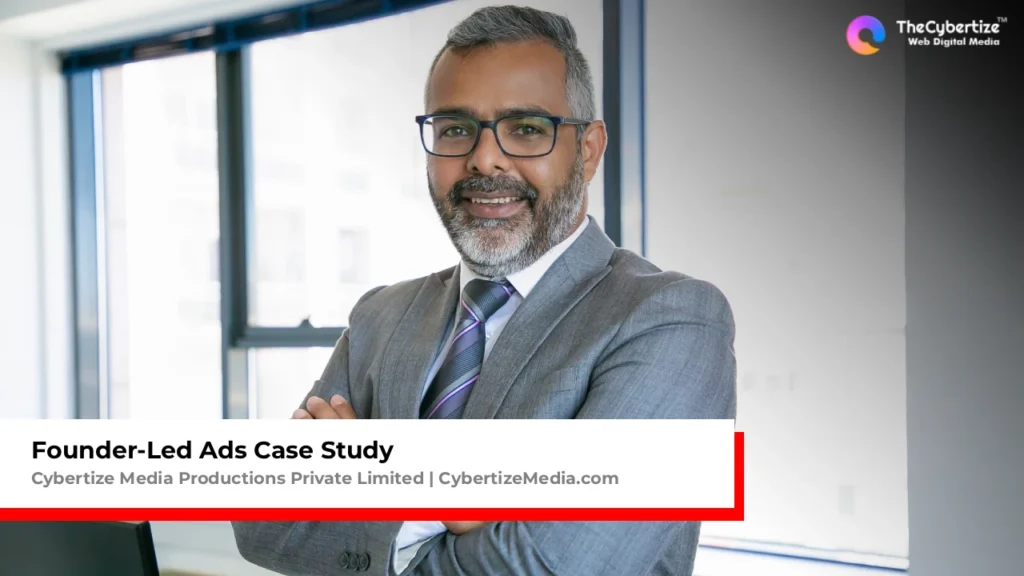
Founder-Led Ads: Something Changed When the Founder Walked Into the Frame
There is a moment that happens in a lot of founder-led ad films that you cannot manufacture with a celebrity or a hired actor.
It is the moment when the person on screen says something about the product that is slightly imperfect. A brief pause. A specific detail that only someone who built the thing would know. A quiet pride that does not perform for the camera because it does not need to.
That moment is worth more than any production value money can buy. Because the viewer, in their gut, knows the difference between someone reading lines and someone telling the truth. And in 2026, that difference is the entire competitive advantage for a brand willing to put its founder in the frame.
Founder-led advertising has moved from a scrappy startup tactic to a mainstream brand strategy. The data is now comprehensive enough that it is not a debate anymore. And yet most brands, including brands that could genuinely benefit from it, are still defaulting to polished campaigns with hired talent, professional scripts, and production setups designed to look nothing like a real human being talking to another real human being.
Founder-Led Ads: This guide covers why that is a mistake, what the psychology behind founder-led advertising actually is, who is doing it best in India and globally, and how a production house should approach filming a founder in a way that captures authenticity rather than performing it.
The Trust Gap That Founder-Led Advertising Fills
Start with the problem it solves.
Consumer trust in traditional advertising has been declining for years. A 2025 Edelman Trust Barometer study found that 64 percent of consumers trust individual experts more than institutional brands when making purchase decisions. That number has been moving in one direction for a decade.
Meanwhile, the trust that audiences extend to people, real, specific, identifiable people who have a reason to believe what they are saying, remains high. Founders have that reason built in. They built the thing. They know why it works. They have a personal stake in the outcome that no hired spokesperson can credibly claim.
Founder-led advertising taps into fundamental human psychology. We trust people more than brands. We believe experts over copywriters. And we connect with authentic stories over manufactured messaging.
Also Read: India’s Best Commercial Directors, The People Behind the Ads You Never Forgot
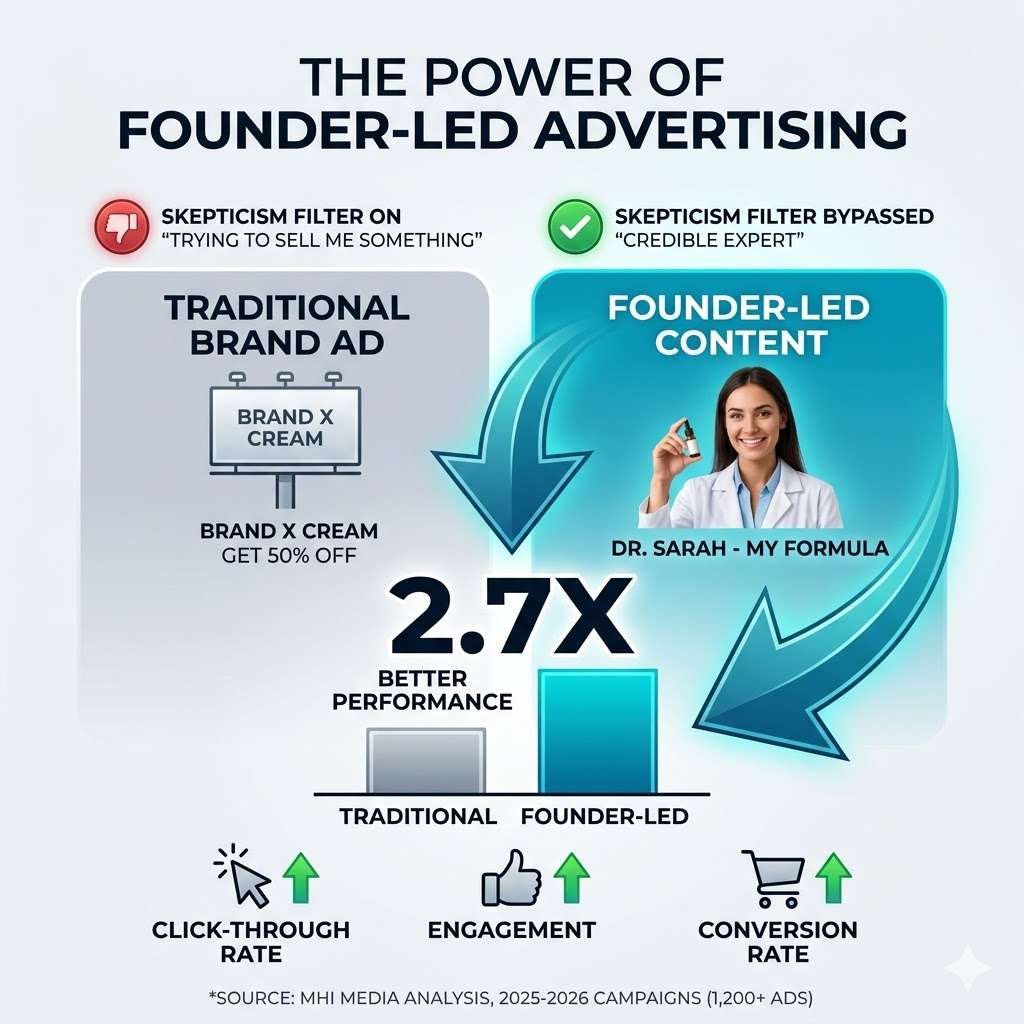
The mechanism is not complicated. When a dermatologist founder talks about the skincare ingredients she chose for her product, the viewer processes that information through a “credible expert” lens rather than a “trying to sell me something” lens. That cognitive shift is enormous. It bypasses the skepticism filter that has been trained into every modern consumer through years of exposure to advertising that ranges from mildly misleading to brazenly dishonest.
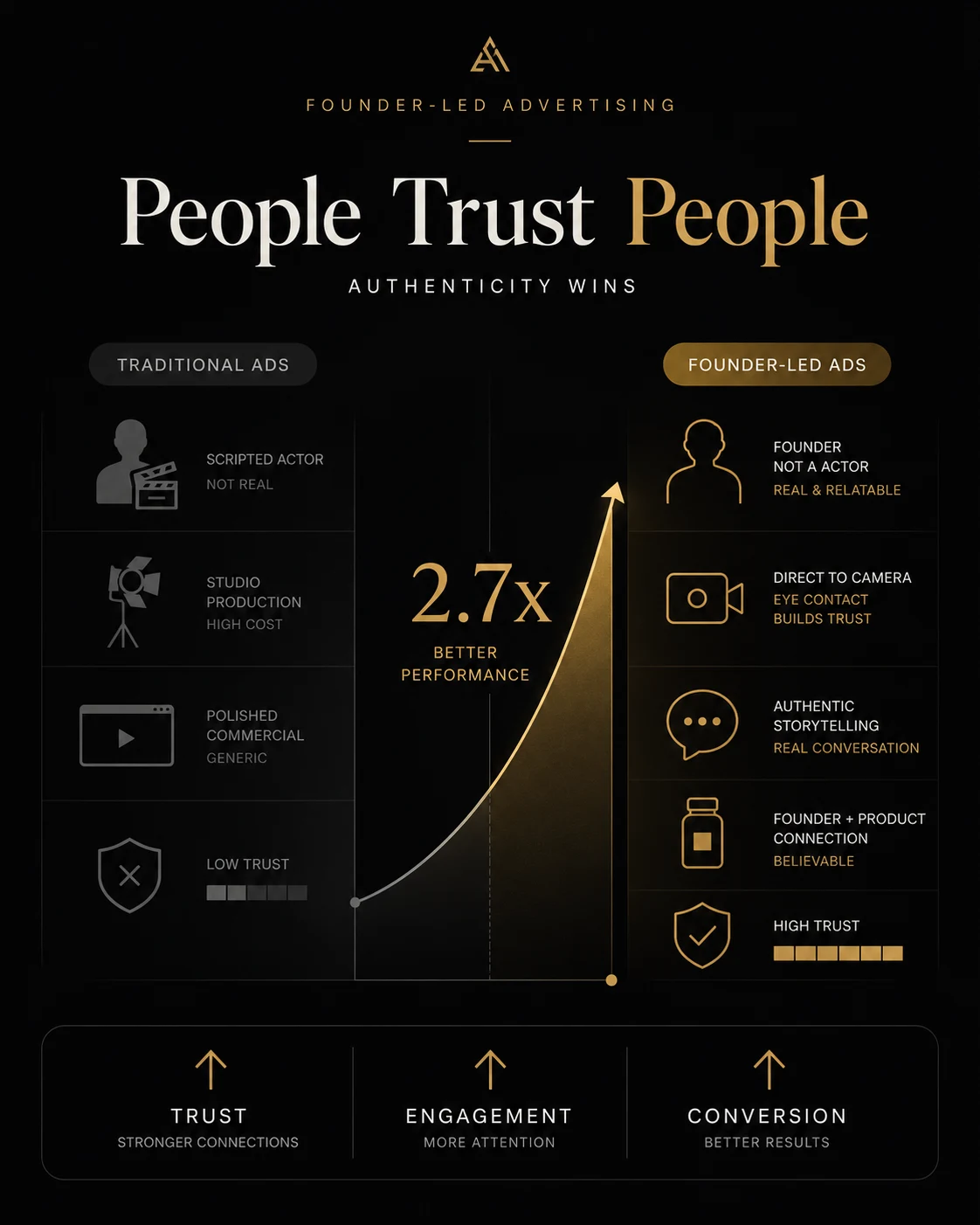
The data behind this shift is striking. According to MHI Media’s analysis of 1,200 plus ad campaigns in 2025 and 2026, founder-led creative outperforms traditional brand content by an average of 2.7 times on key metrics including click-through rate, engagement, and conversion rate.
That is not a marginal improvement. A 2.7x performance difference at the same media spend is the difference between a campaign that pays for itself and one that genuinely compounds the brand’s growth.
Why This Is Happening Now Specifically
The founder-led advertising wave is not random. It is the product of several converging shifts that have been building simultaneously.
The creator economy taught audiences a new relationship with content.
The rise of creators on YouTube, Instagram, and now Reels and Shorts has fundamentally changed what audiences expect from the people on their screens. For a generation that grew up watching individuals document their lives, build businesses, and share expertise directly, the polished anonymity of a traditional brand ad feels not just boring but vaguely dishonest.
Short-form video dominates. Audiences crave authenticity. Faceless corporations struggle to make meaningful connections. The rise of the creator economy has made consumers more comfortable following people instead of companies.
When audiences are accustomed to watching real people talk about real things in real environments, an actor in a studio set delivering scripted lines about a product they have never used reads immediately as the fiction it is.
Shark Tank India made founder credibility mainstream.
In India specifically, Shark Tank India did something that no amount of D2C marketing content could have achieved: it put founders on prime time television and made the act of building a business compelling, relatable, and genuinely aspirational.
Aman Gupta, co-founder of boAt, has become a familiar face in founder-led marketing. Often spotted on Shark Tank India sporting a boAt smartwatch and accessories, he seamlessly integrates his brand into his public persona. The brilliance of this is that it requires no scripting. He wears the product because he believes in it. The audience sees that without being told to see it.
Similarly, Aakash Anand, founder of Bellavita and popularly known as the Perfume Man of India, personally delivered purchases to customers as part of a Valentine’s Day campaign. That single gesture, a founder delivering his own product, generated more emotional resonance than any scripted testimonial could have.
The formula is repeating itself across the D2C landscape. Parul Gulati, founder of Nish Hair, successfully positioned herself as the face of her brand through consistent, personal, on-camera presence. The product and the person are indistinguishable from each other in the consumer’s mind. That is precisely the goal.
The trust gap between consumers and institutions has widened.
This is not about advertising specifically. It is about a broader cultural shift in which consumers have become deeply skeptical of anything that feels institutional, polished, or produced by a faceless entity with undisclosed motives.
Founder-led brands have an advantage here. Without pressure to sanitize messaging for quarterly optics, they can demonstrate values through action, sourcing choices, labor practices, and community investment, earning loyalty from consumers who feel increasingly alienated by corporate positioning exercises. Founder-led brands can humanize their brand in a way large enterprise brands struggle to do.
A founder who talks about why they chose a specific supplier, why they rejected a cheaper ingredient, or why they priced the product the way they did is doing something that a corporate brand cannot replicate. Not because the corporation cannot afford to make the same choices. Because the audience does not believe a corporation when it says these things, but does believe a specific person they have watched on camera.
The Psychology Behind Why Founder Faces Work on Camera
The human brain is wired to read faces. It is one of the most ancient and most finely tuned perceptual capabilities we have. We process faces faster than any other visual input. We extract information from faces that we cannot access through any other channel. And we make trust decisions based on facial cues that operate largely below conscious awareness.
This is why a founder on camera communicates something that a voiceover, a product shot, or a text overlay cannot. The face is the trust signal. The eye contact establishes a direct relationship between the person speaking and the person watching. The micro-expressions that appear when someone is speaking from genuine conviction versus performing a scripted line are detectable, even if the viewer could not articulate what they are reading.
This authentic authority triggers different cognitive processing than traditional ads. Research in social psychology shows we evaluate information differently based on source credibility. A dermatologist founder discussing skincare ingredients, a fitness equipment founder demonstrating the product they developed during their own training, a food brand founder explaining the family recipe behind the product. These people have a relationship with what they are selling that a hired spokesperson cannot credibly claim, and the brain reads that difference without being told.
The practical implication is this: when a founder appears in an ad film and the film is produced in a way that preserves rather than overrides their natural presence, the viewer receives the product information through a trust channel that traditional advertising has never had access to.
What Founder-Led Advertising Looks Like in Practice
There is an important distinction between founder-led advertising done well and founder-led advertising done lazily.
The lazy version: put the founder in front of a camera, hand them a script, and film them delivering it. The result looks like every corporate training video from 2012. The founder is uncomfortable. The delivery is stilted. The script sounds like it was written by someone who has never met the founder and certainly does not sound like the founder. The authenticity that was supposed to be the point is the first casualty of the scripted approach.
Also Read: How Much Does Ad Film Production Cost in India?
The good version: build the content around what the founder genuinely knows, genuinely believes, and genuinely does. Not what the marketing team thinks they should say.
Here is the difference in practice.
The founder talks about the origin story, not the product features. Why did they start this? What problem were they personally experiencing? What did the market not have that they decided to build? These are stories the founder can tell with genuine conviction because they lived them. The product features can live in a separate explainer video.
The founder demonstrates rather than describes. A founder using the product, testing the product, explaining the product to someone who has never heard of it before. Demonstration is always more credible than description. And a founder demonstrating something they built has a quality of familiarity and ease that cannot be taught to a hired presenter.
The production style serves the content, not the other way around. Founder-led content that is over-produced often backfires. The sophisticated lighting rig, the perfect set design, the six takes to nail the line delivery. These things signal “production” rather than “person,” which undermines the authenticity that was the reason for using the founder in the first place. Some of the most effective founder-led ad films in India in 2025 and 2026 were shot in the founder’s own workspace, with natural light, and a single take per topic.
The editing preserves the personality. The imperfect pause. The moment of genuine enthusiasm that breaks through the composed delivery. The small digression that reveals something true about how the founder thinks. These are the moments that create connection, and an over-aggressive edit will cut them out because they do not fit a standard commercial pacing template.
The Indian D2C Founder Advertising Playbook
India’s D2C ecosystem has produced some of the most effective founder-led advertising in Asia over the past three years, and the pattern of what works is now clear enough to describe as a playbook.
Step 1: The Origin Story Film
Every founder has one. The moment they realised there was a problem worth solving. The product that did not exist that they decided to build. The personal experience that made the category personally meaningful.
This is the film that goes on the brand’s homepage, on their LinkedIn, and that plays at the beginning of every investor or partnership conversation. It is two to four minutes long. It features the founder almost exclusively. The production quality should be high enough to reflect the brand’s positioning but not so high that the founder disappears into a glossy campaign aesthetic.
Origin story films perform disproportionately well for engagement and shareability because people share stories. They do not share features lists.
Step 2: The Consistent Platform Presence
The most effective Indian D2C founders in 2025 and 2026 are not making one founder video and calling it done. They are showing up consistently, on LinkedIn, on Instagram, in podcast appearances, in short-form Reels, at a frequency that builds familiarity over time.
Familiarity is the mechanism. The more times a potential customer sees a founder speak about their brand with genuine knowledge and conviction, the lower the trust barrier to first purchase becomes. This is the most cost-efficient customer acquisition strategy available to a founder-led brand, because it leverages the founder’s existing credibility rather than building credibility from scratch through paid advertising alone.
Step 3: The Behind-the-Scenes Integration
Traditional marketing relies on perfection: slick campaigns, flawless design, and rehearsed scripts. But Gen-Z and younger millennials value honesty over polish. A simple behind-the-scenes video of a founder walking through the production floor, explaining a product development decision, or sharing a setback with context, often generates more engagement than a polished brand film.
This content is inexpensive to produce. A founder with a phone and something worth saying can produce content that outperforms a ₹5 lakh brand film if the authenticity is real and the founder genuinely connects with the audience.
Step 4: The High-Production Anchor Film
Here is where production companies like ours come in. At some point in the brand’s growth, the founder’s authentic presence needs to be captured with production values that reflect the brand’s ambition. Not to make it look fake. To make it look like it deserves the media spend it is going to receive.
A well-produced founder film does not override the founder’s authenticity. It creates the conditions for it to be captured and amplified. Good lighting makes the founder look like the most capable version of themselves. Good audio makes every word they say legible and credible. Good direction creates the space for the founder to say the true thing rather than the scripted thing.
The combination of a founder’s authentic voice with the production quality of a professional brand film is the formula that consistently produces the highest-performing founder-led advertising content.
The Mistakes Brands Make with Founder-Led Advertising
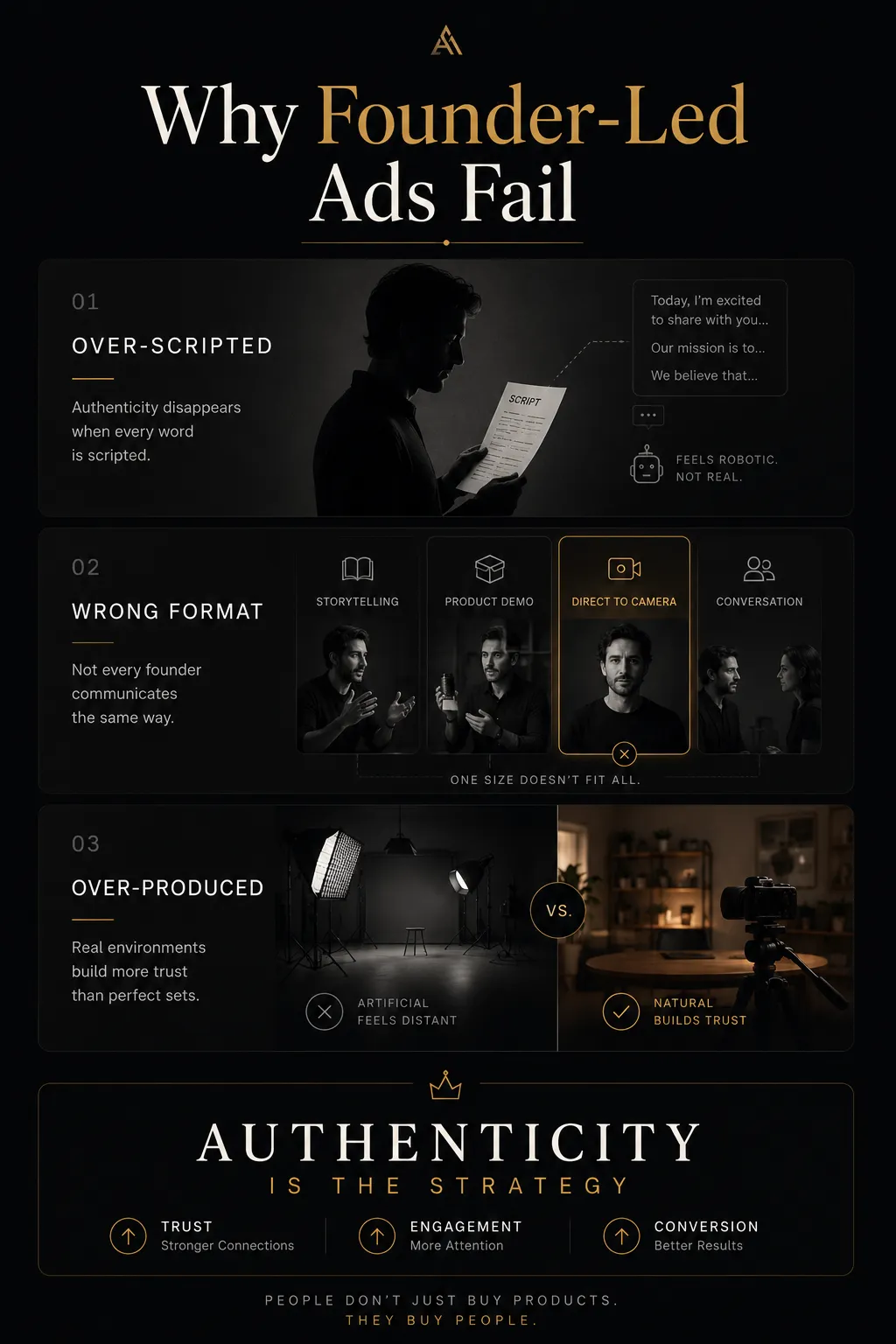
After the data, the case studies, and the enthusiasm, it is worth naming the ways this goes wrong. Because founder-led advertising done badly does more damage than a conventional campaign done well.
Scripting the life out of it. A founder reading a script they did not write sounds like exactly what they are. There is a specific quality of disconnection that happens when an authentic person is put in an inauthentic situation, and the audience reads it immediately. The solution is not to eliminate all preparation. It is to prepare the topics, not the lines. Let the founder talk about the subject in their own language, with their own sentence structures and their own digressions.
Choosing a format that does not suit the founder. Some founders are natural storytellers. Others are stronger demonstrators. Others are best in conversation with another person rather than speaking directly to the camera. The format of the founder-led content should match how the founder naturally communicates, not how the marketing team imagined the content would work.
Over-producing it. A founder filmed in their actual office with natural light and a good microphone often outperforms the same founder in a purpose-built studio set. The environment communicates authenticity before the founder has said a word. The studio set communicates “production,” which is a trust signal that works against the purpose of founder-led content.
Also Read: Top Corporate Video Production Companies in India (2026)
Inconsistency. A single founder video, however well-made, does not build the familiarity that produces trust. The founders who build genuine brand equity through their own presence do it through consistency across months and years. One film at launch, another at a product update, a third at a company milestone. The audience is learning who this person is over time, and that accumulated knowledge is what makes each new piece of content more effective than the last.
Making it about the product when it should be about the person. The best founder-led advertising is about the founder’s relationship with the problem they solved. The product is the mechanism. The person is the story. Advertising that features a founder but makes the product the protagonist misses the entire point of using the founder.
How to Produce a Founder-Led Ad Film: The Production Approach
At Cybertize Media Productions, we approach founder-led content differently from standard brand film production. The brief is different. The preparation is different. And the direction on set is different.
The brief is a conversation, not a questionnaire. Before a word of script is written, we spend time with the founder talking about what they built and why they built it. Not for a research document. For the direction of the film. The language the founder uses in that conversation, the specific words, the rhythm, the moments of genuine emphasis, become the building blocks of whatever structure we put in place for filming.
The script is a safety net, not a script. We prepare a loose framework of topics rather than a line-by-line script. The founder knows what they want to say about each topic. The camera is rolling while they figure out how to say it. The best takes are often the ones where the founder has said something three times and on the fourth attempt found the version of it that is actually true.
The production setup is minimal enough to stay out of the way. A smaller crew is often better for founder-led content than a large production setup. The more people in the room, the more a founder performs for the room rather than the camera. Two to four people maximum: the director, the camera operator, the audio engineer, and if necessary a creative producer managing the conversation.
The edit is generous. We cut to the founder’s truth, not to a standard commercial pacing template. If the founder’s best version of a statement is twelve seconds long and the brand wanted a ten-second unit, the twelve-second version wins.
The production quality is high on everything except performance. The lighting, the audio, the colour grading, the music, everything that does not involve the founder’s delivery should be at the highest quality the budget allows. These elements amplify the founder’s authentic presence without overriding it.
When Founder-Led Advertising Is Not the Right Answer
This would not be an honest guide without naming the situations where founder-led advertising is the wrong choice.
Not every founder is naturally compelling on camera. Some founders are extraordinary product builders, exceptional operators, or brilliant strategic thinkers who do not communicate in a way that translates to video. Forcing a reluctant or uncomfortable founder into an on-camera format in the name of authenticity produces content that communicates exactly the opposite of what was intended.
For founders who are not natural on-camera communicators, the alternative is to tell the story around them rather than through them. Behind-the-scenes content of the founder at work. Interview footage where a skilled interviewer draws out the founder’s knowledge in conversation. Or a brand film that uses the founder’s voice as narration over footage that does not require them to look directly at the camera.
The goal is to communicate the founder’s specific human intelligence and genuine care for what they built. The direct-to-camera format is only one way to achieve that.
The Numbers That Should Make Every Indian D2C Brand Rethink Its Content Strategy
According to 2024 data, D2C brands in India are estimated to have a market size exceeding $80 billion, with a significant portion of their spending allocated towards advertising, primarily through digital channels.
In that context, the performance data for founder-led content is remarkable. Founder-led creative outperforms traditional brand content by 2.7 times on click-through rate, engagement, and conversion rate. User-generated content, which operates on a similar authenticity principle, increases brand trust by 68 percent. Video branding is 43 percent more effective than image-based content. And brands rooted in a clear mission, which founder-led brands almost always communicate more effectively than institutional brands, grow at nearly double the rate of competitors without that orientation.
The compound effect of these numbers is significant. A D2C brand allocating the same media budget to founder-led creative rather than conventional polished content is not just getting better engagement rates. It is building a more durable trust foundation with its audience that reduces customer acquisition cost over time, increases repeat purchase rates, and creates the kind of word-of-mouth that cannot be bought with media spend.
The brands that understand this early and build their content strategy around a genuine founder presence are creating a competitive moat that has nothing to do with product features and everything to do with the human relationship between the person who built the thing and the people who buy it.
Final Word from Cybertize Media Productions
The founder is the most credible person in any room where the brand is being discussed. More credible than the marketing team. More credible than a hired celebrity. More credible than a professional presenter who has been briefed about the product for three days.
The question is not whether to use the founder in advertising. The question is how to produce content that captures the founder’s real intelligence, genuine passion, and specific human perspective in a way that the audience can actually receive.
That is a production problem. And it requires a production team that understands the difference between filming a performance and capturing a person.
At Cybertize Media Productions Private Limited, founder-led brand films and D2C launch content are among the most strategically interesting work we do. The brief is always the same: find the version of this person that the camera makes more visible, not less.
If you are building a brand and you want your story to be the brand’s story, that conversation is worth having before the shoot, not on the day of it.
Cybertize Media Productions Private Limited is a full-service ad film and corporate video production company working with brands across India.