
Table of Contents
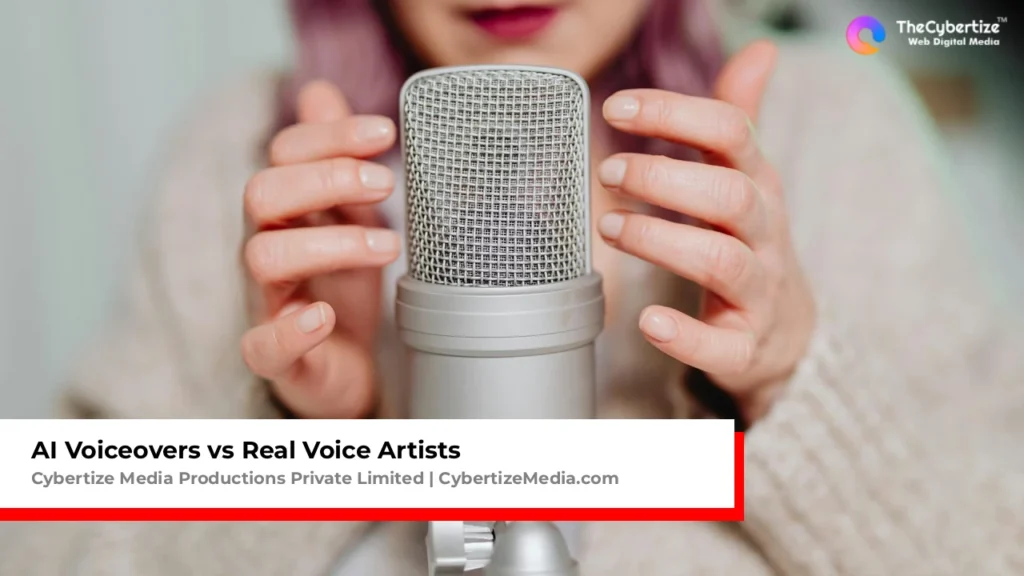
AI Voiceovers vs Real Voice: The Voice Question Nobody Asks Loudly Enough
You’ve approved the script. The shoot is done. The edit is locked. And now someone in the room raises the question that has been quietly dividing production teams across India in 2026:
Do we book a real voice artist — or just use AI?
The AI option is tempting. Tools like ElevenLabs, Murf AI, and Suno can produce Hindi, Tamil, Telugu, Bengali, or English narration in minutes, in any tone, for a fraction of the cost of booking studio time with a professional voice artist. For a brand producing twenty videos a month for digital platforms, the efficiency argument is genuinely compelling.
Also Read: DIY vs. Professional: When to Invest in Production Quality
But voice is not just delivery. In a brand film — particularly in a television commercial, an OTT brand story, or any piece of content where the audience’s emotional response to the brand is the primary objective — the voice is part of the brand’s emotional contract with the viewer. It carries warmth, authority, trust, urgency, playfulness, or gravitas. It is the invisible hand that guides the viewer’s emotional journey through every cut.
At Cybertize Media Productions, we work with both AI voice tools and professional voice artists. We use each where the evidence says they belong. This guide is our honest, specific answer to which one that is — for every type of production, every budget level, and every use case that Indian brands encounter in 2026.
1. The Voiceover Landscape in 2026 — What Has Actually Changed
To make an informed decision, you need to understand how dramatically AI voiceover technology has evolved in the last three years — because the AI voice of 2022 and the AI voice of 2026 are genuinely different products.
What AI Voice Can Do in 2026
The leading AI voice generation platforms in 2026 — ElevenLabs, Murf AI, Inworld TTS, Descript — produce synthetic speech that is, in controlled blind listening tests, sometimes indistinguishable from human recordings for standard narration content. They support dozens of Indian languages and regional accents, they can clone a specific voice from a small sample of recorded audio, they deliver output in minutes rather than days, and they cost a fraction of professional voice talent.
The AI voice generator market is projected to reach $20.71 billion by 2031, up from $4.16 billion in 2025 — a CAGR of 30.7%, reflecting genuine enterprise adoption at scale. — MarketsandMarkets, February 2026
80%+ of the voiceover market by volume moved to AI by 2025 — primarily in e-learning, IVR, tutorial, and high-volume utility content categories. — Industry adoption estimate, 2025
These numbers represent a real structural shift in who is producing audio content and how. The commodity voiceover market — tutorial narration, IVR system voices, e-learning modules, internal training content — has largely migrated to AI. The professional voice artist market has been reshaped around the work that AI cannot do well.
What Has Not Changed
AI Voiceovers vs Real Voice: What AI voice has not changed is the neurological and psychological relationship between the human voice and the human brain. Professional voice artists working across decades of commercial production know something that AI training data cannot capture: the specific quality of vocal intention that makes a listener feel they are being spoken to by someone who means what they are saying.
This distinction is not sentimental. It is measurable. Research published in the International Journal of Information Management in December 2025 found lower consumer engagement for short video ads with AI-generated voiceover compared with human voiceover in equivalent content. The audience can feel the difference, even when they cannot name it.
2. What AI Voiceover Does Brilliantly — The Genuine Advantages
The honest starting point for this guide is acknowledging that AI voiceover has genuine, substantial advantages in specific contexts. Dismissing it entirely is as wrong as deploying it universally.
Speed — From Script to Audio in Minutes
AI Voiceovers vs Real Voice: A professional voice artist session requires booking (often 48–72 hours advance), studio coordination, recording (1–2 hours for a standard TVC script), editing, and delivery. A single AI voice generation takes approximately 30 seconds to 5 minutes from text input to broadcast-ready audio file. For production teams working on multiple content pieces simultaneously, or for brands running iterative A/B testing on ad scripts, this speed advantage is genuinely transformative.
AI Voice: For a digital brand producing weekly content across YouTube, Instagram, and LinkedIn, the time saved by using AI voice for first-cut narration — reserving studio bookings for the final approved version — can compress a 5-day production cycle to 2 days.
Cost — A Fraction of Professional Studio Rates
Professional Hindi voiceover rates for a national TVC in India (broadcast rights included) typically start at ₹75,000 and scale up to ₹2.5 lakh or more depending on term, geography, and the artist’s profile. AI voiceover tools price in the range of $0.50–$2 per minute of audio on a per-use basis, or at flat subscription rates of $5–$50 per month for commercial use. For brands producing high volumes of lower-stakes content, this is a cost difference of 95% or more.
| Content Type | AI Voice Cost (approx) | Human VO Cost (India, approx) | Cost Saving |
|---|---|---|---|
| 30-sec TVC script narration (single use, digital) | ₹500 – ₹2,000 | ₹25,000 – ₹75,000 | 90–95% |
| National TVC (broadcast + digital, 12 months) | ₹1,000 – ₹5,000 | ₹75,000 – ₹2,50,000+ | 90–97% |
| E-learning module (30 min content) | ₹1,500 – ₹6,000 | ₹40,000 – ₹1,50,000 | 90–96% |
| IVR system (50 prompts) | ₹2,000 – ₹8,000 | ₹20,000 – ₹60,000 | 85–93% |
| Multi-language adaptation (5 languages) | ₹5,000 – ₹15,000 | ₹1,50,000 – ₹5,00,000+ | 90–97% |
| Social media content (10 short videos) | ₹2,000 – ₹8,000 | ₹50,000 – ₹1,50,000 | 90–95% |
Scalability — Unlimited Versions and Languages
AI Voiceovers vs Real Voice: Indian brands operating across multiple states face a voiceover challenge that no traditional production model can solve economically: producing genuinely authentic vernacular versions of brand content across Hindi, Tamil, Telugu, Bengali, Marathi, Kannada, Malayalam, Gujarati, and Punjabi — each with culturally appropriate tone and register. AI voice tools with trained regional language models can produce these versions in minutes, at near-zero marginal cost per additional language. This democratises multi-language brand communication for brands that previously could only afford one or two language versions.
AI Voice: For vernacular content localisation at volume — subtitling companion narration, IVR voice menus, e-learning adaptations, and social media caption narration — AI voice is the only economically viable solution for most Indian brands.
Consistency — The Same Voice, Always
Human voice artists, even the most experienced professionals, introduce natural variation between sessions — in energy level, vocal warmth, pacing, and tonal quality. Over a long campaign period, these variations can create audible inconsistency in a brand’s sonic identity. AI voice tools, once trained on a specific voice profile, deliver identical tonal characteristics on every generation — ensuring brand voice consistency across months and years of content production.
3. Where AI Voiceover Fails — The Performance Gaps That Matter in Brand Films
Now the honest half: where AI voice tools consistently underperform for brand film production in 2026, and why those gaps matter specifically in the Indian advertising context.
Emotional Nuance — The Gap AI Cannot Close
The most important quality a voiceover delivers in a brand film is not clarity or correct pronunciation. It is emotional intention — the specific quality of vocal performance that makes the listener feel they are being spoken to by someone who genuinely means what they are saying and understands what the viewer is experiencing.
A skilled human voice artist can deliver the same sentence seventeen different ways — with different weights on different words, different pacing in different emotional moments, different tonal coloring in response to the visual content beneath them. They can read a director’s instruction (‘make this line feel like you’re sharing a secret, not making a pitch’) and translate it into a vocal performance in real time.
Human Voice: Human voice artists bring what professional producers call ‘intent’ — the vocal quality that signals to the listener’s brain that there is genuine emotional intelligence behind the words. This quality is the primary driver of brand trust in voiceover-led advertising.
Research published December 2025 found lower consumer engagement for short video ads with AI-generated voiceover compared with human voiceover in equivalent content. The gap is most pronounced in emotionally high-stakes content. — International Journal of Information Management, December 2025
Live Direction — AI Cannot Respond
AI Voiceovers vs Real Voice: One of the most valuable capabilities of professional voice artists in brand film production is their ability to receive real-time direction and immediately adjust their performance. A voice director can tell a human artist ‘the pace is too measured — this brand is energetic, not authoritative’ and hear the correction in the next take. They can say ‘that word needs to land harder’ or ‘can you smile into this line?’ and get a response within seconds.
AI voice tools accept text instructions (‘more energetic’ or ‘slower pacing’), but they cannot interpret directorial nuance, respond to the emotional context of specific visual moments, or adjust mid-sentence to a director’s evolving creative vision. The result is a voiceover that is technically correct but creatively static — it cannot grow, cannot surprise, and cannot respond.
Indian Language Nuance — Where AI Is Particularly Weak
This is the most India-specific limitation of AI voiceover in 2026, and it matters enormously for brand films targeting regional Indian audiences. Indian languages are not simply different vocabularies — they carry distinct phonological systems, prosodic patterns (the musical rhythm of spoken language), and register variations that signal everything from social class to geographic origin to emotional register.
A skilled Tamil voice artist from Chennai knows the specific cadence of spoken advertising Tamil — the rhythm patterns that feel authoritative versus casual, the pronunciation distinctions between standard Brahmin Tamil and Madurai Tamil, the specific intonation of a price-point delivery that sounds confident rather than desperate. An AI voice tool trained on Tamil text data can produce technically correct Tamil speech. It cannot navigate these register distinctions without being explicitly trained on them in fine detail — and even then, it cannot respond to production feedback the way a human can.
Human Voice: For any brand film intended to connect with a specific regional Indian audience — Tamil Nadu, Bengal, Kerala, Andhra Pradesh, Maharashtra — a native-speaking professional voice artist is not a luxury. It is the difference between a voiceover that the audience accepts and one they feel was made for someone else.
Also Read: AI Ad Creation: Can AI Create Viral Ads? Breaking Down the Formula
The ‘Uncanny Valley’ Problem
AI voice in 2026 has mostly escaped the robotic quality that made early synthetic speech obviously artificial. But it has not entirely escaped what might be called vocal uncanny valley — the sense that something is slightly off in ways the listener can feel but not always identify. This manifests as unnatural prosody (word stress that doesn’t match how the sentence would naturally be spoken), slightly mechanical transitions between phrases, missing micro-pauses that human speakers use naturally for breath and emphasis, and emotional flatness in passages that require subtle vocal coloring.
In controlled listening tests, top AI voices sometimes score comparably to human voices. In the context of a brand film — where the voiceover is playing over emotionally curated visuals, music, and sound design — listeners are more attuned to these micro-imperfections than in any other context. The subtlety of the mismatch is proportional to the production quality surrounding it: the better the film, the more an AI voice sounds slightly out of place.
4. India-Specific Voiceover Rate Guide — 2026
Here is the comprehensive rate guide for professional voiceover artists in India in 2026, broken down by format, language, and usage rights:
Hindi Voiceover — National TVC
| Usage Scope | Duration | Estimated Rate (INR) | Notes |
|---|---|---|---|
| Local / city level (radio, digital) | 30-sec script | ₹10,000 – ₹35,000 | Flat buyout + usage; local rights only |
| Regional (one state, 6 months) | 30-sec TVC | ₹35,000 – ₹75,000 | Including broadcast and digital for 1 state |
| National TVC (TV + digital, 12 months) | 30-sec TVC | ₹75,000 – ₹2,50,000+ | Varies by artist profile and network reach |
| National with OTT inclusion | 30-sec TVC + OTT | ₹1,00,000 – ₹3,50,000+ | OTT adds 30–60% to standard broadcast rate |
| Social media only (6 months, digital) | 30-sec script | ₹25,000 – ₹80,000 | Digital-only rights at lower rate than broadcast |
| Multi-year brand voice contract | Ongoing | ₹3,00,000 – ₹10,00,000/year | Exclusivity in category typically required |
Regional Language Voiceover — National Distribution
| Language | National TVC (30 sec, 12 months) | Digital Only (6 months) | Notes |
|---|---|---|---|
| Tamil | ₹60,000 – ₹2,00,000 | ₹25,000 – ₹60,000 | Strong professional talent pool in Chennai |
| Telugu | ₹50,000 – ₹1,50,000 | ₹20,000 – ₹50,000 | Hyderabad-based artists; high quality pool |
| Kannada | ₹40,000 – ₹1,20,000 | ₹15,000 – ₹40,000 | Growing market; Bengaluru-centric talent |
| Malayalam | ₹50,000 – ₹1,50,000 | ₹20,000 – ₹50,000 | Highly educated VO community in Kerala |
| Bengali | ₹40,000 – ₹1,20,000 | ₹15,000 – ₹40,000 | Kolkata talent pool; literary tradition |
| Marathi | ₹40,000 – ₹1,20,000 | ₹15,000 – ₹40,000 | Mumbai-based; strong theatrical tradition |
| Gujarati / Punjabi | ₹30,000 – ₹80,000 | ₹10,000 – ₹30,000 | Smaller talent pools; higher scarcity premium |
Top AI Voice Tool Pricing (2026) for Reference
| Tool | Plan | Monthly Cost (USD) | Key Strength | Limitation for Brand Films |
|---|---|---|---|---|
| ElevenLabs | Starter / Creator | $5 – $22/month | Most realistic emotional range of any AI tool | Commercial licensing requires paid plan; voice cloning complex |
| Murf AI | Creator / Business | $19 – $66/month | Best enterprise workflow integration; studio editor | Less natural-sounding at emotional extremes vs ElevenLabs |
| Inworld TTS | Developer / Pro | $0.01/1K chars | Highest quality ranking (2026 benchmarks); API-first | Developer-facing; limited brand studio workflow tools |
| Descript | Creator / Business | $24 – $40/month | Voice cloning + integrated audio editing in one tool | Not Hindi-native; limited Indian language quality |
| Speechify | Personal / Pro | $11.58 – $29/month | Strong multilingual including Indian languages | Consumer-focused; less commercial licensing clarity |
Cybertize View: At Cybertize Media, we use ElevenLabs and Murf AI for internal prototyping and first-cut narration during editing — which allows our editors to build the full sound design and music mix against a voice placeholder before the final human recording session. This saves approximately one editing cycle and allows for faster client feedback on tone and pacing before studio investment is committed.
5. The Decision Framework — Which Voice for Which Brand Film?
The most important question is not ‘AI or human?’ in the abstract. It is ‘for this specific piece of content, for this specific audience, on this specific platform, with this specific emotional objective — which voice serves the brand better?’ Here is the honest answer by use case:
| Use Case | Recommended Voice | Why | Key Consideration |
|---|---|---|---|
| National TV Commercial (30-sec TVC) | Human — Non-Negotiable | Broadcast context requires emotional credibility; any AI artefact is amplified on large screens and high-quality speakers | Choose artist with national accent profile or region-specific based on target geography |
| OTT Pre-roll (15–30 sec, JioHotstar/Netflix) | Human strongly preferred | Premium viewing environment; audience is attentive and discerning; brand trust context is high | Same emotional standard as TVC; budget should reflect this |
| YouTube Brand Film (60–90 sec) | Human strongly preferred | Longer format means more exposure to any AI imperfections; brand storytelling requires authentic vocal emotion | Studio quality essential; compression artifacts must be avoided |
| Instagram Reels / Shorts (15 sec, direct response) | AI viable | Lower emotional stakes; performance focus; speed and volume matter more than nuance | Test with both; measure CTR and completion rate; let data decide |
| Corporate Brand Film (internal / B2B) | AI viable to hybrid | Audience is professional; clarity and authority matter more than warmth; production speed often matters | Human preferred if film will be shown at high-stakes events (investor day, AGM) |
| E-Learning and Training Content | AI recommended | High volume, low emotional stakes, fast iteration required; consistency across 100+ modules | Use human for introductory module only; AI for content delivery modules |
| IVR / Customer Service Voice | AI recommended | Consistency, 24/7 availability, easy updates — these are AI’s strongest attributes | Invest in quality voice cloning or professional AI voice character upfront |
| Multi-Language Campaign Adaptation | Hybrid — AI for volume, human for hero | Human for primary language TVC; AI for subsidiary language adaptations with quality check | Human review of AI regional versions by native speaker is mandatory |
| Product Demo / Explainer Video (digital) | AI viable to human | Depends on brand tier; premium brand = human; D2C startup = AI viable | Higher brand standards require human; functional content can use AI |
| Festival / Emotional Campaign (Diwali, IPL) | Human — Non-Negotiable | Highest emotional stakes in Indian advertising calendar; authenticity is paramount | This is never the place to use AI voice, regardless of budget pressure |
| Radio Commercial | Human strongly preferred | Voice is the only medium; no visual to compensate for any vocal flatness; emotional register is everything | Radio listeners are highly attuned to voice authenticity |
| Documentary-Style Brand Film | Human — strongly preferred | Documentary register requires the specific warmth and authority of a real voice with lived experience | AI’s inability to convey documentary authenticity is most pronounced in this format |
6. The India-Specific Voice Question — Why This Market Is Different
AI Voiceovers vs Real Voice: The global AI voiceover conversation is largely framed around English-language production. India’s voiceover landscape is fundamentally different — and those differences make the human-vs-AI decision more consequential here than in almost any other market.
The Register Problem in Indian Languages
Hindi alone is not a single spoken register — it is a spectrum. The Hindi of a national brand TVC targeting urban millennials sounds different from the Hindi of an FMCG campaign targeting semi-urban households in Uttar Pradesh. The distinction is in vocabulary choice, prosodic rhythm, word stress patterns, and the specific warmth or authority of the delivery. A skilled Hindi voice artist navigates this spectrum instinctively, based on the brief and years of professional experience. AI voice tools can be prompted to different ‘tones’ — formal, casual, warm, authoritative — but they cannot navigate the specific cultural register of Hindi spoken for a specific Indian audience in the specific moment of a specific brand communication.
AI Voiceovers vs Real Voice: The Accent Geography of Indian Advertising
Professional Indian voiceover talent is concentrated in specific cities — Mumbai for Hindi film and ad voices, Delhi for authoritative Hindi and news-adjacent register, Chennai for Tamil, Hyderabad for Telugu, Bengaluru for Kannada, Kolkata for Bengali. Each city has a specific accent character that brands use strategically: Delhi Hindi is perceived as authoritative and national; Mumbai Hindi is warmer and more inclusive; Chennai Tamil has a specific formal register distinct from the more colloquial Madurai or Coimbatore Tamil.
AI voice tools trained on text data do not encode this geographic specificity with the same precision as native professional artists who have spent careers developing it. For brands targeting specific regions, this accent geography matters enormously.
The ‘Filmy’ Voice Factor
Indian advertising has a long and commercially successful tradition of voiceover artists who carry recognisable associations from Hindi film dubbing, radio, and television — voices that Indian audiences have been hearing for decades in contexts that have built deep familiarity and trust. The specific warmth of a familiar Hindi VO artist, heard over a brand’s product shot, activates a layer of trust transfer that AI cannot replicate without using actual celebrity voice cloning (which raises different legal and ethical issues entirely).
Cybertize View: In our production work, we consistently find that the right human voice artist does something to the emotional quality of a brand film that we cannot predict from the script or the brief — a specific warmth, a particular authority, a moment of vulnerability in a line read that transforms the effectiveness of the entire piece. This is the part of voice performance that cannot be prompted.
The Multilingual Brand Challenge
AI Voiceovers vs Real Voice: For brands running pan-India campaigns, the voiceover requirement spans 8–12 languages — and the hero language (usually Hindi or English) is matched with regional adaptations. The economics of producing high-quality human voiceovers in all 12 languages are prohibitive for most brands outside the top national advertisers. This is precisely where AI voice adaptation makes genuine strategic sense: produce the hero version with a human artist (preserving the emotional quality for the primary broadcast), and use AI voice adaptation for regional digital versions (accepting a small quality differential that is less noticeable on mobile/digital compared to broadcast).
The key condition for this hybrid approach: every regional AI voiceover version must be reviewed by a native speaker of that language before it is released. AI voice tools can produce technically correct regional language narration with significant accent and prosodic errors that native listeners immediately identify. A 30-minute human review step prevents the regional versions from becoming brand embarrassments.
7. The Real Cost Comparison — Beyond the Sticker Price
The sticker price comparison — AI at ₹500–₹2,000 vs human at ₹75,000–₹2,50,000 for a national TVC — is real. But it is not the complete cost picture. Here are the costs that the sticker price comparison misses:
The Revision Cost Reality
Human voice recording requires studio booking and coordination for every round of significant revision. AI voice can be re-generated instantly from an updated script. For brands with multiple stakeholder approval layers or scripts that evolve during production, this revision cost differential is significant. A human VO session that requires three rounds of revision represents three studio bookings; three AI regenerations represent zero additional cost.
Human Voice: One significant practical advantage of human artists: they can receive directorial feedback mid-session and correct without additional cost. AI revisions are free but require re-prompting, re-generation, and re-integration into the edit — which has a real time cost for the production editor.
The Quality Gap Cost
For emotionally high-stakes brand films — national TVC, festival campaigns, brand repositioning — using AI voiceover and producing a film that feels slightly flat, slightly inauthentic, or slightly off carries a real cost that doesn’t appear on the production invoice: it appears in the brand recall data, the emotional engagement metrics, and — most invisibly but most importantly — in the cumulative brand trust that audiences build or erode with every brand communication they encounter.
The cost of a voiceover that subtly undermines a ₹30 lakh production investment is not the cost of the voiceover. It is the cost of the production investment producing less than its potential return because the final audio layer was the weakest element in an otherwise strong film.
The Legal and Rights Landscape (India 2026)
The legal framework around AI voiceover in India is still developing — but it is developing quickly and in ways that brands should be aware of before making production decisions:
- Voice cloning without consent: Using AI to clone a specific person’s voice without their explicit consent is legally problematic under India’s developing AI regulation framework and may expose brands to defamation or personality rights claims.
- AI disclosure requirements: Several global markets (EU AI Act Article 50, New York State law effective December 2025, California’s SB 942) now require disclosure of AI-generated content in advertising. India’s regulatory framework is following, and brands producing content for international markets must comply with destination-market disclosure laws.
- Usage rights and licensing: AI voice tool commercial licensing terms vary significantly between platforms. ElevenLabs, Murf AI, and others have specific commercial licensing tiers — content produced on a personal plan cannot legally be used in broadcast advertising without upgrade to a commercial plan. Brands that produce national TVC narration on a consumer-tier AI subscription are operating outside those tools’ commercial terms.
- SAG-AFTRA and union considerations: While India does not have equivalent formal union structures, the principle established by SAG-AFTRA (that AI must not be used to replace human talent without consent and compensation) is likely to influence Indian industry norms as AI adoption increases.
8. The Hybrid Model — What the Best Productions Do in 2026
The most efficient and quality-preserving approach in 2026 is not a binary choice between AI voiceover and human artists. It is a deliberate hybrid workflow that uses each where it is most appropriate, at the right stage of the production process. Here is what this looks like in practice at Cybertize Media:
Stage 1: Prototype with AI — Immediately
As soon as a script is approved, generate an AI voiceover prototype using ElevenLabs or Murf AI. Use this as the narration layer in the edit from day one — so the editing team can build picture cuts, music timing, and sound design against a voice placeholder that sounds like the final delivery will sound. This eliminates the ‘silent edit’ problem where editors work to picture only and discover during the human recording session that the pacing doesn’t work.
Stage 2: Direct the Human Performance Against the AI Reference
AI Voiceovers vs Real Voice: When the edit is locked and the human recording session is booked, bring the AI prototype as a reference for pacing and tone direction. The human artist and the voice director can listen to the AI version and explicitly identify where it is right (the general pacing, the word emphasis choices) and where it needs to be different (warmer, more conversational, more authoritative). The AI prototype becomes a creative brief for the human performance, not a replacement for it.
Stage 3: Use AI for Adaptation, Human for the Hero
Once the human performance is recorded and the primary language version is complete, use AI voice tools for regional language adaptations at the digital level. Generate Tamil, Telugu, Bengali, and Marathi versions using AI, review each with a native-speaker quality checker, and approve those that meet the brand’s standard. Any version that doesn’t pass quality review goes to a human artist for that language.
Stage 4: Use AI for Future Campaign Updates
AI Voiceovers vs Real Voice: As the brand’s campaign runs, use AI voice tools for minor script updates, pricing changes, seasonal variations, and digital-only content refreshes. Reserve human recording sessions for any significant brand communication or creative change — where the emotional quality of the voice matters to the brand impact of the content.
Cybertize View: This hybrid workflow consistently delivers better output quality than either AI-only or human-only approaches. The AI prototype saves us one editing cycle and one revision round. The human recording session delivers a performance that the AI cannot match for broadcast-standard emotional brand communication. The AI adaptation layer extends the campaign’s reach across Indian languages at a cost that makes genuine national multilingual campaigns viable for brands at every budget level.