
Table of Contents
Explainer Video ROI India: The Product That Nobody Could Quite Explain Until Animation Explained It
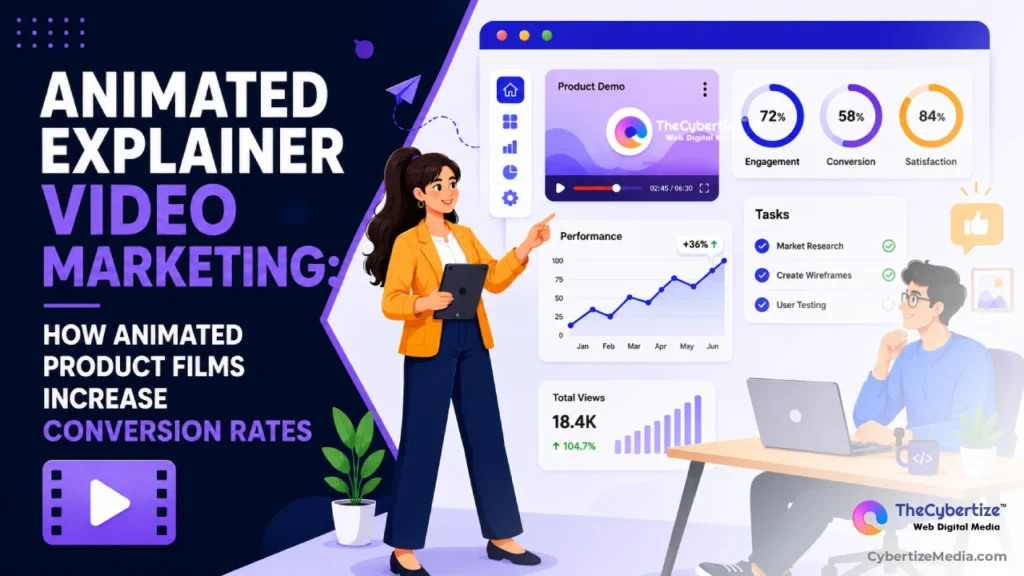
Animated Explainer Video Marketing: There is a specific problem that shows up in brands across SaaS, FMCG, healthcare, fintech, and consumer electronics, and it is always the same problem wearing different clothes.
Sample Explainer Videos:
The product is genuinely good. The team knows it is good. Customers who have used it know it is good. But somewhere between the product and the potential customer who has never heard of it, the explanation breaks down. The website has six paragraphs. The sales deck has fourteen slides. The brand film shows people looking happy. None of it quite answers the question that actually drives the purchase decision: what does this actually do, exactly, and why should I care?
Animation answers that question in a way that no other format can. Not because it is prettier than live-action, though it often is. Because it can show things that cannot be filmed, explain things that cannot be demonstrated, and compress complex cause-and-effect sequences into thirty seconds of clear, visual storytelling.
The conversion data behind this is now substantial enough that animation is no longer an optional creative choice for product-focused brands. It is one of the highest-returning content investments in marketing.
Landing pages with explainer videos convert at 86 percent higher rates. Shoppers who watch a product video are up to 144 percent more likely to add to cart. 85 percent of users are more likely to purchase after viewing an explainer video. And 93 percent of marketers report positive ROI from video marketing, the highest percentage since tracking began.
This guide covers why animated product films drive those numbers, which specific formats produce the best results for different product types, how to build a script and visual structure that actually converts, and what the common mistakes are that turn a potentially high-performing animated film into an expensive piece of content nobody watches.
Animated Product Film Conversion Rate:

Why Animation Converts, The Mechanism, Not Just the Metric
The data is convincing enough on its own. But understanding why animation converts, the specific psychological and informational mechanisms at work, helps you make better decisions about how to build one.
Reason 1: Animation can show the invisible.
Most products do not fully reveal how they work from the outside. A probiotic supplement looks like a capsule. A SaaS platform looks like a dashboard screenshot. An insurance policy looks like a document. None of these visual representations explain why the product matters or what it actually does inside the system it is meant to affect.
Animation has no such limitation. A probiotic supplement can be shown entering the gut, interacting with the microbiome, and visibly changing the environment it enters. A SaaS platform can be shown as a visual system of connected processes rather than a screenshot of a UI. An insurance claim process can be shown as a human journey through a system rather than a legal document.
This ability to visualise the invisible is animation’s most powerful conversion mechanism. When a viewer can see how a product works at the level that matters, not just what it looks like from the outside, they understand the value in a way that changes their relationship to the purchase decision.
Reason 2: Viewers retain 95 percent of information received through video versus 10 percent through text.
This is not specific to animation. It is a fundamental property of how the brain processes information in different formats. The visual-audio combination of video engages more cognitive channels simultaneously than text alone, and multi-channel encoding produces stronger memory traces.
For product marketing specifically, this means a viewer who watches a sixty-second animated product film retains dramatically more information about what the product does than a viewer who reads the same information as text on a product page. The decision to purchase is partly a function of how well the buyer understands the product. Better retention of product information directly correlates with higher purchase confidence.
Reason 3: Animation removes the friction of imagination.
When a buyer reads about a product benefit, they have to construct a mental model of what that benefit looks like in practice. This construction requires effort, and it is also unreliable because the mental model the buyer constructs may be quite different from what the brand intends.
Animation removes that friction by showing the mental model directly. The buyer does not have to imagine the before and after state. They watch it. They do not have to visualise the product working in their context. They see it visualised. The cognitive work of imagining the product’s value is done for them, and the resulting understanding is more accurate and more persuasive than anything a text block can produce.
Reason 4: Animation allows compressed, controlled narrative.
A sixty-second animated film can show a problem, introduce a product, demonstrate its effect, quantify the benefit, and invite a purchase decision in a single, coherent narrative arc. The same information delivered as a website product page would require five separate sections, navigation decisions, and sustained reading attention across two to three minutes.
Animation compresses the conversion funnel into a single viewing experience. The viewer enters the video not knowing the product and exits it understanding the product, believing in it, and having received a clear invitation to act. The optimal length for an explainer video is sixty to ninety seconds. Within that window, the complete conversion story can be told.
The Numbers That Should Change How You Budget for Product Content
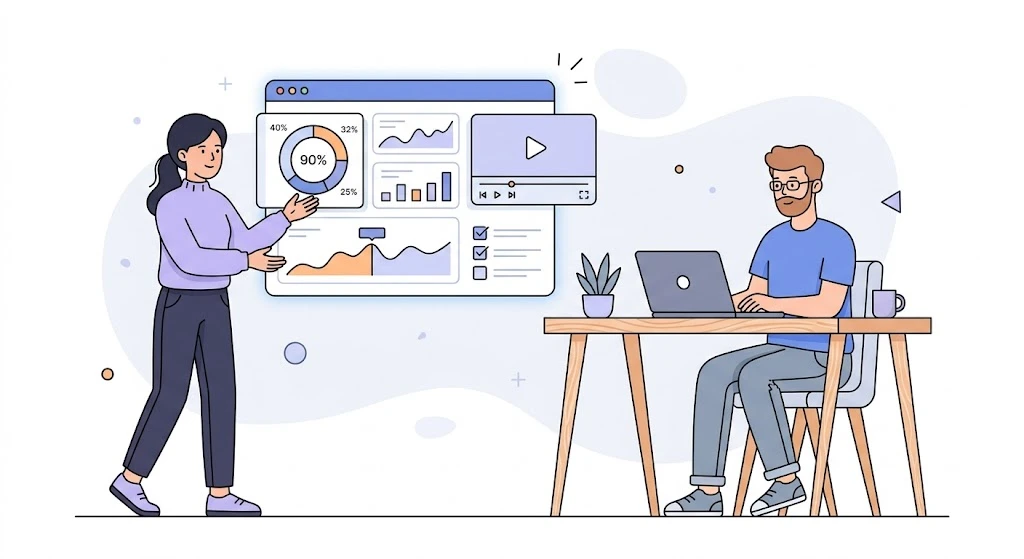
Before getting into the specifics of how animated product films are built and what makes them perform, it is worth sitting with the conversion data properly.
The average conversion rate for websites with video is 4.8 percent compared to 2.9 percent for those without. That is a 65 percent improvement in baseline conversion rate simply from the presence of video on the page.
Video on landing pages increases conversions by 80 percent on average. Explainer videos on product pages boost purchase likelihood by 73 percent. Companies using video in email marketing see 300 percent higher click-through rates.
For animated explainer videos specifically, 82 percent of businesses say their explainer video effectively generates leads. Animated explainer videos outperform live-action for B2B products by 15 percent. Explainer videos are the most popular singular use case for video marketing in 2025, with 73 percent of video marketers having created them.
Adding an explainer video to email newsletters reduces load on support staff by 36 percent. This is a return that most marketing teams do not even think to count: when a product video answers the questions that customers would otherwise email support about, the support cost reduction is a direct financial benefit that compounds over the lifetime of the content.
The ROI timeline for animated explainer and brand video is measurable within three to six months. That is not a long horizon for a content asset that continues performing for two to three years after it is produced.
Businesses using video grow revenue 49 percent faster than those that do not. That statistic covers all video, but the categories where animated explainer video is most commonly used, SaaS, fintech, healthcare, FMCG, and consumer electronics, are also the categories where the ROI has been most thoroughly documented.
Five Categories Where Animated Product Films Work Best
Not every product benefits equally from animation. There are specific categories where the format’s advantages are most pronounced, and understanding these helps brands allocate production budgets with more precision.
- SaaS and Technology Products
This is the category where animation has the highest and most consistent conversion impact. Software products are inherently invisible. The user experience lives on a screen. The value is delivered through a process that happens inside a system the user cannot see directly.
Animation shows that process. It can demonstrate a workflow in thirty seconds that would take a potential user forty-five minutes to discover through a free trial. It can show the before-state (the messy, inefficient, manual process) and the after-state (the automated, organised, fast process) in a narrative sequence that text describing the same transformation cannot replicate.
For SaaS brands, an animated explainer on the homepage or the primary landing page is typically the single highest-ROI content asset in the entire marketing library. The conversion lift from a well-produced animated SaaS explainer routinely justifies its production cost within the first quarter of deployment.
- Healthcare and Pharmaceutical Products
Healthcare products face a specific communication challenge. The mechanism of action, the way the product actually works inside the body or the care system, is both the most important and the most difficult piece of information to communicate. It requires visualising processes that are not visible to the naked eye, in a way that is accurate enough to be credible and clear enough to be understood by a non-specialist audience.
Animation is the only format that does this well. A live-action video of a healthcare product looks like a product sitting on a shelf. An animated film showing how the active ingredient interacts with a cellular receptor, or how a medical device guides a diagnostic process, or how a care pathway connects different service touchpoints, gives the viewer genuine understanding of why the product works.
Medical and technical animation at this level is more expensive than standard motion graphics or 2D character animation. The accuracy requirements are higher and the production process involves subject matter expert review. But the conversion and trust-building impact in a category where purchase decisions require confidence in clinical efficacy is substantial.
- FMCG and Consumer Products With Complex Benefits
Many consumer products claim benefits that are not visible to the buyer at the point of purchase. A supplement claiming gut health benefits. A cleaning product claiming surface-level action at a molecular level. A skincare product claiming cellular renewal. These claims are real but invisible, and the buyer who cannot see or imagine the mechanism is left choosing between a text claim and a competitor’s text claim with no way to evaluate either.
Animation makes the mechanism visible. The supplement’s probiotic strains shown colonising the gut environment. The cleaning agent shown lifting surface contamination at a molecular level. The skincare active shown penetrating the skin layers to the cell level where the renewal happens. Each of these visualisations converts a vague claim into a visible, comprehensible process, and a comprehensible process is a persuasive one.
- Financial Services and Fintech
Financial products are almost universally complex, and complexity is the enemy of conversion. A consumer who does not fully understand a financial product will not buy it. That is not irrationality. It is appropriate caution in a category where misunderstanding has real financial consequences.
Animation compresses complexity into clarity without sacrificing accuracy. A loan product’s eligibility process shown as a visual journey through a system. An investment platform’s return mechanism shown as a visual relationship between time, contribution, and growth. An insurance policy’s coverage logic shown as a series of scenarios with clear outcomes. Each of these animated explanations produces understanding that drives conversion in a way that a terms-and-conditions document, a product brochure, or even a live-action brand film cannot.
In India specifically, financial services brands targeting Tier 2 and Tier 3 consumers face an additional layer of complexity: explaining products that many buyers have never encountered before, in a language and cultural context that a generic brand film often does not address. Regional language animated explainers for fintech and BFSI products are among the highest-converting content formats in this market segment.
- EdTech and Training Products
Education technology products sell the outcome of learning. The problem is that the outcome is not visible until after the purchase has been made and the course has been completed. Animation can show the outcome in advance, compressing the learning journey into a visual narrative that demonstrates the transformation the product delivers.
Beyond consumer-facing marketing, animated training content within corporate learning and development programs is a separately significant category. The completion rates for animated training videos consistently outperform text-based e-learning modules, and information retention from animated video training is measurably higher than from equivalent text content.
Video Marketing Statistics 2026: The Anatomy of an Animated Product Film That Actually Converts
The statistics are clear. The case studies are compelling. But an animated product film that is poorly structured, poorly scripted, or poorly positioned in the conversion funnel will not produce the results the data promises. Here is what a high-converting animated product film actually contains.
The Script: Where Conversion Lives Before the Animation Starts
97 percent of marketers believe an explainer video helps users better understand a product or service. The operative word is “understand.” Understanding is a function of how the information is organised and communicated, not of the visual quality of the animation.
Video Marketing Statistics 2026: A script that buries the core value proposition in the middle of sixty seconds, or that lists product features before establishing why the viewer should care, or that ends without a clear and specific call to action, will not convert regardless of how beautifully it is animated.
The high-converting animated product script follows a reliable structure:
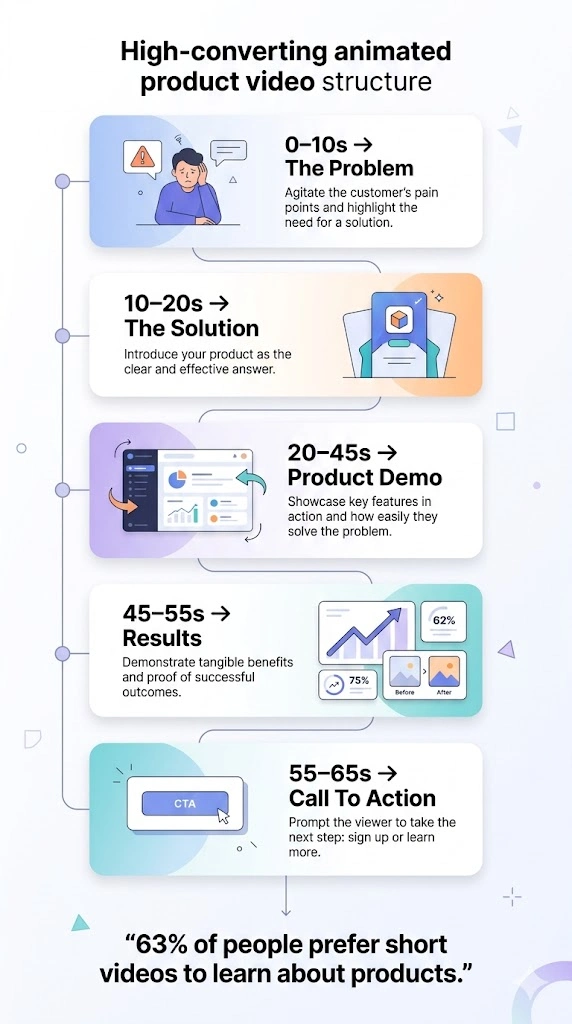
Seconds 0 to 10: Name the problem the viewer recognises from their own experience. Not the product. Not the brand. The problem. If the viewer does not immediately identify with the problem being described, they will not continue watching.
Seconds 10 to 20: Introduce the product as the solution to that specific problem. Not its full feature list. Its single most compelling capability in the context of the problem just described.
Seconds 20 to 45: Show the product working. The animated demonstration of the product in action is the conversion engine. This is where the invisible becomes visible. The mechanism that the viewer could not previously imagine becomes clear.
Seconds 45 to 55: Quantify the outcome. A specific number, a measurable result, a clear before-and-after state. Specificity is credibility. “Reduces processing time by 60 percent” converts better than “dramatically speeds up your workflow.”
Seconds 55 to 65: The call to action. One action. Clear. Low-friction. Specific. “Start your free trial.” “Get a free sample.” “Book a demo.” One action, stated once, with enough context for the viewer to know exactly what happens when they take it.
63 percent of people say they would most like to watch a short video to learn about a product, more than any other format. That preference only produces a conversion if the video is built to convert, not just to inform.
The Visual Style: Match It to the Brand and the Audience
Different animation styles communicate differently to different audiences, and the mismatch between visual style and brand positioning is one of the most common and most costly mistakes in animated product film production.
Animation for D2C Brands: Flat 2D illustration animation is clean, modern, and accessible. It is the dominant style for SaaS and technology brands because it communicates clarity and simplicity, the qualities those brands most want to be associated with. It is also cost-efficient, which makes it practical for brands at most budget levels.
3D product animation is the right choice when the physical form and material construction of the product is itself a conversion argument. A consumer electronics product whose design and build quality is part of its value proposition needs to be shown in three dimensions. A medical device whose precision engineering is the trust-building element needs to be shown with the material accuracy that 3D rendering provides.
Character animation, where the viewer follows a human protagonist through the problem and solution journey, is strongest for products where the emotional experience of the buyer is the conversion story. A consumer wellness product. A lifestyle brand. A parenting or family-adjacent product. The character carries the viewer’s emotional identification and makes the product’s value feel personal rather than functional.
Animation for D2C Brands: Motion graphics, the animation of text, data, shapes, and graphic elements, is strongest for products where data and process are the most credible forms of proof. Financial products, analytics platforms, business intelligence tools, and compliance or regulatory products all benefit from motion graphics that visualise data and process in a way that feels authoritative.
The Length: Shorter Than You Think
Explainer Video Production India: The optimal length for an explainer video is 60 to 90 seconds. Average video length has shrunk from 168 to 76 seconds since 2016 and is expected to reach 39 seconds by 2026. 66 percent of video ads now run under 30 seconds, delivering higher retention and twice the engagement of longer ones.
This does not mean every animated product film should be 30 seconds. It means that every second of a 90-second film needs to be earning its place. The most common mistake in animated product film production is treating length as a budget indicator, assuming longer means more thorough or more professional. The opposite is true. A 90-second film that delivers a complete, clear, emotionally resonant product story is a better film than a three-minute film that says the same things more slowly.
If the product genuinely requires more than 90 seconds to explain, the solution is usually not a longer single film. It is a short primary film (60 to 90 seconds) that drives interest and conversion, supported by longer-form product deep-dives for buyers who have already expressed interest and are in a later stage of consideration.
The Placement: The Right Film in the Right Place at the Right Stage
An animated product film placed on a homepage converts differently from the same film placed on a product detail page, which converts differently from the same film used as a YouTube pre-roll ad, which converts differently from the same film sent in a sales prospecting email.
Each placement serves a different buyer at a different stage of consideration. Placement strategy is as important as production quality in determining whether a film achieves its conversion potential.
Homepage: The awareness and interest stage. The film should establish what the brand does and why it matters in under 60 seconds. The CTA is soft: learn more, explore the product, see how it works.
Product detail page: The consideration stage. The film should show the specific product working in the context of the buyer’s likely use case. The CTA is harder: add to cart, start a free trial, request a sample.
Retargeting ad: The buyer has already visited but has not converted. The film should address the most common objection or unanswered question that prevents conversion. The CTA is specific and time-sensitive: limited offer, guaranteed outcome, risk-free trial.
Sales outreach email: The individual buyer is being approached directly. The film should feel personalised to their category or use case. Including the word “video” in an email subject line increases click-through rates by 65 percent and reduces unsubscribes by 26 percent.
Explainer Video Production India: What Kills the Conversion Rate of an Otherwise Good Animated Film
The data about what animated product films can achieve assumes that the film is built correctly. A film with the wrong structure, the wrong style, or the wrong placement will not produce the results the category data promises.
Here are the specific mistakes that turn a potentially high-performing animated film into a content asset that collects dust.
Starting with the product instead of the problem. The most common script mistake. A viewer who has never heard of your brand has no reason to care about your product in the first ten seconds of a film. They have an immediate reason to care about their own problem. Open with the problem. The product is the resolution of a story the viewer has already joined.
Explaining every feature instead of demonstrating the primary benefit. A forty-five-second feature list is not an animated product film. It is an animated version of a spec sheet, and it performs about as well. Every second spent listing features that the viewer does not yet have a reason to care about is a second not spent showing the product doing the one thing that would make them care. Identify the single most compelling capability. Build the film around demonstrating that capability.
Choosing a visual style that does not match the brand or audience. A fun, character-driven animation style for a B2B compliance software product looks mismatched and undermines the credibility the product is trying to establish. A corporate-feeling flat motion graphics style for a youth-targeting lifestyle brand looks like the brand does not understand its own audience. The visual style is the brand’s first impression before a single word is spoken. Match it to what the buyer expects from a brand they would trust.
A CTA that asks too much. “Buy now” at the end of a sixty-second film shown to a cold audience who has never purchased from the brand is almost always too much commitment. The CTA should be proportionate to the trust level the film has had time to build. “Start free” works. “Get your sample.” “Book a 15-minute demo.” Low-friction, low-commitment, high-clarity. The conversion happens in the next step. The film’s job is to produce the first step.
No captions. Animated product films watched on mobile are frequently watched without sound. Viewers retain 95 percent of a message when watching video with audio and visual together. When the audio is missing because the viewer is watching on mute in a public space, the uncaptioned film communicates only the visual content. A captioned film communicates fully regardless of audio status. Captioning is not accessibility compliance. It is basic conversion hygiene for any film that will be distributed on mobile or social platforms.
Not testing. 73 percent of video marketers have created explainer videos, but far fewer track the performance of specific elements to understand what is and is not working. Which frame is the average drop-off point? What is the completion rate? What is the click-through rate on the CTA? This data is available from every distribution platform and it directly tells you where the film is losing the viewer. A film with a 90 percent completion rate to the final CTA is performing differently from one where 60 percent of viewers drop off at the thirty-second mark. These are different problems with different solutions.
Animated vs Live-Action for Product Films: When to Choose Which
The decision between animated and live-action for a product film is not always obvious, and making the wrong choice for the specific product and audience combination is a meaningful mistake.
Animated explainer videos outperform live-action for B2B products by 15 percent. For products where the mechanism of action, the system or process that makes the product valuable, is the core selling point, animation typically outperforms live-action because it can show the mechanism directly.
Live-action outperforms animation when the product’s physical quality, the material, the texture, the craftsmanship, or the sensory experience, is the primary conversion argument. Food and beverage products, premium consumer goods, lifestyle products, and any product where the viewer’s desire is connected to its physical appearance and the experience of using it benefit from the appetite appeal and tactile communication that live-action provides.
For many products, the answer is both. A hybrid production that opens with animation to explain the mechanism, cuts to live-action to show the product in real-world use, and uses motion graphics for data and outcome visualisation is frequently the highest-performing format for products that need to do multiple things: explain, demonstrate, and create desire simultaneously.
The decision should always come from the brief, not from default preference or cost convenience.
Building for Multiple Platforms From the Same Animation Asset
One of animation’s underutilised advantages over live-action is its platform flexibility. Once the core animation assets are built, adapting the film for different platform specifications, different languages, and different audience segments is significantly cheaper and faster than the equivalent live-action adaptation.
A 90-second animated product film produced for a website homepage can generate:
A 30-second cutdown for YouTube pre-roll. A 15-second vertical version for Instagram Reels and Stories. A 6-second bumper ad for awareness campaigns. A voiceover-swapped version in Hindi, Tamil, Telugu, or any regional language. A version with a different CTA for different stages of the funnel. A version with localised cultural elements for different regional markets.
Each of these adaptations uses the same core animation assets. The incremental cost of producing six platform-specific versions from a single animation project is a fraction of what producing six separate live-action films would cost. For brands producing pan-India campaigns in multiple languages, this cost efficiency is a genuine competitive advantage.
Product Animation Conversion: What to Ask Before Commissioning an Animated Product Film
If you are commissioning an animated product film and have not yet briefed a production company, these are the questions that will produce a better brief and a better film.
What is the single most important thing the viewer should understand after watching? Not the five most important things. The one thing. Every high-converting animated product film has a clear answer to this question and builds the entire sixty to ninety seconds around communicating it.
Who exactly is the viewer and at what stage of the purchase journey will they encounter this film? The film for a cold audience seeing the brand for the first time is a different film from the one for a warm audience who has already read the website and is comparing options.
Explainer Video Production India: Where will this film live? Website, YouTube, Instagram, OTT, sales emails, investor presentations. The placement determines the format requirements, the aspect ratio, the length, the caption requirements, and the CTA.
What is the one action you want the viewer to take immediately after watching? One action. Specific enough that you could describe exactly what happens when they take it.
What visual references represent the tone and quality level you are aiming for? References from any category, not necessarily animated product films, that show the visual territory, the colour palette, the energy level, the pacing, and the overall feeling the film should produce.
Video Marketing Statistics 2026: Final Word from Cybertize Media Productions
An animated product film is not a production decision. It is a conversion decision. The question is not “does our brand need animation?” The question is “where in our customer’s purchase journey is the understanding gap that prevents conversion, and is animation the most effective way to close it?”
For a significant number of products, in a significant number of categories, the answer is yes. The data behind that answer is now comprehensive enough that it is not a debate. The brands not producing animated product films in 2026 are leaving a measurable conversion improvement on the table.
The brands that produce those films and see the results the data predicts are the ones that start with a clear brief about what the film needs to achieve, rather than a clear brief about what the film should look like. Looking good is a by-product of clarity about purpose. Conversion is the purpose.
At Cybertize Media Productions Private Limited, animated product films are produced from the conversion brief backwards: what needs to happen in the viewer’s mind, in what sequence, and by what point in the film for the CTA to earn its ask. The script, the visual style, the pacing, the platform adaptations, and the CTA are all determined by that sequence.
If you are building a product film that needs to do more than look good, that conversation starts with what you need it to do.
Cybertize Media Productions Private Limited is a full-service ad film and corporate video production company working with brands across India.