Table of Contents
When a number like 73% shows up in a market report, the instinct is to nod at it and move on. But if you run a business in India right now and that number is about video production budgets, it deserves more than a nod. It deserves a proper conversation.
Because that figure is not just a trend. It is a signal that the way Indian brands communicate, compete, and close customers has permanently shifted.
At Cybertize Media Productions, we work with brands across categories every single day, whether it is an FMCG brand trying to crack Tier-2 audiences or a B2B company that has realised its LinkedIn feed looks like it was built in 2018. What we see on the ground lines up exactly with what the data is saying. Indian businesses are not just experimenting with video anymore. They are betting on it.
Here is what is actually happening, why it is happening now, and what the smarter brands are doing about it.
The Numbers First: 73% of Indian Brands Increased Video Production Budgets in 2026, Where India Stands in 2026
Let us start with some grounding.
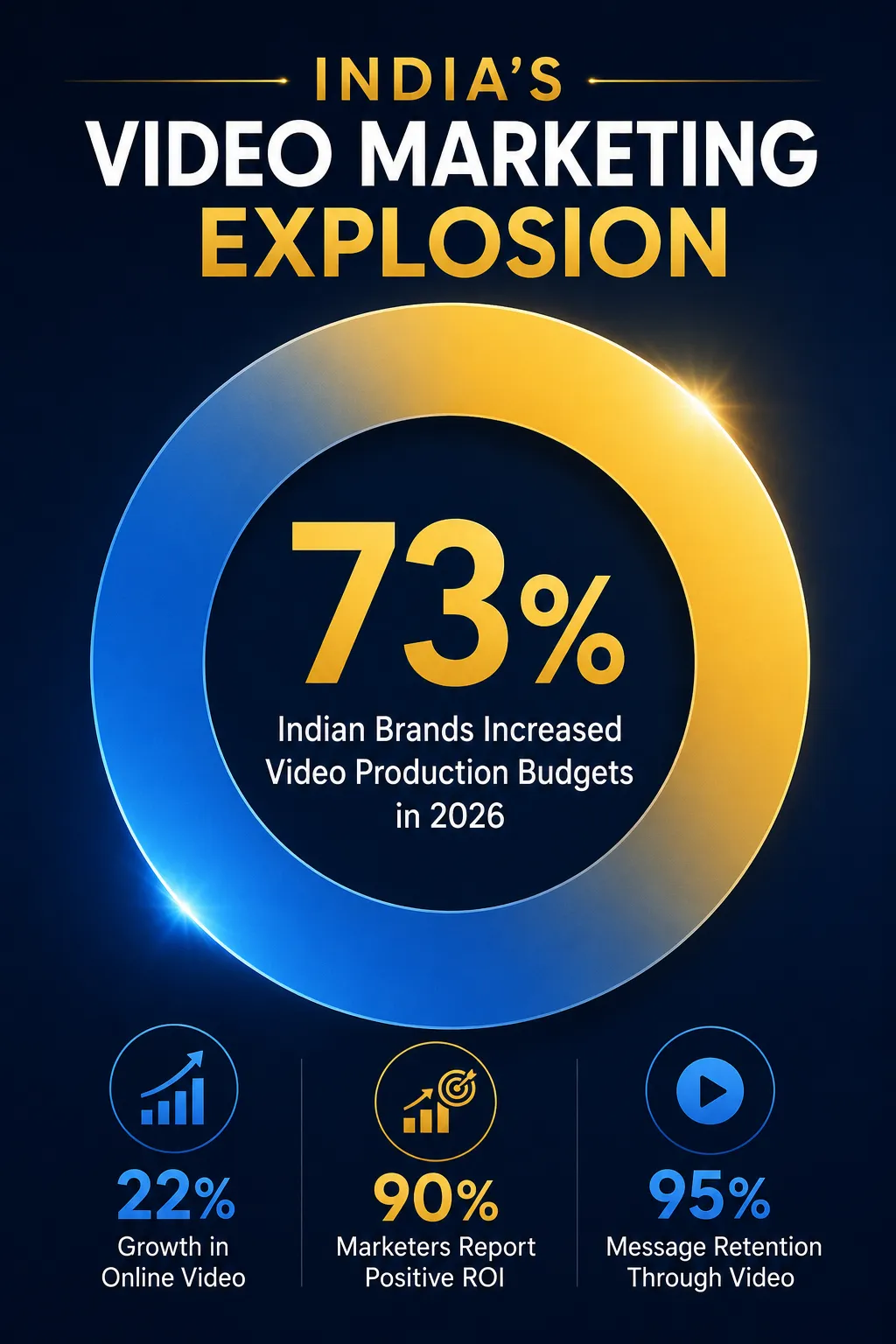
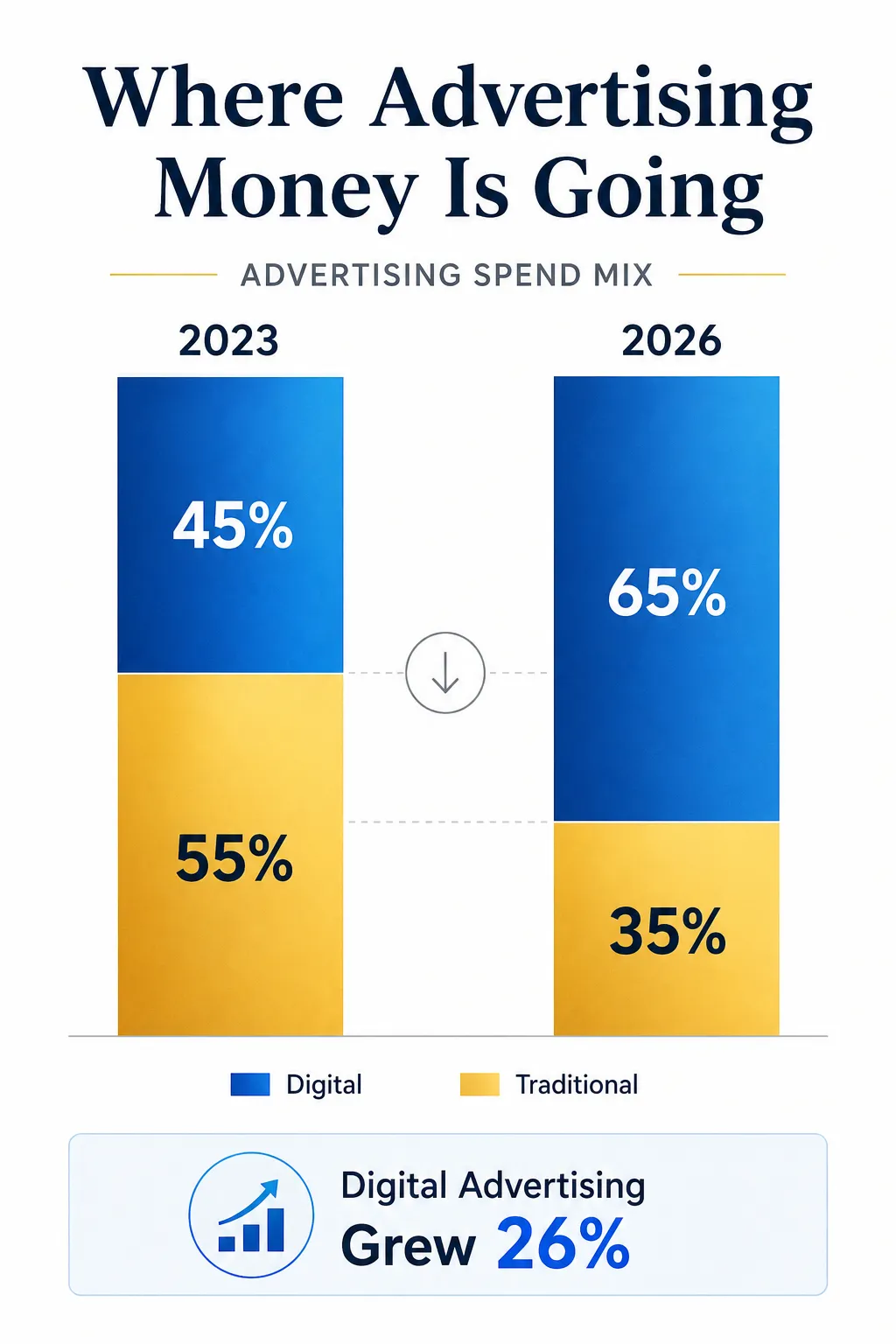
India’s media and entertainment sector reached Rs. 2,78,500 crore (roughly USD 30 billion) in 2025, growing 9.1% year on year according to the FICCI-EY Report released in March 2026. Within that, digital advertising recorded a 26% jump to Rs. 947 billion, now accounting for nearly two-thirds of total advertising rupees spent in the country. Online video alone grew 22% in the same period.
That is not a blip. That is a structural shift in how India allocates its marketing money.
The India video production market is projected to reach USD 71,313.5 million by 2030, growing at a compound annual rate of 45.4% from 2024 onwards according to Grand View Research. India is not just consuming video. It is producing it at scale, commercially and with intent.
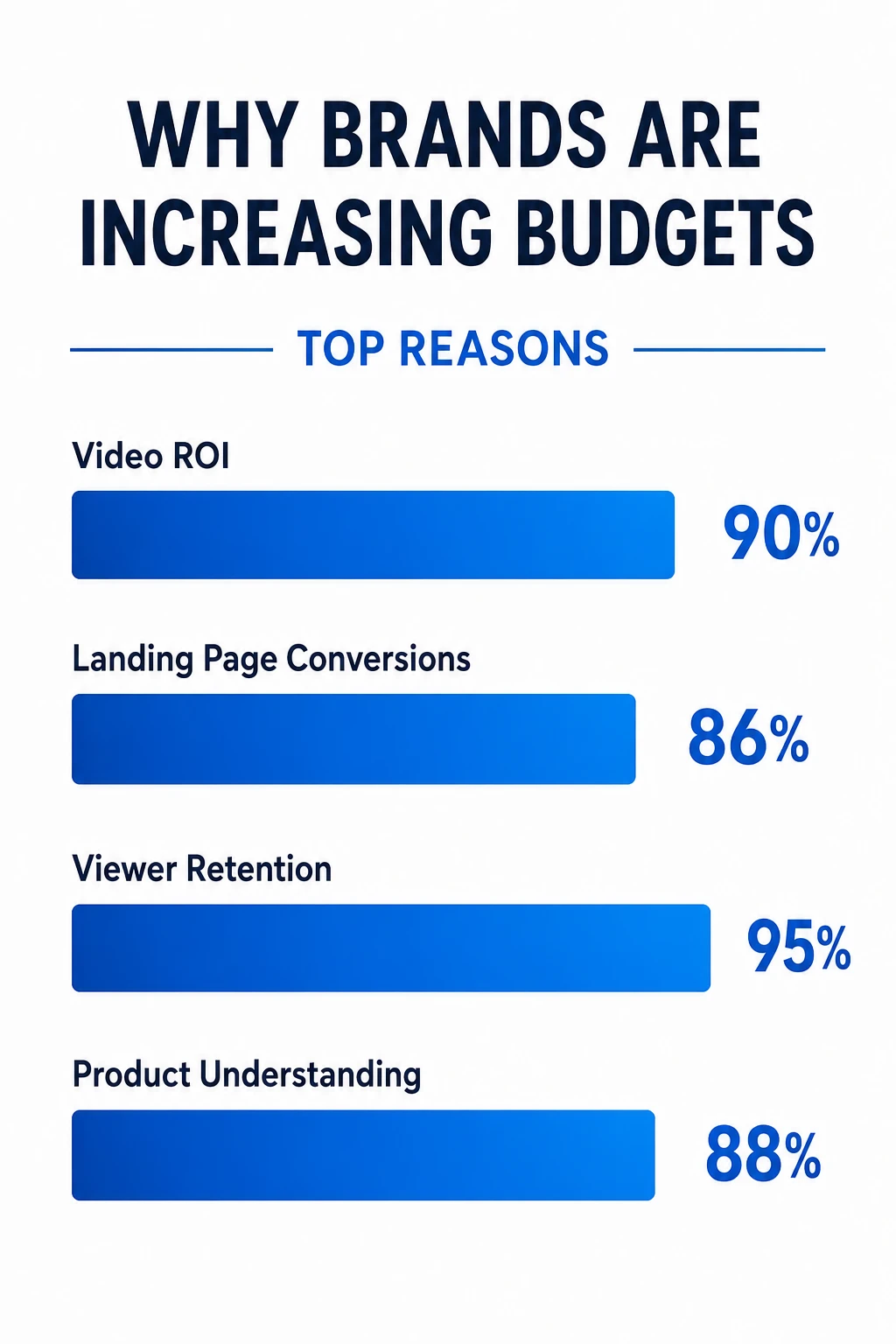
And the brands investing in video are not doing it on faith. Globally, 90% of marketers report that video delivers a positive ROI according to Wyzowl’s 2026 survey. Video on landing pages increases conversions by 86%. A message delivered through video is retained by 95% of viewers versus 10% through plain text.
The math is not complicated. The brands that understood this first are now widening the gap.
Why 2026 Is Different From the Previous Three Years
You could argue that people have been saying “video is the future” since 2018. You would be right. So why is 2026 actually different?
Three things converged at the same time.
The platform shift became undeniable. Instagram Reels now account for more than half of all content consumed on the platform. Video time spent on Instagram has increased more than 30% year on year as of Q3 2025 according to Sprout Social’s Content Strategy Report. YouTube Shorts crossed a billion monthly active users. These are not niche formats anymore. They are where Indian consumers spend their days.
The cost of not investing became visible. Meta CPMs in India rose roughly 40 to 60% between 2023 and 2025 according to upGrowth’s D2C Performance Marketing Playbook. D2C customer acquisition costs moved from around Rs. 800 to Rs. 1,200 per customer in 2023 to Rs. 1,800 to Rs. 2,500 in 2025. Brands still relying only on static performance ads are paying significantly more for significantly less. The brands that built genuine video-led creative equity are holding their CAC steady while others panic over auction costs.
Vernacular video opened a market that static content could never reach. Over 73% of Indian internet subscribers now consume content in regional languages according to India Digital Advertising data, representing an estimated 540 million users. A banner ad in English does not speak to someone in Lucknow or Madurai the way a 45-second video in their own language does. Brands that figured this out first are building real audience relationships, not just reach.
What Indian Brands Are Actually Spending On
The budget increase is not random. When we look at where production money is going, there are clear patterns.
Brand films and corporate storytelling. The 60 to 90 second brand film is having a genuine comeback, not as a TVC substitute but as a standalone digital asset. Production budgets for mid-range films in India currently range from Rs. 75,000 to Rs. 2.5 lakh, and high-end brand films for established companies routinely cross Rs. 5 lakh to Rs. 15 lakh depending on cast, location, and post-production requirements.
Short-form content at volume. Marketers rank short-form video as the number one ROI format for the third consecutive year in 2026, and 57% of marketing budgets now include a dedicated short-form line item globally. Indian brands are catching up fast. The challenge is not making one great Reel. It is building a pipeline that produces consistently.
Explainer and product demo videos. 88% of video marketers say video has helped increase user understanding of their product or service. For categories like fintech, healthtech, and B2B software, where the product is complex and the sales cycle is long, a well-made explainer video does the work of five sales calls.
Event and behind-the-scenes content. Authenticity has become a real metric. Brands are investing in shoot-day coverage, founder interviews, and process documentation because consumers and B2B buyers both respond better to real than to polished. This is one of the highest ROI categories for any brand with any kind of production budget.
The 600 Million Short-Form Video Viewers Problem (and Opportunity)
By 2025, India crossed 600 to 650 million short-form video consumers, with active users spending 55 to 60 minutes per day on short-form platforms.
Think about that for a moment.
More than half a billion people in India now have a daily video habit that is almost an hour long. That is not a content format. That is a behaviour. It is where attention lives now.
For brands, this creates an obvious opportunity and a less obvious problem. The opportunity is access to enormous attention at relatively low CPM compared to traditional media. The problem is that 600 million viewers have also developed sharp taste. They skip bad content instantly. They can tell when a brand has put thought into something and when it has just pressed record on a phone and added a logo.
The brands winning in this environment are not necessarily the ones with the biggest budgets. They are the ones with the clearest brief and the most disciplined production process. A Rs. 2 lakh video with a strong concept outperforms a Rs. 10 lakh video with a weak script almost every single time.
Animation and VFX: The Quiet Budget Winner
One area where Indian brand budgets are growing fast and getting less attention than it deserves is animation and VFX.
India’s animation and VFX sector is projected to grow from USD 1.3 billion in 2023 to USD 2.2 billion by 2026, increasing its share of the media and entertainment industry from 5% to 6% according to a CII-GT report. Brands are a significant part of that growth.
Why? Because animation removes barriers. You do not need a shoot location. You do not need to manage talent and logistics. You can visualise a product that does not physically exist yet. You can tell a story that would require a feature film budget to produce in live action but costs a fraction of that in 2D or 3D animation.
For D2C brands, fintech companies, and healthcare brands that cannot show certain things on camera, animation has become genuinely important, not just nice to have.
What the Brands That Are NOT Investing Are Missing
There is always a counternarrative worth addressing.
Some brands have not increased video budgets because they genuinely cannot afford to. That is a real constraint and there are smart ways to do more with less that good production partners can help with.
But some brands have not invested because they are still waiting to see if video “works.” That question has been answered. The data has answered it many times over. What those brands are experiencing right now is competitors pulling ahead in brand recall, platform algorithm preference, and consumer trust, all of which take time to rebuild once you have fallen behind.
The 5% of companies that plan to cut video budgets in 2025 and 2026 are making a bet that their category is uniquely immune to the consumer behaviour shifts that have reshaped every other category. That is almost never a safe bet.
Also Read: How to Submit an Ad Film to Broadcast TV in India
How to Think About Video Production Investment in 2026
If you are a brand trying to figure out where to start or how to scale, here is a practical way to frame it.
Tier 1: Content volume at low cost. Short-form vertical videos, product clips, quick testimonials. These can be produced at Rs. 15,000 to Rs. 50,000 per video and should be your highest frequency output. Volume and consistency matter more than production value here.
Tier 2: Brand and category communication. Mid-length films, explainers, founder stories, and campaign hero videos. Budget range: Rs. 75,000 to Rs. 3 lakh depending on production requirements. These live longer and work harder across multiple platforms and touchpoints.
Tier 3: Flagship brand content. High production brand films, cinematic ad films, broadcast-quality TVCs or digital equivalents. These are planned six to eight weeks in advance, involve proper pre-production, and budgets typically start at Rs. 5 lakh and scale up based on scale and ambition.
Most brands that are winning have content running across all three tiers simultaneously. The mistake is treating these tiers as exclusive choices rather than a layered strategy.
The Role of Regional and Vernacular Content
This is where a lot of national brands are leaving serious money on the table.
India’s digital ad market crossed Rs. 59,200 crore in 2025 and is projected to reach Rs. 70,000 crore in 2026. A significant portion of that growth is coming from Tier-2 and Tier-3 cities, and from regional language audiences who are consuming video at rates that match or exceed metro consumers.
A Hindi video does not serve Tamil Nadu. An English corporate film does not connect in Patna. Brands that are serious about India are building multilingual video libraries, not just dubbing their English content but genuinely creating for regional audiences with context, references, and cultural nuance that resonates.
This is more expensive upfront. It is significantly cheaper than watching a regional competitor own your audience in markets you ignored.
What Good Production Partners Do Differently
One reason brands sometimes hesitate to increase video budgets is past experiences where they spent a lot and got average results. That is a production partner problem, not a video problem.
A good production partner does not just show up on shoot day. They come in during the brief stage and ask questions that shape the entire project. What is this video for? Where will it live? What action do you want people to take after watching it? What does success look like six months from now?
At Cybertize Media Productions, every project starts with a strategy conversation, not a quotation. The quotation follows the strategy because what you produce should follow from what you need, not the other way around.
The difference between a video that drives real business results and one that looks great on a showreel is almost always decided before the camera turns on.
Also Read: Why Founder-Led Ads Are Dominating Modern Branding | Research by Cybertize Media
What 2026 Looks Like From Where We Stand
India’s digital ad market is expected to grow to INR 3.3 trillion by 2028 according to the FICCI-EY report, with digital media and filmed entertainment among the primary drivers. The trajectory is not uncertain. The question is only which brands are positioned to capture that growth and which ones are still figuring out their Instagram strategy.
The 73% of brands that increased video budgets this year are not all making perfect content. Some of them are still learning. But they are in the market, building muscle, accumulating data, and getting better with every production cycle.
The gap between brands that invest in video seriously and those that treat it as a line item to be trimmed when things get tight is going to be very visible by the time 2028 arrives.
The time to be on the right side of that gap is now.
Cybertize Media Productions Private Limited is a video and ad film production company working with brands across India. We produce brand films, corporate videos, ad films, animations, and digital-first content built for performance.