
Table of Contents
Let’s Be Honest About Where Film Production Stands Right Now
AI tool breakdown for video & film production: If you’ve been in this industry for more than three years, you already know something fundamental has shifted. It’s not just the tools, it’s the pace. What used to take a small team of editors, colorists, VFX artists, and sound designers three weeks to pull together can now, in the right hands, be done in days.
We’re not saying AI has replaced any of those roles. It hasn’t. But it has fundamentally changed what those roles look like day-to-day.
At Cybertize Media Productions Private Limited, we work with clients across brand films, commercials, corporate content, and narrative projects. We’ve tested these tools. We’ve argued about them internally. We’ve watched some of them genuinely transform how we approach pre-production, and we’ve also watched a few overhyped ones fall flat in actual production environments.
This breakdown series is us being real with you. No fluff, no affiliate angles. Just an honest, category-by-category look at what’s worth your time, your money, and your creative trust in 2026.
AI tool breakdown for video & film production: The Numbers You Should Know First
Before we dive into the tools, let’s get grounded in the reality of where this industry sits today.
The global AI video tools market hit $4.2 billion in 2025 and is projected to reach $12.8 billion by 2027 (MarketsandMarkets). That’s not venture capital speculation — that’s real money from real production workflows. The AI video generator segment specifically reached $716 million in 2025 and is on track for $3.35 billion by 2034 at an 18.8% CAGR (Fortune Business Insights).
More telling for working filmmakers: production costs have dropped approximately 97% from 2020 to Q1 2026. A project that would have cost $1,500 to freelance out can now be rendered for under $15 on the right platform. That’s not small. That’s the kind of shift that forces the entire industry to recalibrate what “professional” means.
And the adoption numbers are real. 74% of marketers are now using at least one AI tool in their workflow, up from just 35% the year before. 75% of video marketers are using AI production tools in some capacity. Among content creators specifically, AI tool adoption grew 342% year-over-year through 2025.
Meanwhile, 44% of film productions now use AI for script breakdowns and character analysis. 90% of online video is expected to involve some form of AI assistance by 2030. And critically, 73% of viewers in blind tests could not distinguish high-quality AI-assisted content from traditionally produced video.
That last number should matter to everyone reading this. We’re past the uncanny valley for a large chunk of production needs.
Part 1: Pre-Production, Where AI Is Actually Saving Weeks
Scriptwriting & Development
The romantic notion of a writer staring at a blank page has become the exception, not the rule. AI scriptwriting tools aren’t replacing writers, they’re acting as development partners who never get tired.
ChatGPT-4o and Claude 3.5 have become the go-to first-draft machines for many production companies. You feed them your brief, your tone reference, your client’s brand voice, and in minutes you have a scaffold to work from. The key word is “scaffold.” These tools are excellent at structure, scene breakdown, and dialogue drafts. They’re less reliable for nuanced character motivation and cultural specificity, and that’s where your human writers still earn every rupee.
For those in advertising and brand content, Jasper AI has carved out a serious niche in script adaptation, particularly for regional language variants. If you’re producing content for five Indian markets simultaneously, Jasper can help parallelize your script localization in ways that would otherwise require five separate writers and three weeks of coordination.
AI-powered script breakdowns are now used in 44% of film productions globally. Tools like StudioBinder AI and Celtx’s AI layer can extract scene requirements, cast, locations, props, time of day, and automatically generate a breakdown report. What used to take a first AD an entire day takes these tools about twelve minutes.
Cybertize’s take: We use AI script tools for first-pass ideation and structural reviews on commercial projects. For narrative work and brand films with a strong POV, we still lead with human writers who use AI to pressure-test their ideas, not generate them.
Storyboarding & Visual Development
Midjourney V7 and Adobe Firefly have changed the storyboarding conversation completely. A director who used to need a skilled storyboard artist, and two to three days of revision cycles, can now generate reference frames in a morning.
The quality is genuinely cinematic now. Midjourney V7 handles lighting, depth, and compositional intent in ways that give a DP real reference material. More importantly, it lets directors communicate visual language to clients at the pitch stage without committing to expensive pre-production work.
DALL-E 3 (via ChatGPT) is more accessible but less cinematically precise. It’s excellent for quick ideation but tends to produce images that look more like illustrations than production references.
For production design and art direction references, Stable Diffusion with ControlNet remains the most technically capable option — because it lets you maintain compositional control while iterating on visual style. The learning curve is steeper, but the control payoff is significant.
AI-powered mood boards and color palette generators like Khroma are worth knowing too. Feed it a brand identity, and it will suggest color relationships that a human colorist would be proud of.
Location Scouting & Planning
This is an underrated application. Tools like Google Lens integration in production planning workflows, combined with AI-powered drone path planning software, are reducing location scouting time dramatically.
ScoutMaps and setlocations.com’s AI features use machine learning to match location requirements from your script breakdown against a database of available, pre-cleared locations. For Tier-2 and Tier-3 city productions in India, where location documentation and permissions can be nightmarish, this kind of pre-screening is genuinely valuable.
Part 2: Production, The AI Tools That Are Actually on Set
AI-Assisted Cameras and Monitoring
ARRI, Sony, and RED have all been integrating AI into their camera ecosystems. Sony’s VENICE 2 with AI face-tracking autofocus is so reliable that it’s genuinely changed how some documentary and run-and-gun productions operate. The camera tracks a moving subject through crowds with a consistency that would have required an experienced focus puller five years ago.
Blackmagic’s AI noise reduction built into their newer camera systems means you can push ISO higher on location without the post-production tax of dealing with grain removal later.
For monitoring, SmallHD’s AI-assisted histogram and focus tools are part of professional on-set workflows now. These aren’t gimmicks, they’re genuinely useful on tight turnaround productions where you don’t have time to discover focus problems in the edit bay.
AI-Assisted Directing Tools
Gemini Omni has emerged as what many are calling the best filmmaking tool for multi-shot generation, it handles automatic scene-to-shot breakdowns in ways that help directors visualize coverage before stepping on set.
For virtual production and previs, Unreal Engine 5 with MetaHuman Creator has changed the game for productions that can’t afford to go on location for every shot. The AI-driven real-time rendering inside UE5 means previs quality that would have been impossible without a large dedicated VFX team is now accessible to mid-size productions.
Part 3: Post-Production, This Is Where AI Has Changed Everything
This is honestly where the bulk of the revolution is happening. Post is where time compresses most dramatically with AI assistance, and where the quality uplift is most measurable.
Video Editing
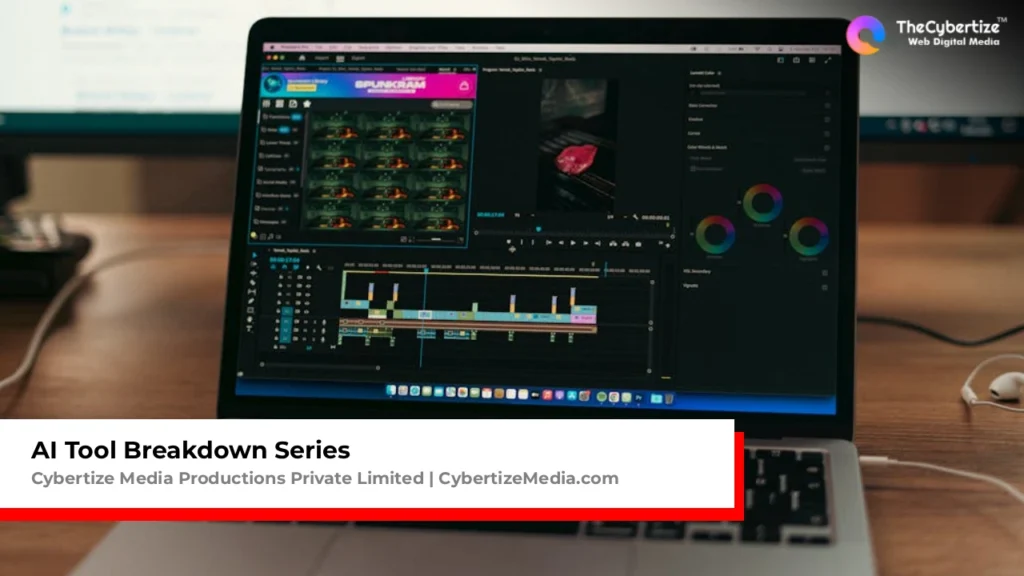
Adobe Premiere Pro (Generative Extend version, 2026) is the gold standard for AI-integrated editing in professional production. The January 2026 update added one-click AI Object Masks that track subjects through entire scenes, something that previously required intensive manual masking work.
The text-based editing feature in Premiere is worth highlighting specifically: it transcribes your footage, then lets you edit by deleting words in the transcript. The timeline updates accordingly. For interview-heavy corporate content and documentary work, this is a genuine time revolution.
DaVinci Resolve 19.5 (free version is still remarkable, Studio at $295 one-time) introduced AI IntelliScript, which builds timelines from a written script. Think about what that means for a corporate video: you script it, you shoot to script, you drop it into IntelliScript, and it assembles a rough cut in minutes. It’s not perfect. But it’s a rough cut in minutes, not hours.
Descript is the editorial AI tool that gets talked about less than it should. It handles transcription-based editing with AI-driven filler word removal, eye contact correction (it literally adjusts where a speaker is looking on camera), and studio sound processing. For interview content and talking-head productions, it’s borderline magical.
The broader picture: AI saves approximately 34% of time spent in editing workflows, and creators using AI-assisted tools are producing 5-10x more content volume than their non-AI counterparts.
Color Grading
DaVinci Resolve’s Magic Mask is one of the most underrated AI tools in professional post-production. It intelligently isolates subjects, skies, and specific tonal regions without manual rotoscoping, and does it with enough accuracy that many colorists use it as a first pass before cleaning up edges.
Colourlab AI deserves its own moment here. It analyzes your footage and suggests grade starting points based on cinematographic style references you feed it. You can tell it “grade this to match Roger Deakins on Blade Runner 2049” and while it won’t replicate Deakins exactly, it gives you a starting point that a skilled colorist can actually work with.
Topaz Video AI is worth knowing for upscaling and restoration. If you’re working with archival footage or need to upscale web-resolution footage for broadcast delivery, Topaz’s AI upscaling produces results that traditional interpolation can’t touch.
VFX and Compositing
Runway Gen-4.5 is where the conversation gets genuinely exciting for VFX work. It handles inpainting and object removal at a level where removing a boom mic shadow or a visible wire rig that slipped through on set can be done in minutes rather than hours in After Effects.
Gen-3 Ultra’s video generation has crossed a threshold where short clips integrate with live-action footage in ways that don’t immediately read as AI-generated. That’s a threshold that matters enormously for indie productions that need impossible shots on possible budgets.
Adobe After Effects’ AI-assisted Roto Brush has been overhauled in the 2025-2026 version. It now tracks complex hair, motion blur, and semi-transparent subjects with significantly fewer manual corrections frame-by-frame. For indie filmmakers who previously dreaded any shot requiring rotoscoping, this is a legitimate quality-of-life upgrade.
Google Veo 3.1 and Runway Gen-4.5 lead on cinematic AI video generation for VFX work. Veo 3.1 generates 60-second clips, Runway produces 16-second clips but with strong camera motion control.
Kling 3.0 has emerged as what many pros describe as a “stable, controllable, production-ready cinematic generator.” For productions that need consistent visual language across generated shots, Kling’s controllability sets it apart.
Professional tiers for these generative tools typically run $30 to $150 per month, providing access to higher resolutions, commercial usage rights, and priority GPU queuing.
One critical note on copyright: If you’re doing commercial work, Adobe Firefly is the safest generative AI choice, it’s trained exclusively on licensed content, which means your commercial deliverables won’t carry copyright risk. Always review terms of service for the specific subscription tier before using AI-generated content in client deliverables.
Audio Post-Production
This category gets underreported in most AI-in-film conversations, and it shouldn’t.
Adobe Podcast’s AI audio enhancement (now integrated into the broader Adobe Creative Cloud workflow) cleans up room tone, reduces noise, and EQs dialogue with a quality that would have required hours of manual processing. For interview content especially, it’s transformative.
ElevenLabs for AI voice generation is genuinely impressive for narration work. If you have an approved script and a tight turnaround, ElevenLabs can produce narration that many audiences can’t distinguish from a human voice actor. It’s not right for every project, there are emotional registers it still doesn’t nail, but for corporate and explainer content, it’s changed the economics of revision cycles.
Descript’s Studio Sound feature and Auphonic for automated audio leveling and loudness normalization are post-production tools that have simply become part of professional workflows at this point.
Automated AI captioning cuts 77% of captioning costs compared to human-generated captions, and caption accuracy on major platforms is now in the 95%+ range for standard Indian English accents.
Music & Sound Design
Suno and Udio are the current leaders in AI music generation. For productions that need custom beds and transitions without the licensing overhead of stock music, these tools produce surprisingly textured, non-generic output.
Soundraw is particularly useful because it generates music with stems, giving editors the ability to control individual instruments and adapt music to picture with real editorial flexibility.
Adobe Firefly’s upcoming audio features and Stability AI’s audio generation tools are worth watching. The space is moving quickly.
Part 4: Distribution & Analytics
Post-production used to be where the film production conversation ended. Not anymore.
Synthesia and HeyGen are transforming how productions deliver content at scale, particularly for corporate video work where the same piece needs to exist in eight language versions. AI dubbing and lip-sync tools mean a production doesn’t end at delivery; it multiplies.
AI-powered subtitle translation tools like Papercup and Deepdub handle broadcast-quality dubbing with AI voice matching. AI-powered dynamic subtitling can reduce localization costs by 70% compared to traditional workflows.
For analytics, Wistia’s AI video intelligence, Vidyard’s engagement analytics, and YouTube’s AI-powered content performance insights give production companies real data on what’s working. If you’re producing content for clients and not looking at AI-driven analytics to inform the next brief, you’re leaving competitive intelligence on the table.
Part 5: The Workflow Reality, How This Actually Fits Together
Here’s what no one tells you in the tool reviews: the magic isn’t in any individual tool. It’s in how they connect.
At Cybertize Media, a mid-size brand film production in 2026 might move through AI touchpoints at every stage: AI-assisted script development → Midjourney storyboards → AI location shortlisting → Premiere’s text-based rough cut → DaVinci Resolve Magic Mask for color → Runway for a VFX shot that wasn’t achievable on location → ElevenLabs for a quick narration revision → Papercup for regional language versions.
That’s not replacing the creative team. That’s compressing the production timeline from eight weeks to four, and giving the creative team more time to focus on the parts that actually require human judgment: the story, the performances, the strategic decisions.
AI streamlines editing workflows by 34%. That number sounds modest until you realize it compounds across every department, every project, every month.
The Honest Limitations You Need to Know
We’d be doing you a disservice if we didn’t say this clearly:
Character consistency is still genuinely hard. AI video generation tools struggle to keep a character looking the same across multiple shots. For narrative work, anything that requires a recurring face or a consistent visual world, generative AI is still a support tool, not a primary tool.
Complex emotional performance is beyond the current state. AI can generate a face. It cannot yet generate the specific way a performance lands. That remains human territory.
Copyright and IP is a genuine legal risk area. Be careful about which tools you’re using for commercial deliverables, and always read the terms. 72% of consumers are concerned about AI-generated deepfake content in entertainment, and regulatory frameworks are evolving quickly.
The skills gap is real. The top adoption barrier for AI tools is not cost, it’s in-house skills, cited by 43% of marketers (Wyzowl). Knowing the tools exist and knowing how to integrate them into a professional workflow are two very different things.
Looking at 2026 and Beyond
90% of online video is projected to involve some form of AI assistance by 2030. The AI video tools market will reach $14.8 billion by 2030. Employment in AI-driven editing, scriptwriting, and content strategy roles is projected to grow 40-60% by 2030.
The productions that thrive will not be the ones who adopt AI fastest, or the ones who resist it longest. They’ll be the ones who figure out how to use AI to amplify their creative judgment rather than substitute for it.
That’s the orientation we operate with at Cybertize Media Productions, and it’s the lens through which every tool in this breakdown should be evaluated.
Final Thought
The film and video production industry is not being replaced by AI. It’s being expanded by it, in terms of what’s possible, what’s affordable, and what a lean team of talented, creative people can produce.
At Cybertize Media Productions Private Limited, we believe the best productions of the next decade will be made by people who know these tools deeply and know, equally well, when to put them down and trust their instincts.
That knowledge lives in the work. Which is exactly where it always has.
Cybertize Media Productions Private Limited, We create film and video content that means something.