Table of Contents
UGC Videos vs Brand Videos: Every marketing manager has faced this question at least once this year. You have a content budget, a product to sell, and two very different schools of thought pulling at you from opposite ends.
On one side, you have someone saying UGC is the future. Real people, real reactions, trust that money cannot manufacture. On the other side, someone is reminding you that your brand cannot look like it was shot on a kitchen counter if you want to be taken seriously at scale.
Both of them are right. And both of them are missing half the picture.
This guide is not going to tell you that one format beats the other in every situation. That would be dishonest. What it will do is give you a clear, data-backed look at when each format wins, what the numbers actually say in 2026, and how to build a video strategy that uses both in the right proportion.
What We Are Actually Comparing
Before anything else, let us make sure we are talking about the same things.
UGC videos (User-Generated Content) are videos created by real people, whether organic customers filming their own experience with your product, or paid UGC creators who make authentic-looking content on behalf of a brand. The defining characteristic is that UGC looks and feels like content made by a peer, not a company.
Brand videos are professionally produced, brand-controlled video assets. This category covers everything from cinematic ad films to corporate brand films, product explainers, testimonial series, and broadcast-quality commercials. The brand controls every frame, every word, and every second.
The difference is not really about who holds the camera. It is about who the viewer believes is speaking and whether that person sounds like a real human being or a marketing department.
The Market in 2026: What the Data Says
Let us ground this conversation in real numbers before we get into opinions.
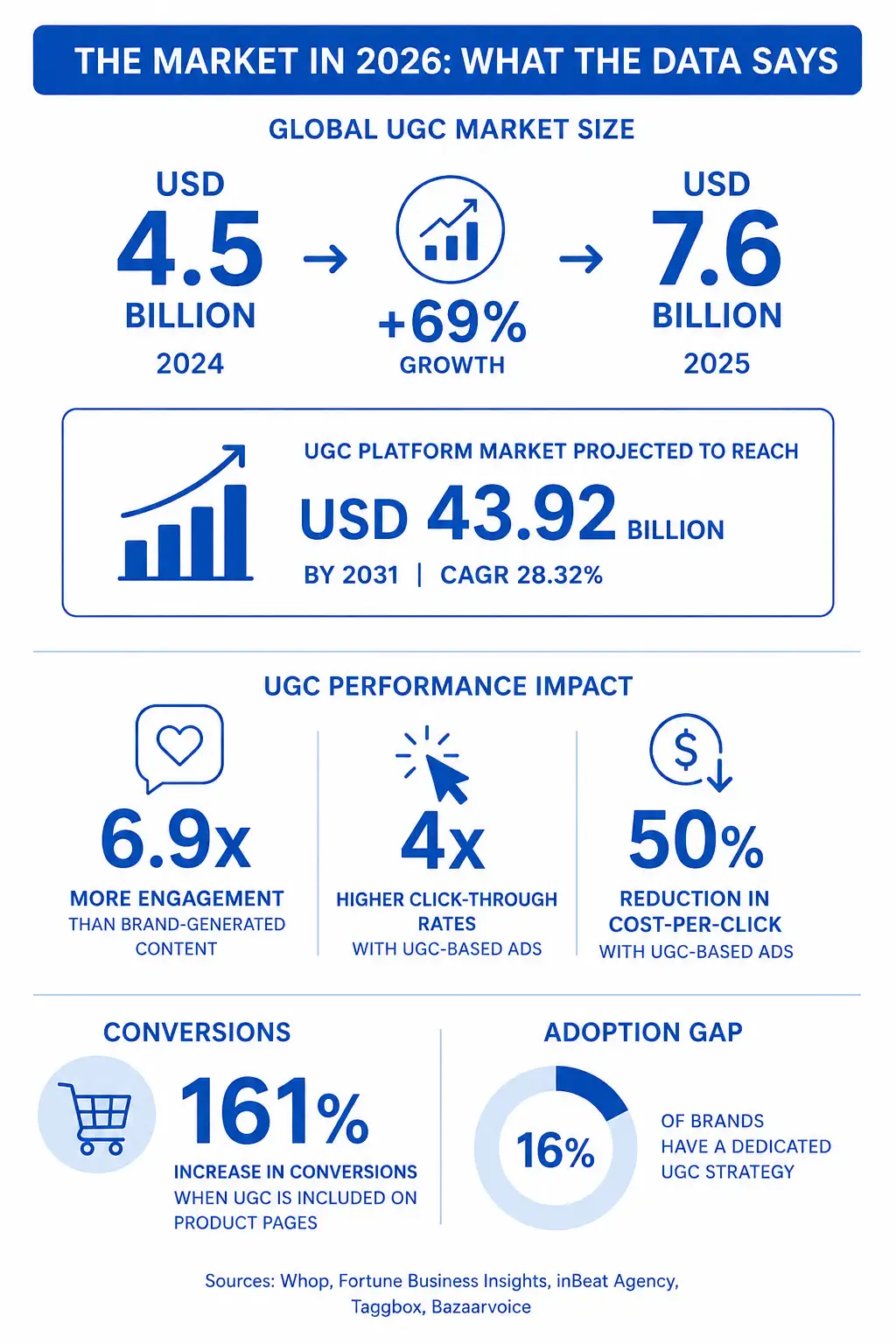
According to data from Whop and Fortune Business Insights, the global UGC market was valued at over USD 7.6 billion in 2025, up 69% from USD 4.5 billion in 2024. The UGC platform market is projected to reach USD 43.92 billion by 2031, growing at a CAGR of 28.32%.
Meanwhile, according to research compiled by inBeat Agency and Taggbox, UGC generates 6.9 times more engagement than brand-generated content on social media. UGC-based ads achieve 4 times higher click-through rates and a 50% reduction in cost-per-click compared to traditional branded ads.
But here is the number that should make every e-commerce brand stop scrolling: according to multiple research sources including Bazaarvoice and inBeat, UGC increases conversions by 161% when included on product pages.
That is not a rounding error. That is a structural advantage.
And yet, according to the same research landscape, only 16% of brands currently have a dedicated UGC strategy. The gap between what the data recommends and what most businesses are doing is enormous.
Also Read: How to Pitch Your Film and Web Series to OTT Platforms
UGC Videos vs Influencer Videos
These two formats get confused constantly, and they are not the same thing.
An influencer video is content posted by someone with a large, established audience. You are paying for their reach. Their followers trust them, and some of that trust rubs off on your product. The relationship between audience and influencer is what you are really buying.
A UGC video is content made by a creator specifically for your brand to use in your own paid ads, your website, your emails, and your social channels. The creator may have zero followers. Their audience size is irrelevant. What matters is the quality and authenticity of the content they produce.
The performance difference is significant. According to data from Billo, UGC is 46% to 71% cheaper than equivalent influencer content. Research from inBeat Agency found that UGC ads are remembered 50% more often than influencer-driven ads, and generate 4 times more clicks than influencer campaigns.
The reason for this is not complicated. Influencer content has an endorsement feel that audiences have learned to recognise. UGC feels like something a friend sent you. That difference in perception translates directly into conversion rates.
For most brands, the right model is not choosing between the two. Use influencers to build awareness and reach. Use UGC to carry the conversion. They work in sequence, not competition.
UGC Content vs Professional Production
Let us talk about money, because that is usually where this debate gets real.
UGC Videos vs Brand Videos: A professional marketing video in India from a mid-level production company can range from Rs. 50,000 for a basic product video to Rs. 10 lakh or more for a well-produced brand film. International data from Billo puts professional video ad production in the range of USD 1,200 to USD 50,000 depending on scale.
A UGC video costs somewhere between Rs. 3,000 and Rs. 15,000 on average. On international platforms, the median cost for a 15 to 60-second vertical UGC video sits around USD 150.
So the cost difference is not marginal. It is structural. And when you pair that cost advantage with the performance data, the ROI math starts looking very different.
According to research from multiple sources, brands save up to 70% on content creation costs by incorporating UGC. For every Rs. 1 spent on a leading UGC platform like Bazaarvoice, brands reportedly received Rs. 4 back, representing a 400% ROI.
But here is what the raw cost comparison misses: professional production gives you something UGC cannot easily replicate. Control. Consistency. Brand architecture. The ability to tell a long-form story with craft. These are not trivial.
A Rs. 10 lakh brand film done well can anchor a brand’s identity for three to five years. It defines your visual language, your tone, and your positioning in a way that a 45-second UGC clip from a creator simply cannot. The question is not which one is worth more per rupee spent. It is about what job each piece of content needs to do.
Creator-Led Content vs Brand-Led Content
This is the philosophical core of the whole debate.
Creator-led content gives the human behind the camera some creative latitude. They talk about your product in their own words. They show it in contexts that feel natural to them. Audiences respond to this because it feels uncontrived. According to Nielsen’s Global Trust in Advertising report, 92% of consumers trust earned media including word-of-mouth and peer recommendations above all other forms of advertising.
Brand-led content is the opposite: every word, every angle, every colour choice is a deliberate brand decision. You know exactly what message is being sent, who is saying it, and how.
The performance gap on social media is stark. According to Taggbox research, UGC is 5 times more likely to create a conversion compared to professionally produced content in social environments. On Instagram, posts with UGC generate approximately 70% more engagement than traditional brand posts. On TikTok, UGC content is 22% more effective than brand-created videos.
At the same time, brand-led content holds a clear edge in premium categories. If you are selling high-value products or services where production quality is a signal of product quality, a poorly lit UGC testimonial can actually damage trust rather than build it. A brand film that looks expensive tells your audience you are a serious company worth taking seriously.
The rule of thumb that holds up in practice: creator-led content wins at the top of funnel where authenticity drives discovery. Brand-led content wins at the bottom of funnel and in retargeting, where credibility and controlled messaging close the deal.
Micro-Influencers vs UGC Creators
This comparison matters because brands often conflate these two when planning campaigns.
A micro-influencer typically has between 10,000 and 100,000 followers and earns the bulk of their value from audience trust built over time on a specific niche. You pay them to post to their audience.
Also Read: How to Pitch Your Film and Web Series to OTT Platforms
A UGC creator is not selling you their audience. They are selling you a piece of content. The average UGC creator has around 10,500 Instagram followers, according to Billo’s research. Their follower count is irrelevant to their value. Their ability to produce authentic, on-brand video content is everything.
The practical implication: if you need reach and discovery, micro-influencers are your investment. If you need high-performing creative assets for your own paid ad campaigns, product pages, and emails, UGC creators are significantly more cost-efficient.
Micro-influencer campaigns in India typically cost between Rs. 5,000 and Rs. 50,000 per post depending on niche and audience. A UGC creator for the same product might charge Rs. 3,000 to Rs. 12,000 for a video you own outright and can use across every channel indefinitely.
For most mid-size Indian brands, a combination works best: a handful of micro-influencer partnerships for reach, with a steady supply of UGC creative feeding your paid ads.
UGC Ads vs Studio Ads
Let us get specific about paid performance, because this is where the data is most decisive.
According to research from inBeat Agency and OfferPop (now Wyng), campaigns using UGC creative report 50% lower cost per click compared to professionally produced studio assets. UGC ads achieve 4 times higher click-through rates than standard ads.
On TikTok specifically, UGC-style videos generate 28% more interactions compared to branded videos, and UGC video ads show 35% higher watch-through rates compared to polished brand ads.
The reason studio ads underperform in social environments is not that they look bad. It is that they look like ads. Consumers have trained themselves to scroll past content that feels like a commercial. UGC blends into the feed. It does not trigger the mental skip reflex.
Studio ads still have clear advantages. They work better in retargeting because by the time a user has already interacted with your brand, they are ready for a more polished, direct brand message. They work better for premium brand positioning. And they work better in environments outside social, such as connected TV, YouTube pre-rolls, and broadcast.
The strategic answer for most brands in 2026 is running both in parallel. UGC handles cold audience acquisition on Meta and TikTok. Studio creative handles retargeting, brand building, and premium channel placements.
Can UGC Replace Traditional Video Production?
Short answer: no. And anyone who tells you otherwise is either selling you UGC services or has not thought it through.
Here is the honest case for each.
UGC can replace traditional production for certain specific jobs. Social media content for awareness. Product page content for e-commerce conversion. Paid ads targeting cold audiences on short-form video platforms. Email campaign creative. These are all situations where UGC consistently outperforms studio production and does it at a fraction of the cost.
What UGC cannot replace:
A brand film that tells your company’s story with craft and cinematic intent. A corporate video for investor presentations or board-level communications. A broadcast TVC where production quality is a direct signal of legitimacy. An ad film produced for a product launch that needs to make a cultural statement. Content for luxury or premium categories where the quality of production is inseparable from the quality perception of the product.
These formats require the deliberate artistry of a professional production team. They require a director who understands visual storytelling, a DP who understands light, an editor who understands pace. That expertise cannot be replicated by a creator with a ring light and a phone.
The more accurate question is not whether UGC can replace professional production, but how much of your video content budget should go to each. According to research from Marketing LTB, campaigns achieve 28% higher engagement when incorporating a strategic mix of UGC alongside official brand content compared to brand-only approaches. That number points directly to a hybrid model.
UGC Videos vs Testimonial Videos
These look similar but they are built differently and serve different purposes.
A testimonial video is a professionally produced piece where a satisfied customer speaks about your brand on camera, usually in a controlled setting with lighting, a backdrop, and a script or guided talking points. You produce it. You control it.
A UGC testimonial is the same idea executed in the creator’s own environment, in their own words, with their own shooting style. It is unscripted in feel even if you have given them a brief.
Testimonial videos work better in professional B2B contexts, on websites, in sales presentations, and in situations where the production environment signals credibility. A corporate software buyer watching a case study video needs to see professional standards.
UGC-style testimonials work better in social environments, D2C e-commerce, consumer products, and anywhere the target buyer is a regular person making a personal purchase decision. The raw, authentic feel creates parasocial trust that a polished testimonial cannot.
Data from Taggbox shows that product review UGC videos on YouTube receive 3 times longer watch time than traditional ads. The attention difference alone justifies building a library of authentic UGC testimonials for consumer brands.
The practical recommendation: use produced testimonials for your website, LinkedIn, and B2B channels. Use UGC testimonials to fuel your Meta, Instagram, and TikTok paid ads.
Also Read: 73% of Indian Brands Increased Video Production Budgets in 2026
Employee-Generated Content vs UGC Content
This comparison does not come up enough, and it should.
UGC Videos vs Brand Videos: Employee-generated content (EGC) is exactly what it sounds like: content created by the people inside your company. Behind-the-scenes footage. Process videos. Day-in-the-life content. Expert commentary from your team members. Cultural snapshots from your workplace.
According to research cited in Marketing LTB’s UGC statistics, brand messages are reshared up to 24 times more when distributed by employees compared to the brand’s own account. That is not a marginal difference. That is a structural advantage built on the same trust principle that makes UGC effective: people believe people.
EGC tends to work particularly well for:
Service-based businesses where trust in the people behind the brand is central to the purchase decision. B2B companies where decision-makers want to see the expertise of the team they would be working with. Employer branding where the goal is talent acquisition rather than customer acquisition. Brand transparency in industries where customers want to know the story behind the product.
UGC from customers, on the other hand, works better for product validation, social proof, and conversion at the bottom of the funnel. When a stranger says “this worked for me,” it carries weight that an employee’s opinion never quite matches for that specific purpose.
The combination of both is underutilised and powerful. EGC builds category authority and human connection to the brand. Customer UGC provides the social proof that converts lookers into buyers.
The Hybrid Strategy: What Actually Works in 2026
The brands winning the video content game in 2026 are not choosing one format. They are building systems.
Here is how a smart hybrid model works in practice:
At the top of the funnel, UGC-style creative runs on Meta and TikTok targeting cold audiences. The content looks native to the platform. It does not look like an ad. It generates engagement and awareness at a fraction of the cost of studio production.
In the middle of the funnel, a combination of brand content and social proof content does the work of credibility. Your brand film lives here. Your case study videos live here. Your micro-influencer collabs live here.
At the bottom of the funnel, retargeting ads use a mix of polished brand creative and high-performing UGC. The audience already knows who you are, so the polished brand content lands better here than it does at the top.
On your website, UGC testimonials and product videos sit on product pages alongside your professional brand photography. That combination, according to Marketing LTB data, produces 28% higher engagement than either format alone.
Also Read: Ad Film Production Cost in Mumbai
In your email campaigns, UGC snippets and customer photos push click-through rates up by as much as 73%, according to research from Extole.
Where Cybertize Media Productions Fits In
At Cybertize Media Productions Private Limited, we sit at an interesting crossroads in this conversation. We are a production company. We produce professional brand films, corporate videos, ad films, and creative content that carries a brand’s identity at the highest level.
But we also understand that the most effective marketing ecosystems in 2026 are not monolithic. They are layered. The brands that win are the ones who invest in professional production for the content that needs craft, and invest in UGC systems for the content that needs authenticity and volume.
Our job, as a production partner, is to help you figure out which is which. And then to produce the professional layer at a standard that makes your entire content ecosystem more credible, because the brand film you produce raises the perceived quality of everything associated with your brand, including the UGC that sits alongside it.
When a viewer sees your polished brand film and then encounters a customer’s authentic UGC review, both pieces of content benefit from the contrast. The brand film gives you authority. The UGC gives you trust. Together, they give you sales.
Cybertize Media Productions Private Limited is a full-service video production company based in India, working with brands and businesses across ad films, corporate videos, brand storytelling, and content strategy. We help brands figure out what their video mix should look like and then produce the professional layer at the standard it deserves.