

Table of Contents
Sit through ten corporate films back to back and you will notice something strange. They all start to sound the same. A drone shot of the office building. A line about “innovation” and “trust.” A CEO speaking slowly into a camera about the company’s “journey.” Then a closing shot of employees smiling at their laptops.
None of it is wrong exactly. It is just forgettable, and forgettable is the most expensive thing a corporate film can be. A brand can spend anywhere from Rs 1 lakh to Rs 5 lakh on a flagship profile film in India, sometimes far more, and still produce something that a viewer cannot recall a single detail of an hour later. We see this pattern constantly at Cybertize Media Productions when brands come to us after an earlier film underperformed, and it is rarely a budget or equipment issue. It is a storytelling one.
The Data Says Video Works. So Why Doesn’t the Film?
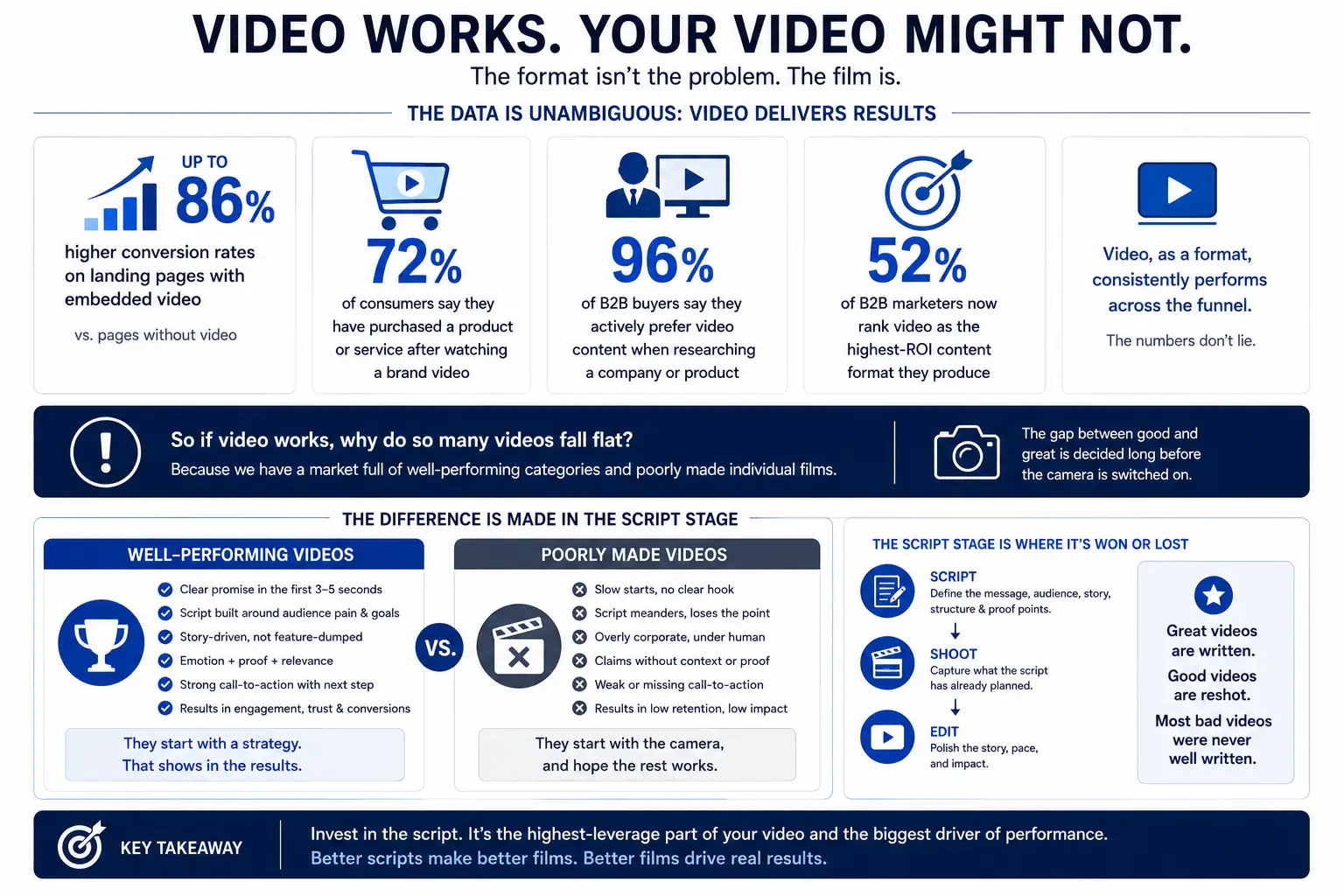
This is the part that confuses most marketing teams. Video, as a format, performs. Landing pages with embedded video see conversion rates up to 86 percent higher than pages without one, and 72 percent of consumers say they have purchased a product or service after watching a brand video. Ninety six percent of B2B buyers say they actively prefer video content when researching a company or product, and 52 percent of B2B marketers now rank video as the highest-ROI content format they produce.
So the format is not the problem. The specific film is. A well-performing category full of poorly made individual films is exactly what corporate video looks like right now, and the gap between the two is almost entirely about what happens in the script stage, long before a camera is switched on.
Reason 1: The Film Is Written for the Boardroom, Not the Viewer
Most corporate films go through five or six rounds of internal approval before a single frame is shot. Every department wants a mention. Legal wants a disclaimer softened. Leadership wants a specific phrase from the mission statement included somewhere. By the time the script survives that process, it has been sanded down into something that offends no one and interests no one either.
The result is a film built to satisfy an internal committee rather than hold the attention of an external viewer, and those are two completely different jobs. A viewer does not care about the org chart. They care about a specific problem being solved in a specific way, told through a specific person or moment. Committee-approved language almost never survives with that specificity intact.
Reason 2: It Opens With the Company, Not With a Reason to Care
The average corporate film opens with the company. A logo animation, a wide shot of the building, a voiceover that begins with “Founded in…” That is precisely the information a viewer cares about least in the first ten seconds, and attention data backs this up starkly. Videos under 60 seconds achieve an engagement rate of roughly 50 percent, while videos running longer than an hour drop to around 17 percent, and the steepest attention loss in almost every video format happens in the opening moments, not the middle.
If the first line of a corporate film is about the company rather than a problem, a stake, or a question the viewer actually wants answered, the film has already lost a large share of its audience before it says anything worth remembering.
Reason 3: Everyone Sounds Like a Brochure, Not a Person
Watch enough corporate testimonials and a pattern appears. Every speaker uses the same handful of phrases. “Seamless experience.” “Trusted partner.” “Best-in-class solution.” These phrases exist because they are safe, not because anyone actually talks that way, and viewers can tell the difference instantly, even if they cannot articulate why a testimonial feels hollow.
The films that do get remembered almost always include one specific, slightly imperfect human detail, a hesitation, a real number, a genuine complaint that got solved, a moment that was not scripted. That single unscripted beat usually does more for credibility than the entire polished section around it, because it is the one part of the film an audience believes was not written by a committee.
Reason 4: There Is No Actual Story, Just a Sequence of Facts
A corporate film is not automatically a story just because it has a beginning, middle, and end. Most corporate films are a sequence of facts: founded in this year, operates in these markets, serves these clients, believes in these values. That is information, not narrative, and information without tension or stakes rarely holds attention the way an actual story does.
A story needs a problem worth solving and a reason the outcome mattered. “We serve 40 cities” is a fact. “A hospital in a town with no cold chain infrastructure could not store vaccines until this system was built” is a story. The second version is not more expensive to film. It is simply a different, more deliberate choice at the script stage.
Reason 5: It Tries to Speak to Everyone and Ends Up Speaking to No One
Many corporate films are asked to do an impossible job: impress investors, reassure existing clients, attract new talent, and win over prospective customers, all inside the same three minutes. Trying to satisfy every audience at once usually means the film says something broad enough to apply to all of them and specific enough to genuinely resonate with none of them.
Personalisation data makes the cost of this clear. Seventy four percent of consumers say they want personalised video content from brands rather than generic messaging, and personalised video consistently sees higher completion rates than generic content aimed at everyone at once. A film built for one clear audience with one clear message almost always outperforms a film trying to be everything to everyone.
Reason 6: The Craft Is Polished but the Message Is Empty
This is the trap that catches brands with the biggest budgets. A film can have excellent lighting, a confident voiceover, drone shots, and clean motion graphics, and still say nothing memorable, because polish and substance are not the same thing. High production value can actually make a hollow message more noticeable, not less, because there is nothing distracting the viewer from realising there was never a real point being made.
The films people actually remember are rarely the most expensive ones. They are the ones where a real decision was made about what the film is actually trying to say, and every other choice, visuals, music, pacing, was built to support that one idea rather than to look impressive on its own.
What Actually Makes a Corporate Film Memorable
The fix is rarely a bigger budget. It is a narrower, more honest brief. A memorable corporate film usually does four things a forgettable one does not: it picks one specific audience and one specific message instead of trying to cover everyone, it opens with a problem or a question rather than a company introduction, it includes at least one real, unscripted human moment instead of only rehearsed lines, and it treats the script stage as seriously as the production stage, rather than rushing through it to get to the shoot.
None of that requires a bigger crew or a longer shoot day. It requires a script that survives contact with a real, external viewer, not just an internal approval chain.
Frequently Asked Questions
Why do most corporate films feel so similar to each other?
Corporate films go through heavy internal approval processes where every department adds a request, which sands the script down into safe, generic language. Since most companies follow the same approval pattern, the resulting films end up sounding remarkably alike.
Does a bigger budget guarantee a more memorable corporate film?
No. High production value without a clear, specific message often makes the emptiness more noticeable, not less. The films that get remembered are usually built around one sharp idea, regardless of budget tier.
What is the biggest storytelling mistake corporate films make?
Opening with the company instead of a reason to care. Viewers lose attention fastest in the opening seconds, so leading with “Founded in…” rather than a real problem or stake usually loses a large share of the audience immediately.
Should a corporate film try to speak to investors, customers, and talent all at once?
It is possible, but it usually weakens the message for all three audiences. Personalised, audience-specific video consistently gets higher completion rates than generic content built to appeal to everyone at once.
How long should a corporate film be to hold attention?
Data shows a clear pattern: videos under 60 seconds see roughly 50 percent engagement, while much longer formats see engagement drop sharply. Shorter, sharper films built around one idea generally outperform long, comprehensive ones.
Why do corporate testimonials often feel fake even when the person is real?
Because they are usually scripted using safe, brochure-style language like “seamless experience” or “trusted partner” instead of how the person actually speaks. A single unscripted, specific detail usually does more for credibility than a fully polished, rehearsed answer.
Is a story-driven corporate film more expensive to produce than a standard one?
Not necessarily. The difference is usually in the script stage, choosing a specific narrative over a list of company facts, rather than in crew size, equipment, or shoot days.
How much does a good corporate film typically cost in India?
Flagship corporate brand films in India generally range from Rs 1 lakh to Rs 5 lakh, while simpler explainer or testimonial formats can start closer to Rs 50,000. Premium, multi-location brand films can go well beyond Rs 10 lakh, depending on scale.
Does video actually drive business results, or is it mainly for brand image?
Video drives measurable results. Landing pages with video see conversion increases of up to 86 percent, and 72 percent of consumers report purchasing after watching a brand video, so a well-made corporate film has a direct commercial case, not just a branding one.
What is the single biggest fix for a boring corporate film script?
Narrowing the brief. Pick one audience and one message instead of trying to cover every department’s request, and open with a real problem instead of a company introduction. That one change fixes more corporate films than any production upgrade.
Cybertize Media Productions Private Limited is a full-service ad film and video production company helping Indian brands turn corporate video briefs into films people actually remember.