
Table of Contents
You Know the Video. You Have Seen It a Thousand Times.
The establishing shot of the office building. The aerial drone footage. The CEO behind a desk, reading slightly too carefully from somewhere just off-camera. A montage of employees who look like they were chosen from a stock photo service. A voiceover that uses the word “solutions” fourteen times without once explaining what any of those solutions actually do.
Then the tagline. Then the logo. Then nothing, because the viewer clicked away after forty seconds and nobody watched it except the marketing team that commissioned it and the production company that delivered it.
Corporate Storytelling: This video exists in some form on the website of almost every mid-size to large company in India right now. It may have cost ₹5 lakh or ₹25 lakh to produce. It probably took six weeks and four rounds of revisions. It is technically competent, visually inoffensive, and utterly forgettable.
That is what is dead. Not corporate video as a medium. Not the idea of a company telling its story on camera. The specific format that has passed for corporate storytelling for the last twenty years: polished, safe, information-dense, emotionally empty, and built to satisfy internal approval processes rather than to move an actual human being watching it.
The format is failing. The need it was meant to serve is not.
What the Numbers Actually Say About Attention in 2026
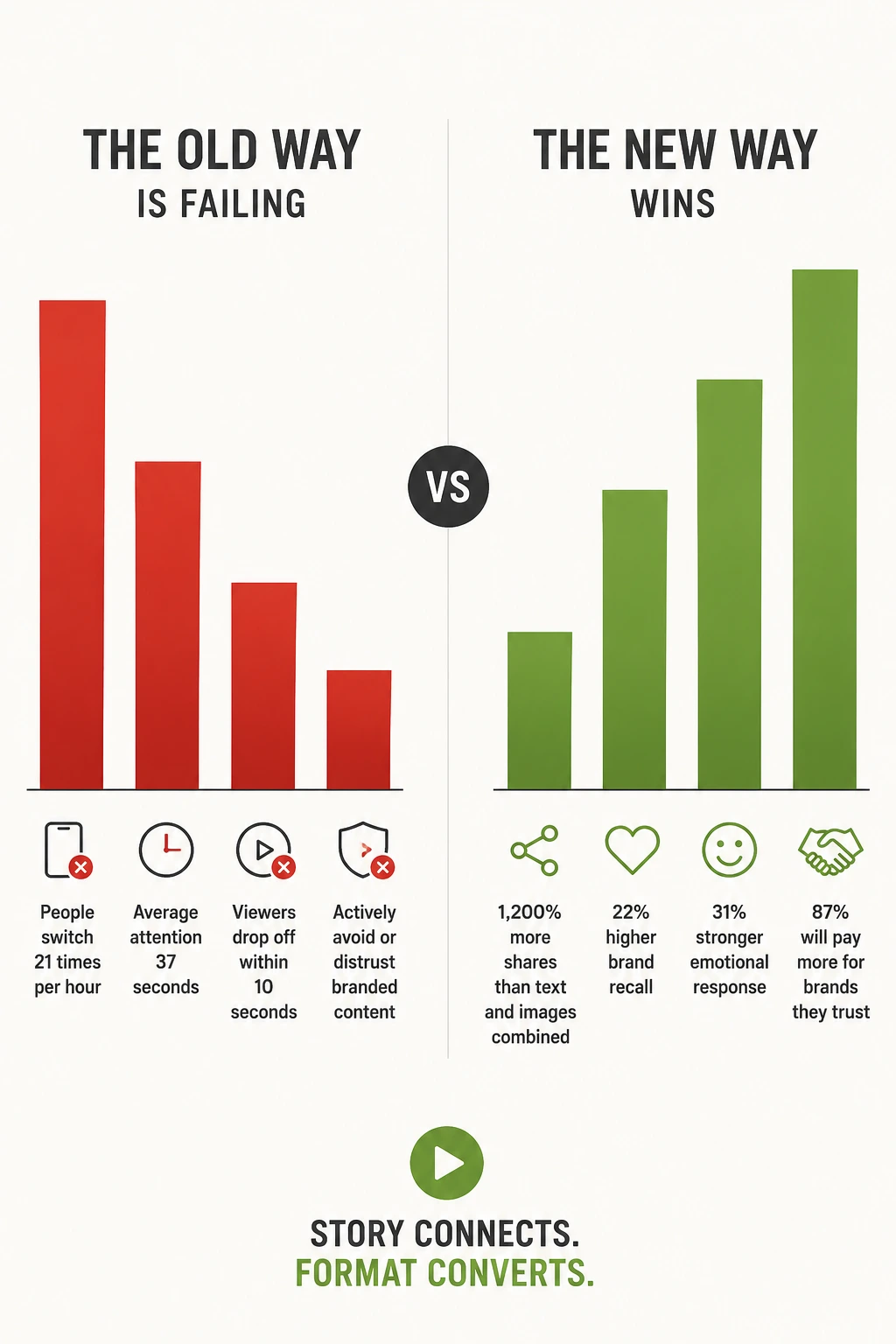
The attention crisis in content is real and the corporate video format was not built for it.
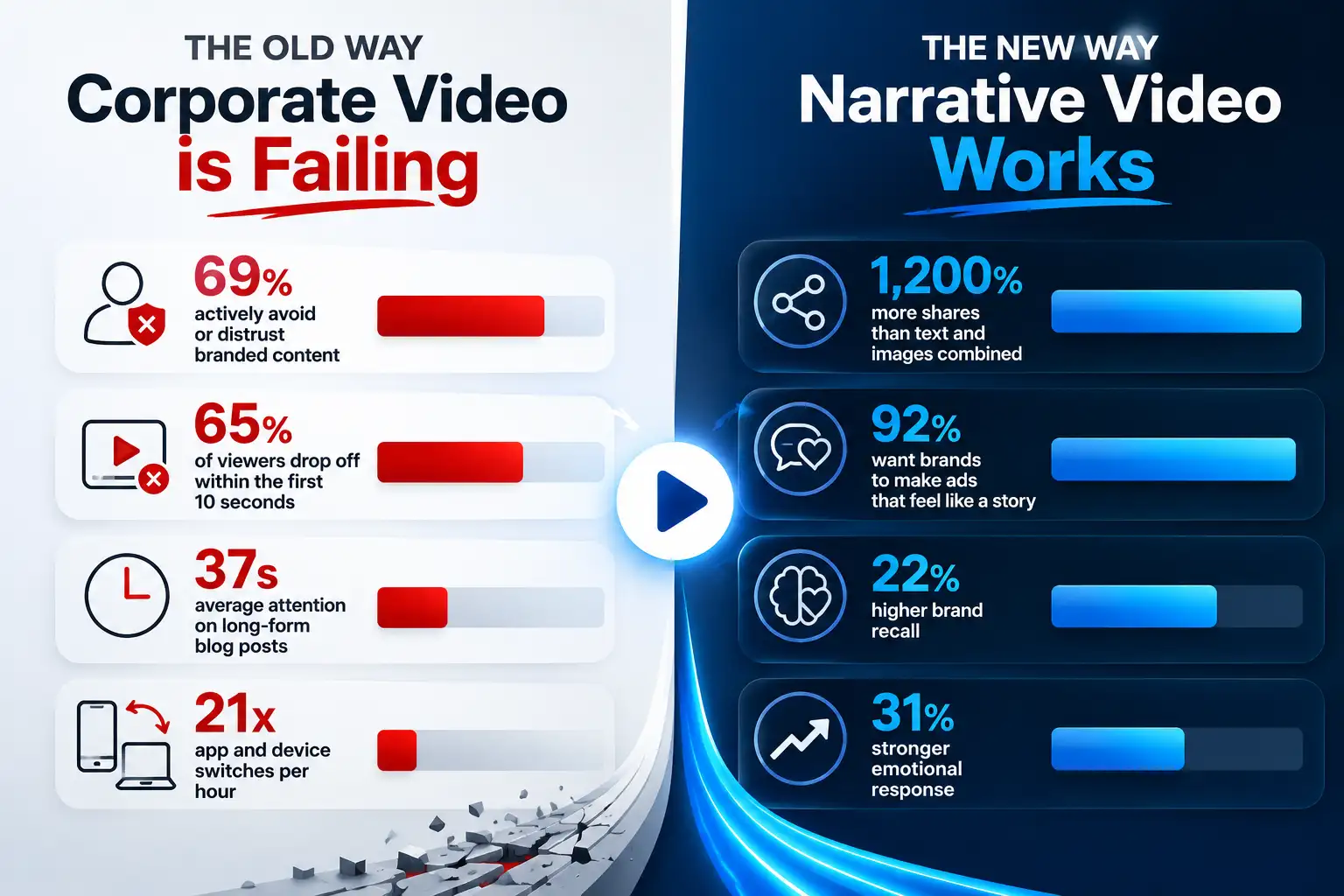
The average person switches between apps and devices 21 times per hour in 2025. Static content competes with infinite alternatives that are one scroll away. Long-form blog posts hold audience attention for an average of 37 seconds. 65 percent of video viewers drop off within the first ten seconds. 69 percent of audiences actively avoid or distrust branded content.
That last number deserves to sit for a moment. Nearly seven in ten people approach branded content with active distrust before a single frame has played. The starting position for any corporate video is already adversarial. The viewer does not want to be sold to. They do not want to be impressed by your facilities. And they definitely do not want to hear your CEO use the phrase “end-to-end solutions” again.
And yet, video content with narrative structure receives 1,200 percent more shares than text and images combined. 92 percent of consumers say they want brands to make ads that feel like a story. Narrative video content results in 22 percent higher brand recall and 31 percent stronger emotional response compared to non-narrative advertisements. 87 percent of customers are prepared to pay more for products and services from brands they trust, and that trust is built most efficiently through content that feels genuine and human.
$300,000 and beyond for broadcast-level commercial productions.
These two sets of numbers are not contradictory. They are explaining the same thing from two directions.
The format that has dominated corporate video production for two decades is failing. The underlying human need for story, for connection, for content that makes you feel something before it asks you to believe something, is stronger than it has ever been. The brands that understand this are not abandoning video. They are abandoning the format that stopped working.
Corporate Storytelling: The Specific Ways the Standard Corporate Video Fails
It is useful to name exactly what is going wrong, because the problems are specific and they have specific solutions.
It starts with what the company wants to say, not what the audience wants to hear.
The standard corporate video brief looks something like this: we want to communicate our company’s values, our global presence, our technical capabilities, and our commitment to quality. We want it to be professional and impressive.
This brief is entirely about the company. The audience does not appear in it. The viewer’s experience of watching the video is not considered as a design constraint.
Also Read: How Much Does a Corporate Video Cost in 2026?
The result is a video that works perfectly as a document of the company’s self-perception and almost completely fails to create any meaningful experience for the person watching it. The company wanted to be impressive. The viewer wanted to be understood. These are different needs and the standard corporate video serves only one of them.
It tells instead of showing.
Corporate Storytelling: Research by Dan and Chip Heath found that after a presentation, only 5 percent of people recalled specific statistics while 63 percent remembered the story told by the presenter. The corporate video format inverts this. It leads with claims, facts, and statistics. The story, if it exists at all, is buried in the final thirty seconds as a kind of emotional garnish on top of a structure that was fundamentally informational.
Stories bypass rational defenses. When someone presents data, the viewer’s critical mind engages. When someone tells a story, the critical mind relaxes. The viewer enters what psychologists call narrative transportation. They stop questioning and start experiencing. The corporate video, by leading with data and claims, activates the exact cognitive mode that makes the content least persuasive.
It is designed to be approved, not to be watched.
This is the real root of the problem. Corporate videos are produced through approval processes that involve multiple stakeholders with different agendas. Legal wants certain claims removed. HR wants certain phrases included. The CEO wants their bit in the middle. The marketing team wants the tagline prominent. The CFO who has final approval has never met the target audience in their life and is evaluating the video based on whether it makes the company look good to people like themselves.
The video that emerges from this process has been optimised for internal approval rather than for external impact. Every editorial edge has been smoothed. Every moment of genuine emotion has been reviewed for risk. Every specific human truth has been generalised into a safe, broad claim that offends nobody and moves nobody.
The resulting video is not a communication. It is a compromise.
What Corporate Storytelling Actually Is
Corporate storytelling is not “making corporate videos more emotional.” It is a completely different approach to the problem of how a company communicates with an audience.
The difference starts at the brief stage, with a single question that the standard corporate video almost never asks:
What do we want the person watching this to feel, and what true story do we have that will make them feel it?
Not “what do we want them to know.” Not “what do we want them to think about us.” What do we want them to feel. And what true story, from our company’s actual experience, from our employees’ actual lives, from our customers’ actual transformations, makes that feeling accessible?
The story that replaces the company montage.
Here is the kind of corporate storytelling that works. It is not a hypothetical.
A manufacturing company in Pune decided to make a corporate film about quality. The standard approach would have shown the factory floor, the ISO certifications on the wall, the quality control team at work, the CEO talking about their commitment to precision.
The film they actually made showed a single quality inspector, fifteen years on the job, and the one moment in her day that she considers the most important: the final visual inspection before a component is signed off. The film spent two minutes on her face as she examined parts. It showed the specific things she looked for and what happened inside her when she found a flaw. It ended with her talking about what it meant to her that the components she approved ended up in hospitals across three countries.
Corporate Storytelling: Nobody in that film talked about quality. The film was entirely about quality. And every viewer who watched it understood the company’s commitment to it at a level that no amount of “end-to-end quality solutions” language could approach.
That is corporate storytelling. The subject of the video was a human being. The purpose of the video was a business outcome. The two are not in conflict when the brief is right.
The story that replaces the CEO statement.
Leadership communication is one of the most frequently produced and least effective categories of corporate video. The standard CEO statement video exists as a format because it is easy to approve and nearly impossible to make genuinely compelling. The CEO, in most cases, has been coached to be composed, authoritative, and on-message. The result is a composed, authoritative, on-message video that no employee or investor watches for longer than thirty seconds before their attention wanders.
The leadership communications that work in 2026 are the ones where the leader is shown being a person rather than performing a role. The moment of genuine uncertainty before a major decision. The admission of a mistake and what the company learned from it. The specific conversation with a customer that changed how the company thought about the product. These moments, when a leader allows themselves to be human on camera rather than authoritative, produce content that employees share with each other, that journalists find worth writing about, and that investors find more reassuring than any scripted confidence performance.
Research confirms what instinct suggests: relatable, human stories outperform celebrity-centric or authority-positioning stories for authenticity metrics. The leader who appears human is more trusted, not less.
The story that replaces the client testimonial.
The standard client testimonial is one of the most formulaic pieces of content in corporate video production. The client sits in a nice office. They say the company they are endorsing is professional, reliable, and delivered results. They use the company’s preferred language to describe the benefit they received. The video ends.
Nobody is moved by this. Not because testimonials cannot be powerful. Because this version of a testimonial is not a story. It is a review, structured like a review, delivered like a review, and received by the viewer like a review: processed, filed, and forgotten.
Also Read: Why Founder-Led Ads Are Dominating Modern Branding | Research by Cybertize Media
The testimonial video that actually builds trust and drives consideration tells the client’s story from before the company’s involvement. It shows the problem they had, specifically and honestly enough that the viewer recognises the problem from their own experience. It shows the moment the client decided something had to change. And then, as part of that already-established narrative, it shows the company’s role in the resolution.
That is a story. It has a protagonist who is not the company. It has a problem the viewer recognises. It has a resolution that is emotionally satisfying because the viewer was invested in the protagonist before the company appeared. And the company’s role in the resolution is therefore meaningful rather than self-reported.
The Elements That Make Corporate Storytelling Work
After looking at what fails and why, the principles behind what works are clear enough to be stated directly.
A protagonist who is not the company.
The most consistent mistake in corporate storytelling is making the company the hero of its own story. Companies are not heroes. People are. The employee who solved the impossible problem. The founder who refused to give up at the moment when giving up was the rational choice. The customer whose life changed because of what the company built. The supplier whose village was transformed because of how the company chose to source.
Put a human being at the centre of every corporate story you tell, and make that human being’s journey the structure of the film. The company’s role in that journey is the message. The human being’s journey is what keeps the viewer watching long enough to receive the message.
55 percent of consumers are more likely to remember a story than a list of facts. The story they remember is the human story. The company’s role in that story is what they remember about the brand.
Specificity over generality, always.
The difference between “we are committed to quality” and “she has checked every part that has left this facility for fifteen years and has never let a flawed one through” is not one of scale. It is one of specificity. The specific version is more believable, more memorable, and more emotionally resonant than the general version. Every time.
The corporate video format consistently chooses generality because specific claims are harder to approve. Specific employees can leave. Specific numbers can be disputed. Specific stories can be complicated.
All of those complications are exactly what makes specific storytelling so much more powerful than the alternative. The viewer knows, at some level, when they are being told a comfortable approximation of the truth. They respond at a much deeper level to something that is specific enough to be real.
Conflict and tension, not just resolution.
A story without tension is not a story. It is a timeline. The corporate video that shows only the good things, only the achievements, only the upward trajectory, only the smiling employees, is not telling a story. It is producing a brochure with motion.
The corporate stories that earn genuine attention include the moment things were difficult. The product that nearly failed and did not. The market that rejected the brand’s first attempt. The founder who spent eighteen months not knowing if the company would survive. The engineering team that discovered a fundamental flaw three weeks before launch.
These moments of tension are the moments that make the resolution meaningful. Without them, the achievement has no weight, because the viewer never understood what was overcome to reach it. With them, the viewer is invested in the outcome in a way that creates genuine emotional resonance.
Storytelling campaigns that incorporate vulnerability consistently outperform those without it in engagement metrics. The brand that is willing to be honest about its journey builds more trust than the brand that performs only the curated version.
An emotion the viewer can access, not just witness.
The standard corporate video produces emotions in its subjects: the CEO looks proud, the employees look engaged, the customers look satisfied. The viewer watches these emotions being performed on screen but does not feel them.
Great corporate storytelling produces emotions in the viewer. The specific detail of the story that makes the viewer feel something they recognise from their own experience. The moment that is close enough to something true in the viewer’s life that they are no longer watching someone else’s story. They are watching a story that connects to their own.
This is the mechanism behind narrative transportation: the viewer is so absorbed in the story that the brand’s message arrives without resistance because the viewer has, for a moment, stopped being a skeptical audience member and started being an invested participant.
95 percent of purchasing decisions happen unconsciously. Stories bypass rational defenses in a way that information never can. The corporate story that creates genuine emotion in its viewer is doing work at the decision-making level that the standard corporate video cannot access.
What the Production Process Looks Like for Corporate Storytelling
Making this shift is not just a creative decision. It changes the production process at every stage, and understanding those changes is what allows brands and production companies to brief this kind of work properly.
Research before scripting.
A corporate story cannot be invented. It has to be found. Before a word of script is written, the right production partner spends time inside the company looking for the story that already exists: the employee whose experience reveals something true about the company’s culture, the customer whose transformation is specific enough to carry a narrative, the founding moment that is honest enough to be worth telling.
This research phase is not a nice-to-have. It is where the story lives. A corporate storytelling brief that skips research and asks for a script based on the marketing deck will produce a scripted version of the marketing deck, which is where most corporate videos begin and end.
Interviews before scripts.
The best corporate storytelling productions invest significant time in unscripted conversations with the people who will appear in the film before the script is written. Not to collect quotes to be placed in a predetermined structure, but to find the moments of genuine expression that tell you where the real story is.
The inspector in the Pune factory did not describe her relationship with quality in the language that the marketing team would have chosen. She described it in the language of a specific person who has done a specific job for fifteen years. That language, which is hers and only hers, is what makes the story ring true.
Direction that captures rather than produces.
The direction of a corporate storytelling film is fundamentally different from the direction of a standard corporate video. In a standard corporate video, the director’s job is to produce the planned performance: get the CEO to deliver the approved lines with the approved energy, get the B-roll that matches the storyboard, deliver the film that matches the brief.
In corporate storytelling, the director’s job is to create the conditions in which something true can happen on camera, and then to recognise it when it does. This requires a different relationship with the script (a framework, not a script), a different relationship with the subjects (collaborative, not directed), and a different relationship with the unexpected (welcoming, not eliminating).
The specific moment in an interview when a subject says something that was not in the plan and the camera keeps rolling because the director recognises that the unprepared truth is better than the prepared version: that is the most important moment in corporate storytelling production, and it happens because the director was looking for it.
Corporate Storytelling Formats That Are Actually Working in 2026
The shift from corporate video to corporate storytelling is showing up in specific formats that are outperforming the standard approach across metrics.
The Employee Story Series.
Rather than the company montage with smiling employees in the background, individual employees are given a film each. Their specific role, their specific relationship to the work, their specific reason for being there. A retail brand shows the person who packs the boxes and why they take pride in it. A tech company shows the engineer who came from a village in Rajasthan and built a feature used by five million people. A healthcare company shows the operations coordinator whose mother was once a patient at the same hospital they now work in.
These films perform better than the company montage in every metric that matters: watch time, shares, employee pride, recruitment enquiries, and customer trust. They outperform because they are specific, human, and true.
The Origin Revisited Film.
Not the standard “we were founded in 2008 to solve problem X” version. The film that goes back to the specific moment the founder made the decision that defined the company: not the optimistic version, but the honest one that includes what they were afraid of and what they almost did instead.
Origin revisited films consistently outperform standard brand films for shareability because they reveal something people did not know, in a way that changes how they think about the brand. The viewer who finishes an origin film feeling like they understand the brand differently than they did before is a viewer who has been converted in the deepest sense.
The Customer Transformation Documentary.
One customer. Enough time to tell their story properly, not a ninety-second testimonial but a three to five-minute documentary that follows their journey from the problem to the resolution with enough specificity that the viewer understands both. The company appears as a character in that story but is never the protagonist.
B2B story arcs that demonstrate customer outcomes boost lead quality. The prospect watching this film is not just learning what the company does. They are watching a version of what their own transformation could look like, which is the most effective sales tool that exists.
The Honest Annual Report Film.
Companies produce annual reports. Almost nobody reads them. An increasing number of companies are producing annual report films that use the data of the year as the structure for a genuine story: what worked, what did not, what the company learned, and where it is going. The honest version of this film, the one that does not shy away from the difficult quarter or the missed target, builds more trust than the triumphant version because it treats the viewer as an adult capable of processing complexity.
The Brief That Produces Corporate Storytelling Instead of Corporate Video
Every production brief in the world is trying to answer the same question: what should this film be?
For corporate storytelling, that question has a specific answer: this film should be the truest, most specific, most human expression of the thing this company does and why it matters.
Not the most comprehensive. Not the most impressive. Not the most approval-ready. The truest.
The brief that produces corporate storytelling instead of corporate video asks:
Whose story is this? Not what is this company’s story. Whose. Which specific human being’s experience is the entry point for the audience?
What did that person or those people have to overcome? Not what did the company achieve. What was hard. What was uncertain. What was at stake.
What does the viewer feel at the end that they did not feel at the beginning? Not what do they know. What do they feel. The feeling is the message.
What is one completely specific detail that only this company’s story could contain? The detail that cannot be moved to a different company without becoming false. That detail is the soul of the film.
Final Word from Cybertize Media Productions
The corporate video format that has dominated business communication for the last twenty years is not going to disappear overnight. There will still be briefs for company montages, CEO statements, and client testimonials in their standard forms. Some of them will still get made, approved, uploaded to a website, and watched by nobody except the people who made them.
But the companies that are genuinely building audience trust, employee pride, and commercial credibility through video in 2026 are not making those films. They are asking different questions at the brief stage, working with production partners who know how to find a story rather than produce a performance, and distributing content that earns its audience’s attention rather than hoping to receive it by default.
The medium has never been more powerful. The format that has been used to deliver content through that medium is exhausted. The brands that understand the difference are already pulling ahead.
At Cybertize Media Productions Private Limited, corporate storytelling is the most interesting and most consequential work we do. It requires a different production approach, a different director-subject relationship, and a different definition of success than the standard corporate video. But the films that result from getting those things right are the ones that people watch twice, share without being asked to, and remember a year later.
That is the difference between a corporate video and a corporate story. One is made to be completed. The other is made to be remembered.
Cybertize Media Productions Private Limited is a full-service ad film and corporate video production company working with brands across India.