Table of Contents
Animation Ads: Most advertising creative decisions come down to a simple question asked under time pressure: do we have the budget to animate this, or do we go with static? The question is usually framed as a production resource question. Rarely is it framed as a performance question, because the assumption embedded in how most marketing teams work is that both formats will get roughly similar results once the targeting is right.
That assumption is not supported by the data. And in 2026, with the performance gap between animated and static ad creative wider than it has ever been and documented across every major platform, continuing to treat animation as a budget luxury rather than a performance driver is a measurable choice with measurable consequences.
This is a piece about what the data actually says, where it is most decisive, where it is more nuanced, what kinds of animation outperform live-action as well as static, and how to build a creative strategy that uses every format for the job it is best at.
The Core Numbers
Start with the headline figure this article is built around, and then go deeper into where it comes from and what surrounds it.
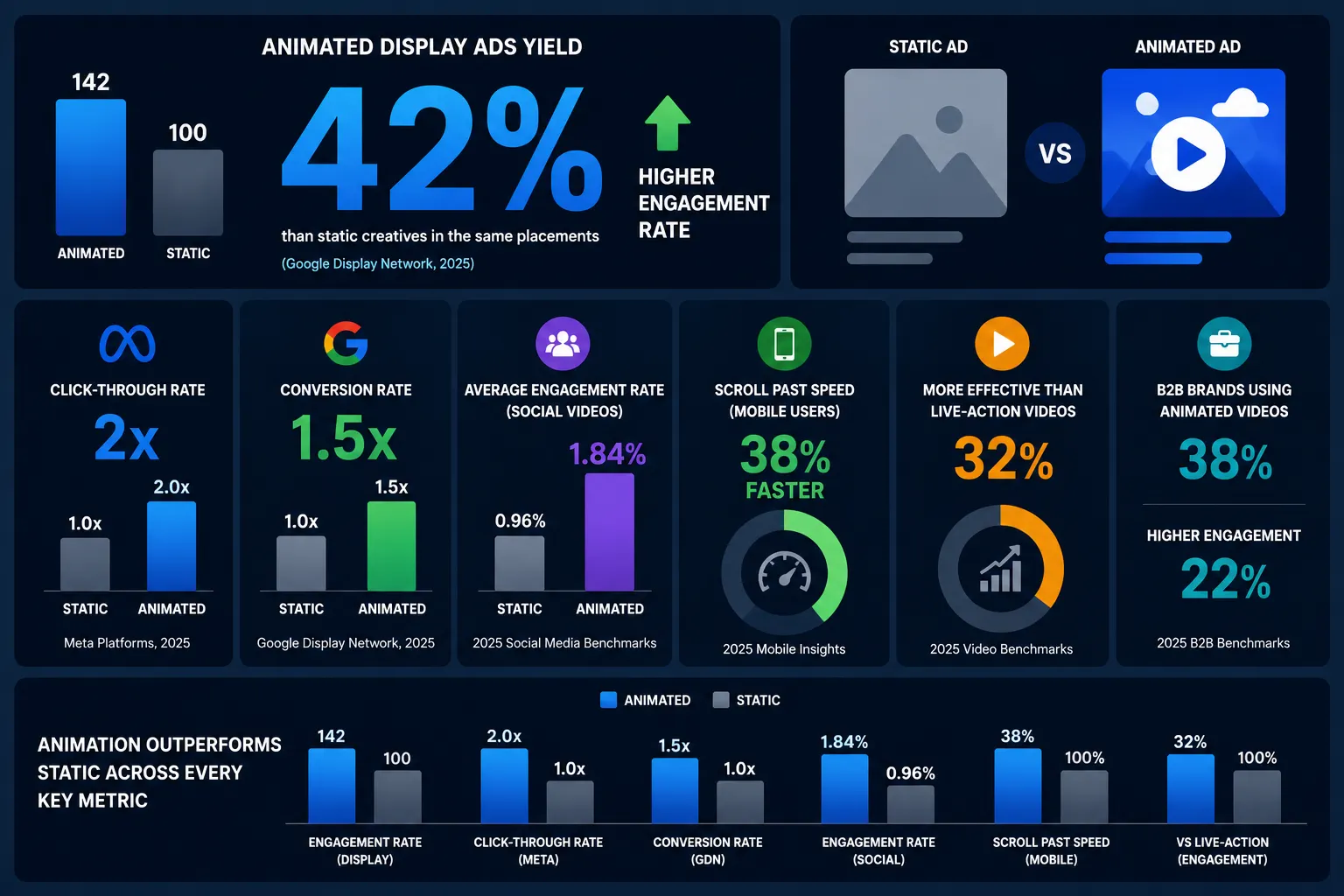
Animated display ads yield a 42% higher engagement rate than static creatives in the same placements, according to 2025 digital advertising statistics aggregated across the Google Display Network. This is a same-placement comparison, meaning the formats are evaluated against identical targeting, bidding, and audience parameters. The 42% difference is the format’s contribution to performance, isolated from every other variable.
Also Read: Why Explainer Videos Fail Even When the Animation Looks Good
That number sits alongside a broader pattern that is consistent across every platform where it has been measured:
Animated video ads generate 2x the click-through rate of static image ads on Meta platforms, according to Meta’s 2025 advertising benchmarks. On Google Display Network, animated ads achieve 1.5x the conversion rate of static banners.
Animated social videos show an average engagement rate of approximately 1.84%, almost twice the rate of static ads at approximately 0.96%.
Mobile users scroll past static ads 38% faster than motion-based ads.
Animated ads are 32% more effective than live-action videos at driving viewer engagement. This last number is particularly significant because it positions animation not just above static, but above live-action production in pure engagement terms, and at significantly lower cost per asset when production economics are factored in.
Animated videos are used by 38% of B2B brands and show 22% higher engagement rates compared to traditional talking-head formats.
The pattern is consistent. Across display, social, mobile, and video, animated formats outperform static formats on engagement, click-through rate, and conversion at a margin that is not marginal. It is structural.
Animation Ads: Why Animation Works, The Attention Mechanism
The performance gap is not accidental. It is the result of how the human visual system processes motion versus static images, and understanding the mechanism makes it easier to design animated creative that deliberately exploits it.
The human brain is wired to detect and attend to movement. This is an evolutionary survival mechanism: something moving in the peripheral vision of an early human was more likely to represent a threat or an opportunity than something still, so the visual cortex developed a hard-wired preference for processing motion before static stimuli. That preference has not changed because we now spend our time scrolling social feeds instead of scanning landscapes.
Animated ads create an immediate focal point that pulls the eye away from surrounding content, giving brands a crucial advantage in crowded feeds where users scroll at speed.
In a social media feed where every piece of content is competing for a fraction of a second of attention, the animated element is the one the eye is drawn to before a conscious decision is made to look. Static content requires the viewer to choose to look. Animated content earns a look before the choice is made.
This is why the first-second performance of animated ads tends to be so much stronger than static: the view is captured by the motion before the viewer has had time to evaluate whether the content is relevant to them. Static ads require relevance signals, a thumbnail, a headline, a visual subject, to do the work of attracting attention. Animated ads attract attention first and then deliver the relevance signal.
The memorability advantage compounds the engagement advantage. Wyzowl’s 2026 State of Video Marketing report, drawing on 12 years of original survey data, found that 93% of video marketers say video has directly increased brand awareness. Brand recall is significantly higher for video ads than for other ad types. That recall compounds at the moment of purchase: a brand already lodged in memory wins consideration over one that is not.
Platform-by-Platform Performance Breakdown
The aggregate numbers matter, but the platform-specific benchmarks are what make animation strategy actionable. Performance gaps vary significantly by platform, and knowing where the gap is widest helps allocate animation budget most efficiently.
Meta (Facebook and Instagram)
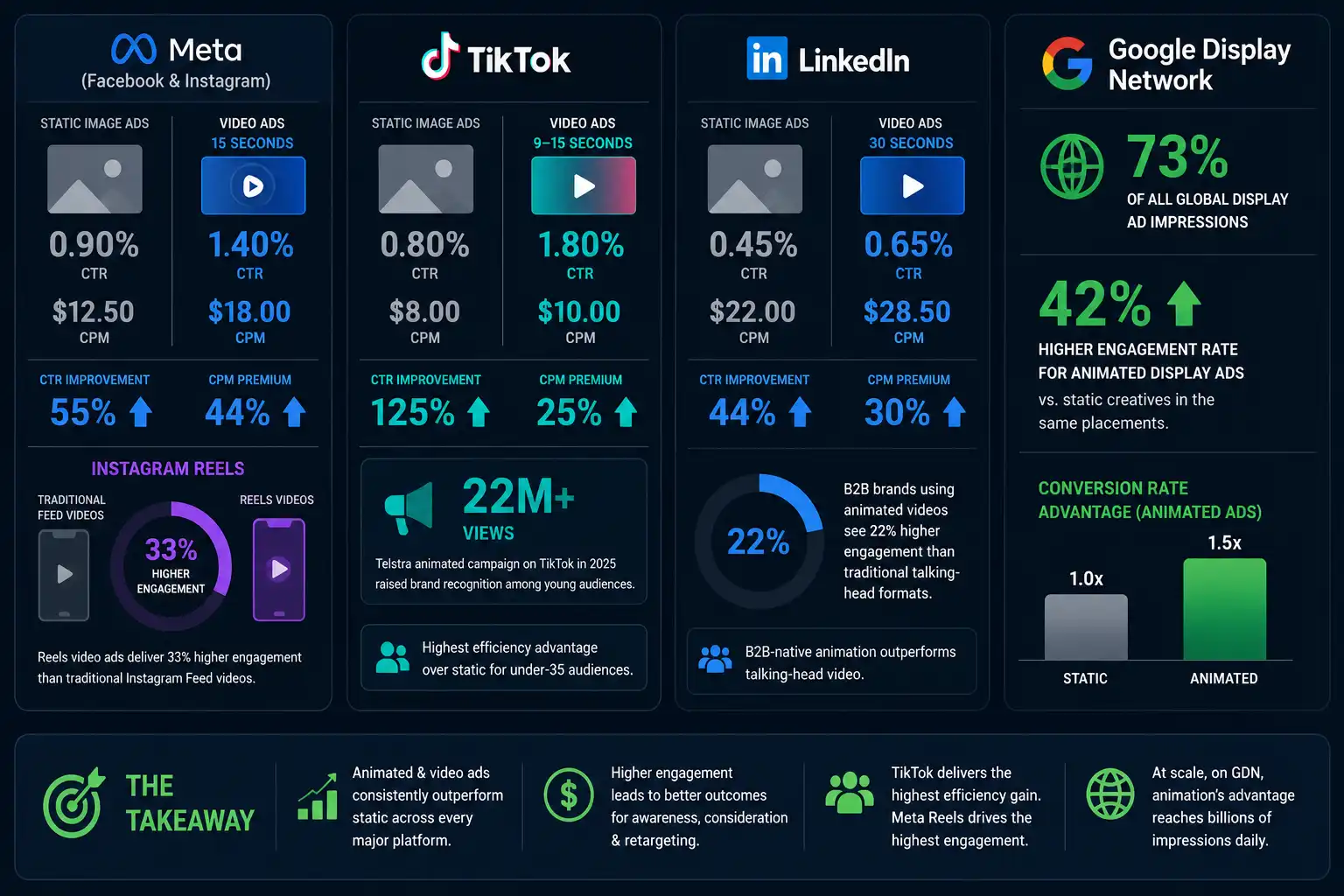
On Meta Feed, static image ads average a 0.90% CTR at a CPM of USD 12.50. Video ads at 15 seconds average a 1.40% CTR at a CPM of USD 18.00. The 55% CTR improvement comes at a 44% CPM premium. At those relative rates, animated video is the higher-efficiency format once the engagement metric is what drives downstream business outcomes, which it is for awareness and consideration campaigns.
For Instagram Reels specifically, brands running video ads on Instagram Reels see 33% higher engagement than those using traditional Instagram Feed videos. Within animated and video formats, the vertical, native format of Reels dramatically outperforms feed placements for the same creative.
TikTok
On TikTok, static image ads average a 0.80% CTR at a CPM of USD 8.00. Video ads at nine to fifteen seconds average a 1.80% CTR at a CPM of USD 10.00. The CTR improvement is 125% for a CPM premium of only 25%, making TikTok the platform where animated and video creative delivers the highest efficiency advantage over static by a significant margin.
A Telstra animated campaign on TikTok in 2025 gathered over 22 million views and raised brand recognition among young audiences. For brands targeting under-35 audiences specifically, TikTok’s algorithmic preference for native-feeling video and animation content makes it the highest-return platform for motion creative investment.
On LinkedIn, static image ads average a 0.45% CTR at a USD 22.00 CPM. Video ads at 30 seconds average a 0.65% CTR at a USD 28.50 CPM. The CTR improvement is 44% with a 30% CPM premium, making LinkedIn the platform where animated creative has the smallest efficiency advantage over static in pure CTR terms. However, for B2B brands specifically, animated videos used by B2B brands show 22% higher engagement than traditional talking-head formats, which means the right kind of animation, not repurposed social video but B2B-native motion graphics and explainer animation, still outperforms the alternatives.
Google Display Network
Google Display Network serves 73% of all global display ad impressions. Animated display ads yield a 42% higher engagement rate than static creatives in the same placements. At the scale of the GDN, that 42% engagement advantage is operating across a distribution that reaches effectively every internet user on the planet. For display retargeting specifically, where the animation style and format do not need to earn a cold audience’s initial attention but instead need to remind a warm audience of a brand they have already encountered, the engagement advantage of animation is particularly valuable.
On Google Display Network, animated ads achieve 1.5x the conversion rate of static banners. The conversion rate advantage in retargeting is directly attributable to animation’s memorability: a viewer retargeted with an animated ad they remember, even subconsciously, from a previous encounter is more likely to convert than a viewer who sees a static banner that does not trigger recognition.
Also Read: How AI Storyboarding Saves Pre-Production Time
Animation vs Live-Action: The Comparison That Matters in 2026
The more interesting comparison for production companies and brands with serious content budgets is not animation versus static. It is animation versus live-action, and the data here is both more nuanced and more commercially significant.
Animated ads are 32% more effective than live-action videos at driving viewer engagement. This figure sits alongside the production economics comparison that makes it commercially decisive: most social media animated ads between 15 and 30 seconds cost between USD 2,000 and USD 10,000 total. Motion graphics and kinetic typography start at USD 1,000 to USD 8,000 per minute.
A comparable live-action ad production, even at a modest production level, typically costs significantly more once you account for location, crew, talent, equipment, and post-production. Animation can often be produced for 30 to 70% of the cost of an equivalent live-action production and, on most platforms, outperforms it on engagement.
There are specific contexts where live-action maintains a clear advantage: emotional brand storytelling where the humanity of real people and real moments is the central creative mechanism; product demonstrations where the physical reality of the product needs to be shown; and authenticity-driven formats like UGC-style ads where the whole point is that it does not look produced.
Live-action remains a strong tool for emotional branding and image stories. However, for advertising focused on results, animated ads have become a more profitable format. That is why brands more and more often combine live shooting with motion graphics, or fully switch to animated formats for lead generation, sales, and campaign scaling.
The emerging best practice in 2026 is a hybrid model: live-action for brand-building hero content and top-of-funnel emotional storytelling, with animation handling the performance advertising layer, the explainer content, the product feature communication, and the always-on social creative that needs to scale across formats and placements without a reshoot.
Which Animation Style Performs Best by Context
Not all animation is equal in performance terms, and choosing the wrong animation style for a given context is a common reason animated ads underperform their potential even when they outperform static.
2D character animation remains the dominant format in 2026 for consumer-facing ads, particularly in e-commerce, fintech, and healthcare. It allows brands to create relatable characters without the expense of live talent, communicate abstract concepts visually, and maintain a consistent visual language across multiple assets. 2D animation remains the most popular format in 2026. It allows quick campaign launches, fast hypothesis testing, and a strong visual style without high budgets.
Motion graphics and kinetic typography are the strongest format for B2B and SaaS contexts, where the product being advertised is software, data, or a service that has no physical form to show. Motion graphics can make a dashboard, a workflow, or a data output visually compelling in a way that neither a static screenshot nor a live-action screen recording achieves. Products with technical features, layered pricing, or abstract value propositions become clear in 60 seconds of animation.
Whiteboard animation is a specialist format with documented performance advantages in educational and explanatory content. Whiteboard videos have a 74% average completion rate, the highest of any animation style, according to Wistia’s 2025 data. For brands communicating complex information, regulatory content, or multi-step processes, whiteboard animation trades visual excitement for exceptional viewer attention and message retention.
3D animation delivers the highest production quality ceiling but at significantly higher cost. 3D animation and stop-motion are the most expensive animation formats at USD 10,000 to USD 50,000 or more per minute. At that price point, 3D animation makes sense for product visualisation where the three-dimensional form of the product is central to its appeal, luxury brand content where production value signals are part of the brand communication, and gaming or entertainment brand advertising where 3D is the native visual language of the audience.
HTML5 animated banner ads deserve specific mention for display advertising contexts. HTML5 technology enables designers to build animated banner ads that function like miniature websites, using HTML, CSS, and JavaScript. These banners offer better image quality, interactive elements, and cross-platform compatibility compared to legacy formats and are fully supported across Google Search, Display, and YouTube campaigns. For programmatic display campaigns specifically, HTML5 animated banners consistently outperform static PNG or JPG banners on viewability, engagement, and conversion metrics.
When Static Ads Still Win
A complete picture of the animated versus static comparison requires honesty about the contexts where static holds its own or genuinely outperforms animated creative.
A clean, high-contrast static ad with a direct call-to-action can outperform an overcomplicated animated piece. Format matters, but execution matters more.
The specific contexts where static tends to win:
Retargeting warm audiences at the conversion stage. For hot audiences at the conversion and retargeting stage, static ads with clear, benefit-driven copy and a strong CTA often minimise distraction and drive the lowest cost per acquisition. A warm audience that already knows and is considering a brand does not need a moving image to be reminded it exists. They need the simplest, most direct possible expression of the reason to act now.
Email advertising. Static images in email consistently outperform animated GIFs when deliverability and load time are factors, particularly for enterprise email clients that block moving images by default. The animated email advantage, which does exist for platforms that support it, disappears when the animation never loads.
Extremely short-form placements. In placements where the viewing window is less than three seconds and there is no opportunity to tell a story in motion, a well-designed static image with a clear focal point and strong copy can communicate faster than animation that needs at least a second or two to establish its visual logic.
Cost-sensitive scaling. Static ads have obvious advantages: fast to produce, cheap, universal compatibility, and minimal file-size risk. When a campaign needs 50 different creative variants for audience testing, the cost of animating all 50 versus producing 50 static variants makes static the economically rational choice for the testing layer, with animation applied only to the winning concepts.
The Scaling Advantage: Why Animation Ads Is the Most Efficient Creative Format at Scale
One of the most underappreciated advantages of animation over live-action is its scalability, and in performance advertising contexts, scalability is a strategic differentiator, not just a production convenience.
In 2026, the effectiveness of advertising directly depends on how well content is adapted to user behaviour on a specific platform. It is here that animated ads have a strategic advantage. They are easy to scale to any format.
A live-action ad produced in a 16:9 horizontal format for YouTube requires a separate shoot or at minimum a significant re-edit to work as a 9:16 vertical for TikTok and Instagram Reels, a 1:1 square for Facebook Feed, and a banner format for GDN. Each format change may require re-shooting or re-licensing talent.
An animated ad produced at one ratio can be repositioned and reformatted for any platform ratio without additional production. The animation assets, characters, background elements, and motion sequences, can be repositioned within the frame for each format, with the same production covering four or five different placement types.
One animated asset can be cropped and reformatted for YouTube, Instagram Reels, display ads, and email without producing a single new frame.
At scale, across a campaign running simultaneously on five platforms in three different ad formats, the cost efficiency of animation relative to live-action is not incremental. It is transformative. The brands running the highest volume of creative variants in performance advertising are increasingly using animation as their primary production format precisely because of this scalability advantage.
What This Means for Indian Brands in 2026
India’s digital ad market reached approximately USD 7.1 billion in 2025, growing at over 20% year-on-year according to industry data, with mobile accounting for over 70% of all digital ad impressions. That mobile-first context is particularly significant for the animation versus static comparison, because mobile users scroll past static ads 38% faster than motion-based ads, and display ads on mobile achieve a 73% viewability rate compared to 64% on desktop.
The combination of a mobile-first audience that scrolls past static content faster and a viewability advantage for mobile placements makes the animation engagement advantage even more pronounced in the Indian market than the global average suggests.
Indian brands in the e-commerce, fintech, edtech, and consumer goods categories have been among the fastest adopters of animated ad creative in Asia, driven partly by the cost advantage of domestic animation production talent, which is significantly more affordable in India than in Western markets, and partly by the performance data from early adopters that has now accumulated over two or three campaign cycles.
The opportunity gap remains significant for mid-size Indian brands that have not yet systematically shifted animation into their performance advertising creative strategy. They are running static creative in placements where their competitors are running animation, which means they are accepting a structural engagement disadvantage of 38% to 42% in the placements that matter most.
How Cybertize Media Productions Approaches Animation Creative
Animation Ads: At Cybertize Media Productions Private Limited, animation creative is a central part of our production offering, not a specialised extension of it. We have built animation capability specifically because the performance data for animated creative in Indian digital advertising contexts is too consistent to treat animation as an optional add-on to a static-first creative strategy.
Our approach starts with a format decision framework that maps creative format to campaign objective, funnel stage, and platform placement before any production begins. We do not default to animation because it performs better on average. We choose animation for the specific placements and objectives where the data shows it performs better consistently, and we choose static or live-action for the contexts where those formats hold their ground.
For brands that are running primarily static creative in their performance campaigns and want to understand what the shift to animated creative would deliver, we offer a creative audit that benchmarks current creative against platform averages and models the likely performance improvement from a systematic format shift.
The 42% engagement gap between animated and static creative in the same placement is not a figure to file under “interesting statistics.” It is a number that has a direct translation into click volume, consideration rates, and campaign ROI. Whether or not to close that gap is a business decision, not a creative preference.
Cybertize Media Productions Private Limited is a full-service video and animation production company based in India, producing animated ads, motion graphics, 2D character animation, explainer videos, and brand content for performance advertising and digital marketing campaigns across every major platform.