Table of Contents
So you’ve shot your TVC. The grade is done, the sound mix is locked, and your client loves it. Now comes the part nobody really warns you about – actually getting that film on air.
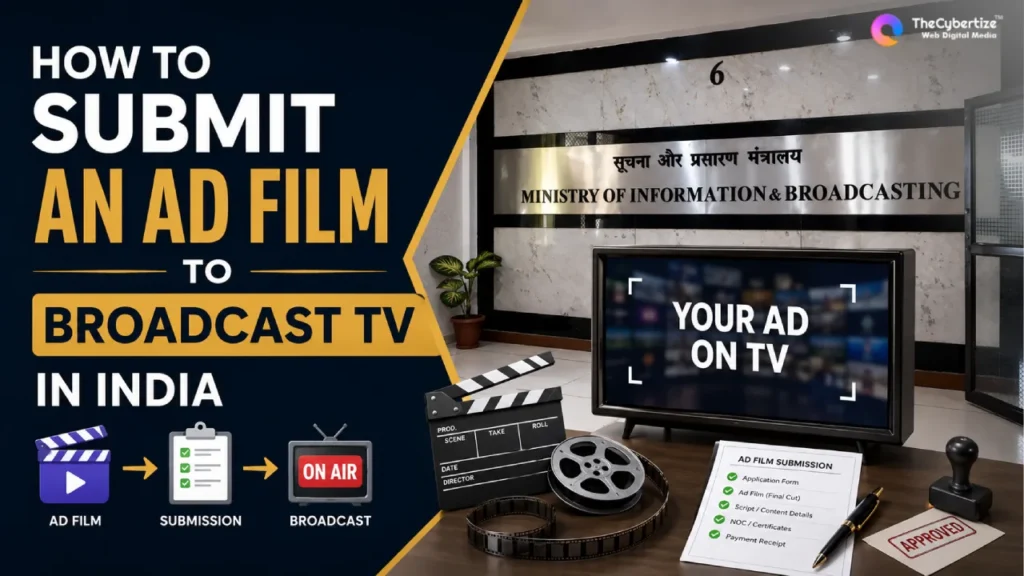
Submitting an ad film to broadcast TV in India is not one step. It’s a chain of steps, and any single weak link can delay your telecast by days or kill your campaign launch entirely. We’ve navigated this process dozens of times at Cybertize Media Productions, and we’ll tell you exactly what happens, what gets rejected, and what you need to do to avoid the most common traps.
This guide covers the entire journey – from technical delivery specifications to the Supreme Court-mandated Self-Declaration Certificate, from media buying to channel traffic departments. Whether you’re a brand doing this for the first time or a production house building a repeatable workflow, this is the reference you want.
Why the Submission Process Matters More Than Most People Think & How to Submit an Ad Film to Broadcast TV in India?
There’s a common assumption in the industry that once the film is made, the hard part is over. It isn’t.
Indian broadcast TV has one of the most layered regulatory environments in Asia. You’re dealing with the Ministry of Information and Broadcasting (MIB), the Advertising Standards Council of India (ASCI), individual channel standards and practices teams, media agencies, traffic coordinators, and – since June 2024 – a Supreme Court order that added an entirely new compliance layer on top of everything else.
Get any of these wrong and your ad doesn’t go on air. The brand misses its launch window. Someone gets an angry call from the client. That person is usually you.
Let’s make sure that doesn’t happen.
Also Read: 12 High-Converting Ad Film Concepts Brands Should Be Using
Step 1: Understand the Regulatory Framework Before You Deliver Anything
Before you export a single file, you need to understand what governs advertising on Indian television. There are three key pillars.
The Cable Television Networks (Regulation) Act, 1995 and the Cable TV Rules, 1994
Rule 7 of the Cable Television Networks Rules, 1994 is the foundational advertising code for everything that goes on air via cable and satellite TV in India. This is the document that sets the baseline – what your ad cannot contain, what claims it cannot make, what products it cannot depict.
Under Rule 7, your ad must not:
- Deride any race, caste, colour, creed, or nationality
- Violate any provision of the Constitution of India
- Glorify violence or obscenity
- Exploit the national emblem, constitutional excerpts, or the personality of national leaders
- Project a derogatory image of women
- Endanger the safety of children or create interest in unhealthy practices
- Contain any indecent, vulgar, suggestive, or repulsive material
Rule 7(10) also states that all advertisements must be clearly distinguishable from the programme – no bleeding of your ad into editorial content, no lower-third captions that interfere with the programme.
And critically, Rule 7(11) caps advertising time at a maximum of 12 minutes per hour, of which only 10 minutes can be commercial advertising. This affects media planning but not your film delivery directly.
The ASCI Code
Rule 7(9) explicitly states that no advertisement which violates the ASCI Code for Self-Regulation in Advertising shall be carried in the cable service. This means ASCI compliance is not optional – it’s woven into the law itself.
ASCI regulates truthfulness, decency, fairness, and safety. Their code is particularly specific about health claims, comparative advertising, and advertising directed at children. If your client is making a product claim that isn’t backed by evidence, ASCI will flag it – and the channel will not run it.
ASCI also maintains guidelines on disclaimer text height, timing of disclaimers, and readable font sizes. These are not suggestions. A small, quickly-flashed disclaimer that nobody can read is a violation, and channels have been instructed to check for this.
The Broadcasting Content Complaints Council (BCCC)
The BCCC operates at the industry level and handles complaints against non-news TV channels. A complaint can be filed within 14 days of the first broadcast of any content. The BCCC can also take suo moto action. While this is primarily a post-broadcast mechanism, it informs how channel Standards and Practices (S&P) teams pre-screen content before it goes to air.
Step 2: The Self-Declaration Certificate – the Biggest Change Since 2024
This is where many brands and agencies got caught off guard in mid-2024, and where many still get confused today.
On May 7, 2024, the Supreme Court of India issued an order in Writ Petition (Civil) No. 645/2022 (IMA & Anr. vs. Union of India & Ors.) mandating that all advertisers and advertising agencies must submit a Self-Declaration Certificate (SDC) before broadcasting or publishing any new advertisement.
This requirement came into effect on June 18, 2024. Existing ads already on air were exempt, but every new advertisement – TV, radio, print, digital – requires an SDC before it can go to air.
What is the Self-Declaration Certificate?
It is a certificate signed by an authorised representative of the advertiser or advertising agency declaring that:
- The advertisement does not make misleading claims
- The advertisement complies with all relevant regulatory guidelines, including Rule 7 of the Cable TV Rules 1994
- The advertisement meets ASCI standards
Where do you submit it?
For TV and radio advertisements, the SDC must be submitted through the Broadcast Seva Portal of the Ministry of Information and Broadcasting:
https://new.broadcastseva.gov.in
For print and digital advertisements, the portal is the Press Council of India (PCI) website at presscouncil.nic.in.
Who signs it?
The certificate must be signed by the authorised signatory of the advertiser – the brand, not the production house. If you are a production house or agency, make sure your client is looped in early. They need to be registered on the Broadcast Seva Portal and their signatory needs to complete the upload before you submit the film to the channel.
This is a common bottleneck. Brands that haven’t done this before will need time to register, get their signatory authorised, and navigate the portal. Factor in at least 2-3 working days for this process if it’s their first time.
Proof of submission
Once the SDC is uploaded, the portal generates a confirmation. Advertisers must provide this proof to the relevant media platforms – broadcasters will now check for this before scheduling your ad. All broadcasters and publishers are directed to refrain from airing any advertisement that does not have a valid SDC on record.
At Cybertize Media Productions, we now include the SDC submission as a formal checklist item in our pre-delivery process. If your production or agency workflow doesn’t have this yet, add it now.
Step 3: Technical Specifications – What the File Must Look Like
This is where production houses often underestimate the level of detail involved. Channel technical teams are strict about spec compliance. A file that looks fine on your edit suite monitor can come back rejected for reasons that have nothing to do with the creative.
Here are the standard broadcast specifications for TV commercials in India as of 2025. Note that individual channels may have slight variations – always confirm with the channel’s traffic or technical team.
Video Specifications
| Specification | HD (1080p) | HD (720p) | SD |
|---|---|---|---|
| Resolution | 1920 x 1080 | 1280 x 720 | 720 x 576 |
| Frame Rate | 25fps or 29.97fps | 25fps | 25fps |
| Codec | H.264 or ProRes | H.264 or ProRes | MPEG-2 |
| Bitrate (H.264) | Minimum 12 Mbps | Minimum 8 Mbps | As per channel spec |
| Bitrate (MOV/ProRes) | Minimum 80 Mbps | Minimum 42 Mbps | – |
| Colour Space | Rec. 709 | Rec. 709 | – |
| Scan Type | Progressive or Interlaced | Progressive | Interlaced |
Audio Specifications
| Specification | Requirement |
|---|---|
| Sample Rate | 48 kHz |
| Bit Depth | 24-bit |
| Loudness | -20 LKFS (allowable variance: ±1 LKFS) |
| True Peak | Must not exceed -1 dBTP |
| Channels | Stereo (L+R); 5.1 if required by channel |
| Audio must be in phase | Yes – always check this before delivery |
The loudness standard is critical and frequently misunderstood. Indian broadcasters follow the -20 LKFS integrated loudness standard (some channels specify -23 LKFS – confirm per channel). This is different from what many editors are used to in digital and streaming. If you’re mixing for web and then delivering to TV without a separate TV mix, your ad will likely fail QC. Always produce a dedicated broadcast mix.
Safe Area and Disclaimer Text
All on-screen text – especially disclaimers – must sit within the safe area as per EBU R95-2017 recommendations. ASCI has specific guidelines on disclaimer text height relative to screen size. Disclaimers that are too small, move too fast, or appear for insufficient duration are a common rejection reason. If your film has a legal disclaimer (which most FMCG, pharma, and financial ads do), get a compliance reading on the text size before you lock the grade.
File Format for Delivery
Most major Indian channels accept MXF (Material Exchange Format) wrapping for broadcast delivery. Some also accept QuickTime (.mov) with ProRes or H.264 codec. MP4 is generally acceptable for digital but should be confirmed before delivering to a broadcaster. When in doubt, deliver MXF OP1a. It is the most universally accepted broadcast wrapper in India.
Step 4: The Media Buying and Channel Booking Process
Now we get into the business side – who actually books the airtime, and how your film gets scheduled.
How TV advertising is booked in India
Brands (or their advertising agencies) buy airtime from channels directly or through media planning and buying agencies. The major players in Indian media buying include GroupM (Mindshare, Wavemaker, Mediacom), Publicis Media (Starcom, Zenith), IPG Mediabrands, Madison World, and Havas Media, along with a growing number of independent boutique agencies.
If you’re a brand without an agency, most major channels will have a direct sales team you can approach. Channels like Star (now JioStar), Zee Entertainment, Sony (Culver Max), and Colors (Viacom18, now part of JioStar) have structured rate cards, though actual rates are almost always negotiated.
Ad rates: what you’re dealing with
For context on what’s at stake financially, here are approximate rates as of 2025:
- Prime time (7-11 PM) on national GEC channels (Star Plus, Sony, Colors, Zee TV): ₹1.5-₹4 lakh per 10-second spot
- Non-prime slots (12-6 PM): ₹30,000-₹80,000 per 10-second spot
- News channels (Aaj Tak, NDTV, Republic): ₹5,000-₹50,000 per 10-second slot
- Regional language channels (Zee Marathi, Star Jalsha, ETV Telugu, Sun TV): ₹25,000-₹1 lakh in prime time
- Business news (CNBC-TV18, ET Now): ₹20,000-₹80,000
These numbers matter to you as a production house because they determine how much your client has allocated for media versus production – and they affect the urgency of delivery timelines. A client spending ₹50 lakh in media for a prime-time launch slot does not want to hear that your file failed technical QC on the day of scheduled telecast.
Also Read: How Animated Product Films Increase Conversion Rates
IPL and high-demand inventory
For completeness – the Indian Premier League remains the most valuable advertising inventory on Indian television. Brands pay significant premiums for IPL spots, which is why any campaign launching around the IPL window carries particularly high-stakes delivery requirements. Production houses working on IPL campaigns should build in extra lead time for everything.
Step 5: Channel Traffic Departments – Your Most Important Relationship
This is the step that nobody talks about in production circles, but it’s arguably the most operationally critical part of the entire submission process.
Every broadcast channel has a Traffic Department (sometimes called Ad Traffic or Commercial Traffic). This team is responsible for:
- Receiving your ad film file
- Assigning it an ISCI (Industry Standard Commercial Identifier) or channel-specific identifier code
- Scheduling it into the playout system in the correct spot positions
- Confirming technical QC before the spot goes live
The Traffic Coordinator (or Ad Trafficker) is your main point of contact once the media is booked and you need to physically deliver the file.
How to work with Traffic
- Once your media agency confirms the booking, they will give you the traffic contact details and delivery specifications for each channel.
- Submit your file (via the channel’s preferred delivery method – see below) along with the completed traffic instructions, ISCI code, and SDC reference number.
- The channel’s technical QC team will review the file. If it passes, they confirm it’s in the system. If it fails, they’ll send a QC rejection report specifying exactly what needs to be fixed.
- You fix and resubmit. This is why you should always build in at least 48-72 hours between delivery and first air date.
Delivery methods
Indian channels receive ad files through several methods:
- Ad2C / Extreme Reach: The dominant ad delivery platform in India. Most large channels (JioStar, Zee, Sony, Colors) are connected to this network. Your media agency will set up a campaign on this platform, and you upload the file there.
- Peach: Another widely used platform, particularly for international brands and agencies.
- FTP / Aspera (channel-specific): Some channels still operate their own secure FTP or Aspera servers. Traffic will provide login credentials.
- Physical hard drive delivery: Still used in some regional and smaller channel contexts, especially for highly time-sensitive deliveries.
For most national campaigns in 2025, Ad2C or Extreme Reach is the standard. Get your production team comfortable with this platform. It handles QC reporting transparently and lets you track submission status in real time.
Step 6: Standards and Practices (S&P) Review
Beyond technical QC, your creative content goes through a Standards and Practices review at the channel level. Every major Indian broadcaster has an S&P team whose job is to ensure that the content of your ad does not violate the Advertising Code or ASCI guidelines.
This is not the same as technical QC. S&P looks at:
- Comparative claims against named competitors
- Health and efficacy claims that need substantiation
- Depictions of children, women, or vulnerable groups
- Alcohol, tobacco, or surrogate advertising compliance
- Fairness to competitors
- Endorsement disclosures (under ASCI’s guidelines, endorsers must have actually used the product)
- Disclaimer visibility and duration
S&P review timelines vary. For straightforward ads, it can happen within 24-48 hours. For ads with significant claims (especially in pharma, healthcare, financial services, or food categories), it can take longer – and channels may request written substantiation of claims before approving telecast.
If your ad is in a sensitive category, get an ASCI pre-clearance (called ASCI’s Advertising Advice service) before approaching channels. It’s a proactive service that gives you a compliance reading before your film is submitted. This is strongly recommended for:
- Pharmaceutical and OTC health products
- Financial products (especially investment and insurance)
- Food and beverage health claims
- Educational institutions
- Celebrity or testimonial-based campaigns
ASCI’s Advertising Advice service isn’t mandatory, but it significantly reduces the risk of rejection at the channel level and demonstrates good faith compliance – which matters if an ad later faces a complaint.
Step 7: The Final Submission Checklist
Here’s how we approach final submission at Cybertize Media Productions, collapsed into a checklist:
Pre-submission (brand/advertiser side)
- Self-Declaration Certificate uploaded to Broadcast Seva Portal by authorised signatory
- SDC reference number/proof of submission obtained and shared with agency/production house
- Media booking confirmed with channel traffic contacts shared
Technical file preparation
- Final broadcast mix at correct loudness standard (-20 LKFS or per channel specification)
- True peak not exceeding -1 dBTP
- Audio confirmed in phase
- Video at correct resolution and bitrate for target channels
- Colour space Rec. 709 confirmed
- All on-screen text (especially disclaimers) within safe area
- Disclaimer text size and duration reviewed against ASCI guidelines
- File wrapped in correct format (MXF OP1a preferred, or as specified by channel)
Content compliance
- Ad does not violate any provision of Rule 7 of Cable TV Rules 1994
- ASCI Code compliance confirmed
- If sensitive category: ASCI Advertising Advice obtained (recommended)
- No misleading claims, substantiation documentation ready if requested by S&P
Delivery
- File uploaded to Ad2C / Extreme Reach / channel FTP (as applicable)
- Traffic instructions completed with correct ISCI code, on-air date, spot duration
- SDC reference number attached to submission
- QC confirmation received from channel or platform
- S&P clearance confirmed (allow extra time if applicable)
- First air date confirmed with media agency planner
What Happens If Your Ad Gets Rejected?
Rejections happen, even to experienced teams. The question is how fast you recover.
Technical rejection: Channel traffic sends a QC report. Common reasons include loudness out of spec, wrong frame rate, audio phasing issues, or resolution mismatch. Fix the specific issue, export a corrected file, resubmit through the same platform. This is usually resolved in 24 hours if your post-production team is responsive.
Content rejection: This is more complex. S&P flags a claim, a depiction, or a compliance issue. You’ll need to either modify the creative or provide substantiation. If the modification is minor (editing a line, changing a visual), it can be turned around in a day or two with a good post facility. If it’s structural to the concept, you may need to have a harder conversation with the client.
Misleading claim complaint (ASCI): If your ad goes on air and a consumer or competitor files a complaint with ASCI, ASCI’s Consumer Complaints Council (CCC) will review it and issue a decision within approximately 30 days for non-urgent complaints. ASCI can ask for the ad to be modified or withdrawn. Persistent non-compliance gets referred to MIB for further action.
The best way to avoid all of this is to do the compliance homework upfront – before the film goes into production, not after it’s locked.
Regional Channels: A Different Set of Considerations
If your campaign includes regional language channels – and in India, it often should – there are some additional considerations.
Regional channels each have their own traffic teams, their own FTP or delivery systems, and sometimes their own local modifications to the technical spec. Sun TV’s requirements are not identical to Star Vijay’s. Zee Marathi’s traffic team operates differently from Zee Bangla’s.
For regional campaigns, the media agency (or client’s media team) should provide you with channel-specific specs for each regional broadcaster in the plan. Do not assume that one master file will work for all channels. Always confirm.
Also, regional campaigns sometimes involve language versioning – your Tamil, Telugu, Kannada, Malayalam, Bengali, or Marathi dubs need to be delivered separately, with correct audio tracks, and sometimes with localised legal disclaimers if the claim or product pricing varies by region.
Doordarshan (DD) – the government broadcaster – has its own separate submission process through Prasar Bharati. If your client’s campaign includes DD National or any DD regional channel, factor in that Doordarshan operates differently from private broadcasters. Their traffic process is more paper-based and can take longer. Booking is done through Prasar Bharati’s commercial services.
A Note on OTT and Connected TV
This guide is focused on linear broadcast TV, but it’s worth flagging: if your campaign includes JioHotstar, SonyLIV, ZEE5, or any OTT platform in India, the delivery process is different.
OTT platforms have their own technical specs (often H.264 or H.265 in MP4 or MXF), their own content review process, and their own booking systems. The SDC requirement also applies to digital advertising per the PCI portal route. The loudness spec may differ – some OTT platforms target -14 LUFS (aligned with streaming normalization), while others follow broadcast standards.
If you’re delivering the same campaign to both broadcast and OTT, plan your export deliverables as separate tracks from post-production. Do not use the same file for both.
How Cybertize Media Productions Handles This End-to-End
At Cybertize Media Productions, we don’t just deliver a film – we deliver a campaign-ready film. Our post-production workflow is built around broadcast compliance from the very first export.
Here’s what that actually means in practice:
Every film we produce goes through a dedicated broadcast QC pass after final grade and sound mix. We check loudness (integrated, short-term, and true peak), frame rate, bitrate, safe area compliance, and disclaimer visibility before a single file leaves our facility.
We advise clients on the SDC process early – as soon as the shoot is complete, we’re asking the brand’s team whether they’ve registered on the Broadcast Seva Portal, because this is the step that creates last-minute panic if left to the final week.
We maintain direct relationships with traffic coordinators at the major channels and delivery platforms. If there’s a QC flag, we know how to read the rejection report and turn around a corrected file fast.
And we understand that for many brands – particularly those using broadcast TV for the first time, or scaling from regional to national – the process itself is unfamiliar. We walk them through it, not just deliver files and step back.
That’s what end-to-end ad film production actually means.
Conclusion
Submitting an ad film to broadcast TV in India is a multi-layered process that spans regulation, compliance, technical QC, content review, and channel coordination. The Supreme Court’s 2024 Self-Declaration Certificate mandate has added an important new layer to a process that was already detailed.
The brands and agencies that navigate this well are the ones who treat the submission process as part of the production workflow — not something that begins after the film is delivered. When you know the specifications, build in the right lead times, prepare your client for the SDC process, and work closely with channel traffic teams, getting your film on air is entirely manageable.
At Cybertize Media Productions, this is part of what we do. If you’re producing a TVC or corporate film and want to understand how we handle the end-to-end delivery process, we’re happy to walk you through it.
Cybertize Media Productions Private Limited is a Mumbai-based ad film and corporate video production company. Our work spans TVCs, digital films, corporate brand films, and product films for brands across FMCG, retail, fintech, healthcare, and real estate.