Table of Contents
The Two Approaches Side by Side:
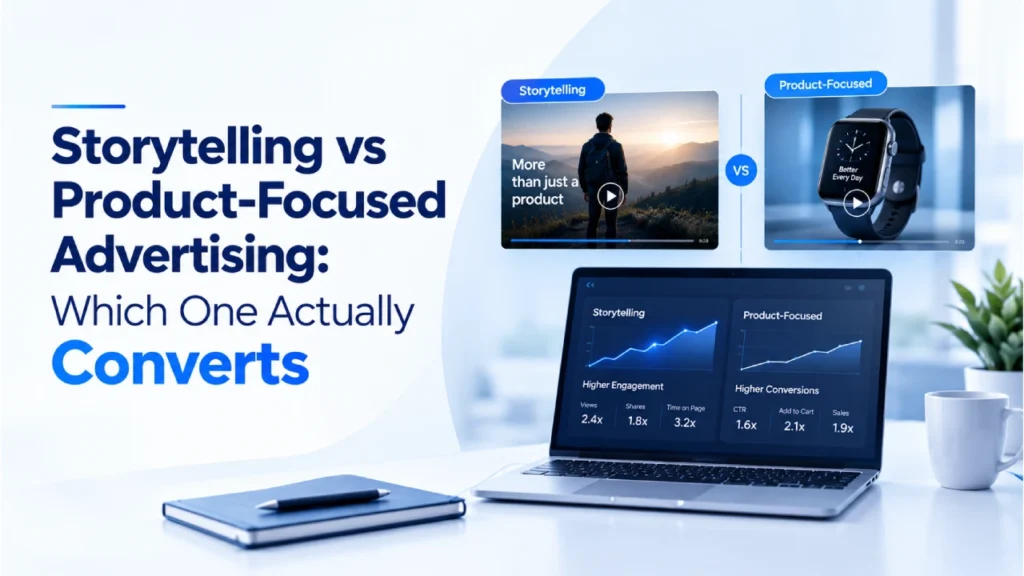
Storytelling vs Product-Focused Advertising
| Factor | Storytelling Ads | Product-Focused Ads |
|---|---|---|
| Main job | Build memory, preference and long-term demand | Convert people already considering a purchase |
| Funnel stage | Awareness and consideration | Consideration and purchase |
| Time horizon | Effects build over months and years | Effects show up quickly, then fade |
| Strongest evidence | IPA data on profit and brand effects, Nielsen sales lift | Video conversion lift on product and landing pages |
| Best categories | FMCG, lifestyle, automotive, BFSI brand films, festive campaigns | High-involvement products, D2C offers, retail promotions |
| Main risk | Beautiful film, unclear product link | Efficient but forgettable, weak brand-building |
| Typical placement | YouTube, cinema, OTT, TV, Instagram Reels | Meta and Google performance ads, product pages, marketplaces |
Which One Actually Converts
Every few months, a marketing head walks into a meeting with the same question. Should the next film tell a story, or just show the product and the price? One side of the room says nobody remembers features. The other side says nobody buys from a film that never mentions the product.
Both sides are right, and that is exactly why the argument never ends. The honest answer to “which one converts” is that it depends on who is watching and where they are in the buying journey. But “it depends” is a lazy answer without evidence, so here is what the data actually says, and how we think about it at Cybertize Media Productions when a brand asks us to make this call.
What We Mean by Each Approach
A product-focused ad leads with the thing being sold. It shows features, demonstrates how it works, states a price or an offer, and asks for the sale. Researchers often call this rational advertising, because it works by giving the viewer information to reason with.
A storytelling ad leads with a human situation. A character wants something, something stands in the way, and the product earns its place in the resolution. It works by changing how the viewer feels about the brand, not by listing what the brand does.
Most real ads sit somewhere between the two. The useful question is not which pure form is better, but which direction a specific film should lean, and why.
What the Evidence Says About Storytelling
Storytelling vs Product-Focused Advertising Data: The strongest dataset in this debate is the IPA Effectiveness Databank in the UK, which collects rigorously audited case studies from three decades of advertising. Les Binet and Peter Field analysed hundreds of these campaigns and found that emotional campaigns outperformed rational ones on every brand metric measured, including awareness, trust, differentiation and fame. In their findings, rational campaigns averaged about 1.0 brand effects per campaign, while emotional campaigns averaged about 1.7.
The profit side is just as striking. Widely cited summaries of the IPA data report that purely emotional campaigns delivered profitability gains of around 31%, compared with roughly 16% for purely rational ones. Binet and Field also found that the advantage grows over time, particularly for campaigns that run three years or longer, because feelings toward a brand outlast memories of facts about it.
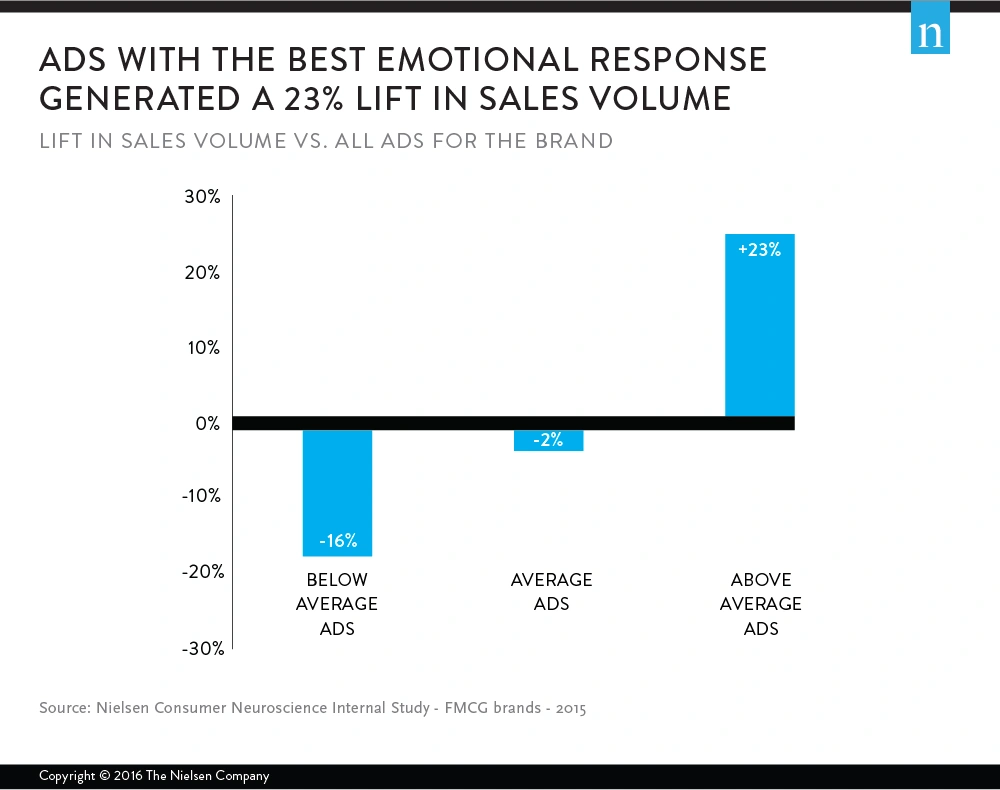
Nielsen’s neuroscience-based testing points the same way. Its analysis of 100 FMCG ads found that ads with above-average emotional response drove a 23% lift in sales volume compared with average ads. And a separate memory study reported that 81% of viewers recalled the brand in emotional ads, against 69% for rational ones, though it also found that younger adults actually remembered more of the rational content, which is a useful reminder that audience matters.
Also Read: From Brief to Ad Film, How a Marketing Brief Actually Becomes an Ad Film
What the Evidence Says About Product-Focused Advertising
None of this means product-focused ads are weak. It means they do a narrower job. Binet and Field’s work draws a clear line here. Rational, product-led messaging mainly works on people who are already in the market. If someone is actively comparing two air purifiers, a clear demonstration of filter performance and a visible price can tip the decision. A heartwarming story about a family breathing easier will not answer their question.
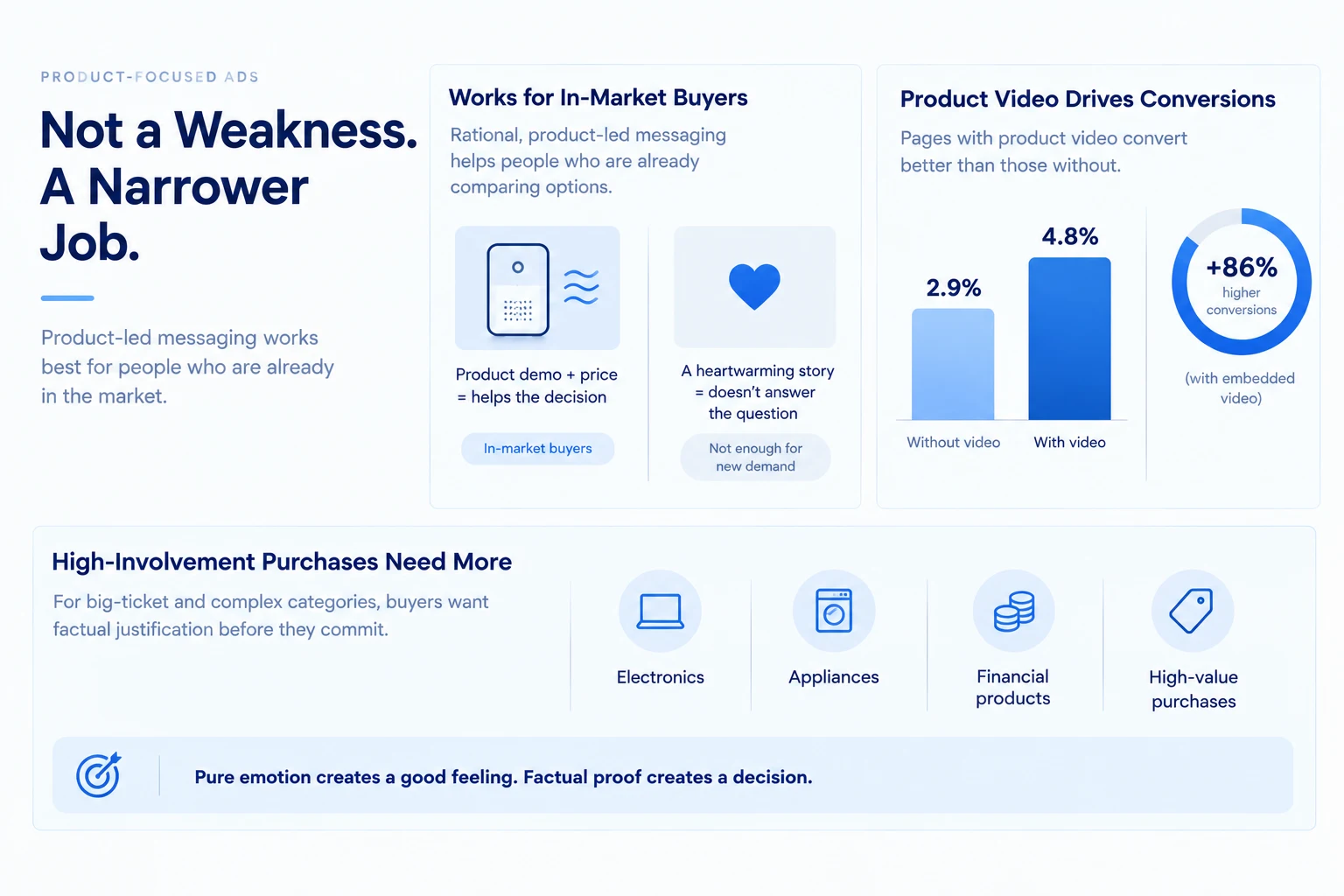
This is where the conversion data on product video becomes useful. Aberdeen Group and WebFX research found that product pages with video convert at about 4.8%, against 2.9% for pages without it, and embedded video on landing pages has been linked to conversion lifts of up to 86%. Those numbers tell you that showing the product clearly, in motion, helps the person who has already arrived at the page. They do not tell you that product demos create demand from people who were not looking.
There is also a category effect. For high-involvement purchases, such as electronics, appliances, financial products or anything with a large price tag, buyers want factual justification before they commit. Pure emotion without proof leaves them with a good feeling and an unanswered question.
Why Most Brands Should Blend Both
Here is the part that often gets lost in the storytelling versus product debate. Binet and Field’s later work suggests that campaigns combining emotional storytelling with rational proof points tend to deliver the strongest overall long-term effects, particularly where the buyer needs a reason as well as a feeling. Their widely discussed guidance on budget balance, roughly 60% on brand building and 40% on activation, comes from the same body of research and reflects the same idea. Story builds the pool of people who prefer you. Product-led activation harvests the ones ready to buy.
In practice, this does not mean stuffing a feature list into a story. It means designing the film so the product is part of the narrative, not an interruption of it. A watch that is the reason a father makes it to a recital on time carries both the feeling and the function. A single master film can then be cut into a story-led version for awareness and a tighter, product-first version for performance placements, which is also far cheaper than shooting two separate campaigns.
Also Read: Ad Film Cost in Delhi, A Complete Pricing Breakdown 2026-2027
Storytelling vs Product-Focused Advertising: A Practical Way to Decide
When a brand brings us this question, we usually work through four checks before touching a script.
First, who is the viewer? If the audience is mostly cold, meaning they do not know the brand or are not shopping yet, lean story. If they are warm retargeting audiences or search-driven shoppers, lean product.
Second, what is the purchase risk? The higher the price and the consequence of a wrong choice, the more proof the film needs, even inside a story.
Third, how crowded is the category? When competitors all show the same features, the product-first approach turns into noise. A distinctive emotional idea can be the only real differentiator.
Fourth, what is the media plan? A fifteen second performance placement cannot carry a full narrative. A cinema or YouTube slot can. The format should shape the creative, not the other way around.
Where Brands Get It Wrong
The most common failure on the storytelling side is the film nobody can connect to the brand. It wins compliments, and then a viewer cannot say who made it. Strong brand cues, early and natural, fix this without breaking the story.
On the product side, the usual failure is asking a feature film to do an emotional job. A spec-heavy ad can sit on the screen with excellent clarity and still leave no trace, because nothing in it gave the viewer a reason to care. Nielsen’s finding that creative drives roughly 49% of a brand’s sales lift is a reminder that the quality of the idea matters as much as the media behind it.
Neither failure is about picking the wrong side. Both come from skipping the earlier question of what the ad is supposed to do.
The Short Answer
If the question is which one converts people who are ready to buy today, product-focused advertising usually has the edge. If the question is which one builds the demand, preference and pricing power that make tomorrow’s conversions cheaper, the evidence favours storytelling by a clear margin. The brands that grow steadily tend to run both, in the right order, with the product woven into the story rather than bolted on at the end.