Table of Contents
The creative industry has a new competitor, but the data tells a complicated story
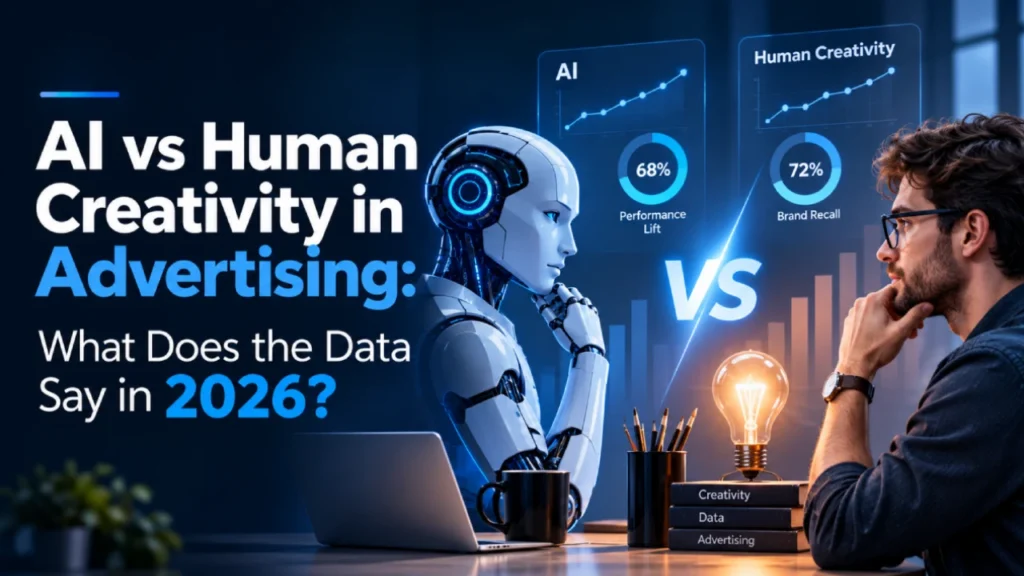
In 2026, two serious research efforts reached opposite headlines. A Marketing Science study found that an AI-built set of ad visuals beat a professional designer’s work on click-through rate in a live Instagram campaign. Ipsos and Syracuse University found that human-made video ads were stronger on predicted sales and brand growth than fully AI-generated versions of the same brief.
Both can be true. The AI vs Human Creativity in advertising debate often confuses capability with effect. AI-generated advertising can now deliver visuals, scripts and video at remarkable speed, but making an advertisement and making one that changes behaviour are different jobs.
So is AI a better creative partner, a replacement for some creative tasks, or a rival to human professionals? This article follows the evidence, separates experiments from commercial outcomes, and labels professional analysis as such. We write as a Delhi NCR production company, so the focus is on film and video for Indian brands.
What the 2026 research actually says about AI vs Human Creativity in Advertising
The studies below compare AI-generated ads vs human-created ads in very different ways, which is why the headlines conflict.
| Study | Design | Headline result |
|---|---|---|
| Ipsos and Syracuse University, 2026 | 10 human 30-second ads vs fully AI versions of the same brief; 3,000 US consumers; predicted sales and brand impact | Human ads 14% stronger short term, 17% stronger long term |
| Daviet and Nishimura, Marketing Science, 2026 | Live Instagram campaign; AI visuals picked by an active-learning system vs a professional designer; click-through rate | 0.98% vs 0.65%; 18 months later, 3.38% vs 3.24% |
| Exner, Hartmann, Ding, Zhang and Netzer, Columbia Business School, 2026 | Matched AI and human sibling ads on Taboola; 16 billion+ impressions; click-through rate | No average gap; AI ads that did not look like AI won |
| Heitmann and colleagues, Journal of Marketing, 2026 | AI model trained on consumer ratings; Polestar ads on Meta, about 28,000 impressions | CTR 2.04% vs 1.37%; weaker for a surprise-led product |
Three things stand out. Only the Ipsos study tested finished 30-second films against a sales-validated measure. Most positive results measure clicks or ratings, not sales. And AI means different things: a single-pass video model in one study, a feedback-trained optimisation system in another.
When AI-generated advertisements outperform human creativity
The clearest wins come from systems built for performance. In the Marketing Science campaign, the AI portfolio was chosen by a model that predicted which visuals would perform and screened them for brand fit before launch. Its results were also more consistent than the designer’s, meaning fewer weak creatives. The follow-up lead 18 months later was only 0.14 percentage points, so the advantage persisted but was modest.
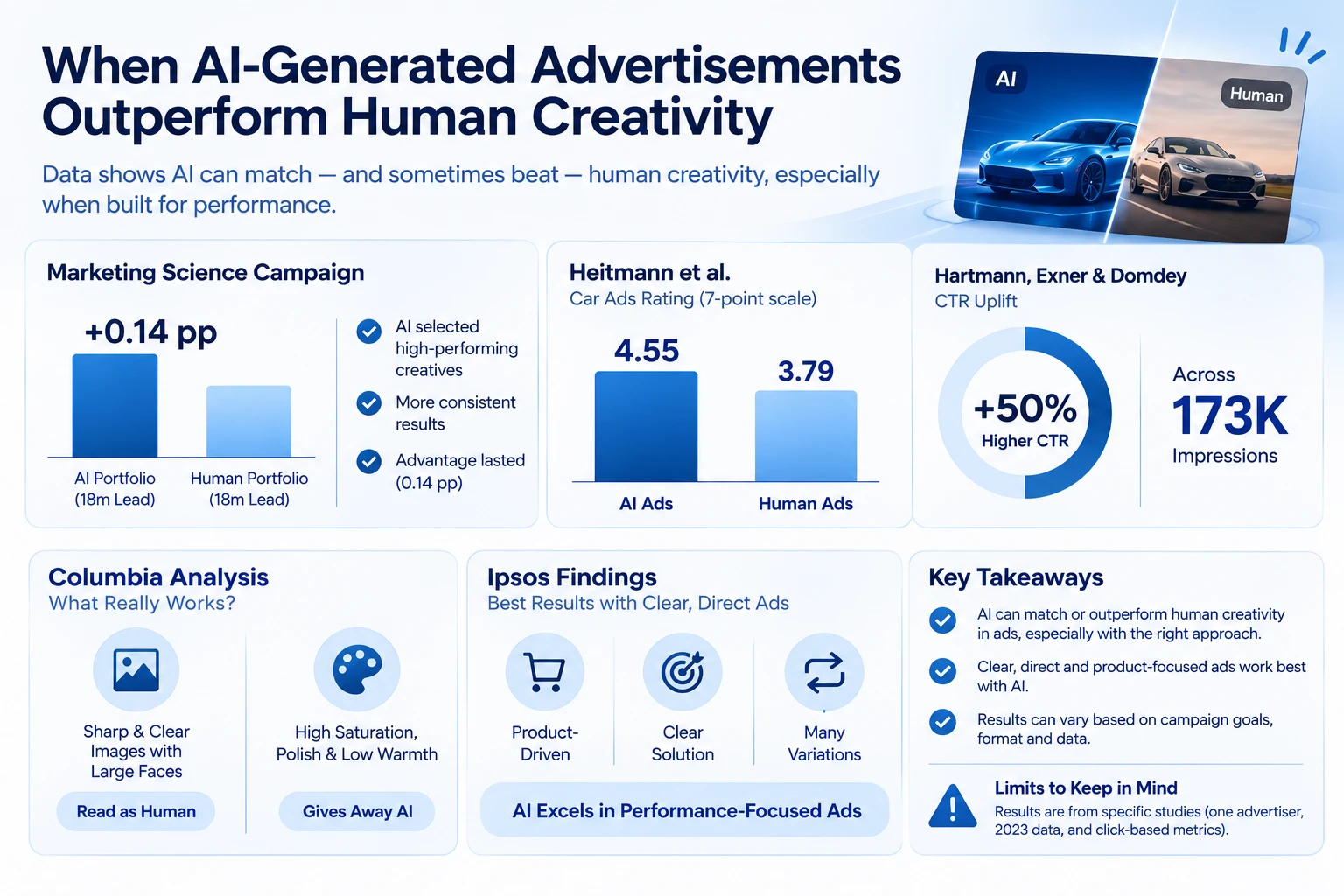
Other studies support the pattern. Heitmann and colleagues trained an image model on consumer ratings of effective ads; its car ads averaged 4.55 against 3.79 for real ones on a seven-point scale. Hartmann, Exner and Domdey found in the International Journal of Research in Marketing that AI banners earned up to 50 percent higher click-through than a stock photograph across 173,000 impressions.
Perception mattered as much as quality. In the Columbia-led analysis, AI ads were not better on average once campaign factors were controlled, but those that did not look AI-made beat human ads. Sharp, clear images with large faces read as human. Intense colour saturation, polish and low warmth gave AI away.
Ipsos adds a useful boundary. Its strongest AI-made films were product-driven, direct and built on creative formats the brand had used before. In our view, that is where AI in advertising production earns its keep: clear problem, clear solution, many variations.
Limits apply: the Marketing Science result covers one advertiser on one platform and measures clicks, and the Columbia matched-ad analysis used 2023 data, so newer models may behave differently.
Where human-created advertising still has an advantage
Ipsos and Syracuse controlled for strategy by reverse-engineering the brief behind each original ad, then generating a film from it with no human edits. Only 25 percent of viewers who saw an AI ad were at least somewhat confident it was AI, yet human work was rated more entertaining, more unique and more talkable.
Human creativity in advertising shows most clearly in storytelling. Ipsos found that 49 percent of ads in its wider data use storytelling, against only 30 percent of the AI films, and the most effective ad of all was a human-made Chewy holiday film built on a real human tension. Ipsos adds that ads breaking category conventions are over 20 percent more likely to win brand attention, a leap it argues AI rarely takes.
Product type is another boundary. In Dan Li’s experiments at Widener University (two online studies, 275 participants), AI ads were rated higher, but significantly so only for utilitarian products, not hedonic ones, where feeling matters more than function. The Journal of Marketing team found a related limit: AI trained on category averages scored slightly below real ads for the Smart Fortwo, a tiny car whose advertising relies on surprise, and could not match the humour of human dog-food ads.
That team also warned of sameness: the same plant motif recurring across sunscreen ads, similar roads across car ads. If every advertiser’s model converges on one average, distinctiveness suffers.
Why an advertisement that looks impressive does not always sell
Click-through rate is the share of viewers who click after seeing an ad. It measures curiosity, not conviction. A striking image can win the click and still fail to build memory or purchase intent, which is why AI advertising effectiveness cannot be judged on one number.
Evidence on what happens after the click is thin. Taboola’s release on a related Columbia-led field study of 500 million impressions says AI visuals did not reduce downstream conversions, but the claim comes from the platform itself, so treat it as a lead, not proof.
Attention is not emotion, and emotion is not brand memory. Kantar found that ads using generative AI provoked stronger emotional reactions, yet one widely shared unofficial ad landed in the bottom quarter of tested ads for brand memorability because the brand barely featured in the story. In a 2026 eye-tracking study of 39 young, heavy AI users, AI-generated ads won 58.97 percent of forced choices, but the images were more densely detailed and the sample was tiny.
Strategy still decides. In Ipsos’s data, the strongest work, human or AI, began with a brief rooted in a resonant human truth: the Cheerios pair, built on being there for the people who need you, scored highest across the ten brands. Brands need attention, brand linkage, emotion, conversion and cost per outcome read together.
The real advantage may be AI and human creative collaboration
The collaboration evidence is thinner but consistent. In a Journal of Advertising Research experiment, 98 advertising professionals were randomly assigned to no GenAI, GenAI, or GenAI after prompt training. Only the trained group produced significantly more ideas, and perceived creativity did not differ. AI widened the funnel only for people who knew how to direct it.
Hybrid results are encouraging but modest. In the eye-tracking study, human ads refined by AI with one generic prompt were chosen about as often as the originals (49.88 percent). System1 and Jellyfish tested 18 AI-assisted films and reported 3.4 stars against 2.3 for System1’s 123,000-ad database, though the sample was small and seven films came from Jellyfish’s own group.
In production terms, AI is most useful before the camera rolls. In our view, experienced teams can use it for:
- Concept exploration, storyboards and previsualisation
- Moodboards, visual references, and location and set design exploration
- Editing assistance, multiple creative variations and campaign adaptation
Human judgement matters most where the brand is won or lost: choosing the concept, refining the script, directing performances, controlling visual language, reading cultural nuance and keeping the brand consistent. Ipsos noted that video models make errors and inconsistencies, and some of its AI ads needed several iterations to reach a testable standard. Someone has to decide what good enough means.
What this means for advertising films and video production in India
Most controlled evidence here comes from US or Western platform data. We did not find a comparable controlled study on Indian audiences or regional-language advertising, so what follows is professional analysis, not research findings.
The rules are moving faster than the research. India’s amended IT Rules, notified on 10 February 2026, require synthetic content to be labelled, with duties falling on intermediaries such as platforms. ASCI’s guidelines, issued on 29 September 2026 and effective from 29 December 2026, require advertisers to label AI content where it materially influences consumer decisions and non-disclosure could mislead. Disclosure planning now belongs in the brief.
By format, our view is this for AI in video production:
- TV commercials and brand films: use AI for animatics and look tests; protect the performances, sound and craft that carry emotion, where Ipsos found AI weakest.
- Corporate films: real founders, plants and teams are the proof. Synthetic stand-ins can weaken credibility.
- Product advertisements: shoot the physical product accurately; use AI around it for backgrounds and variants.
- Digital and social video: AI-led versioning is where testing evidence is strongest, with human review.
- Regional and multilingual campaigns: AI can speed adaptation, but idiom, humour and cultural cues need native writers and directors.
AI can reduce certain pre-production costs, such as visualisation, revisions and versioning, but not every project gets cheaper. Iteration, human review, legal checks and labelling add work, and real locations, authentic people, physical products and cinematography still cost what they cost. A transparent line-item budget shows where AI saves money and where it does not, which is how we approach budgets at Cybertize Media Productions, without assuming Mumbai-level spend.
How brands should decide between AI-generated and human-produced advertising
Let the objective choose the method.
| Approach | Suits | Watch for |
|---|---|---|
| AI-led | Lower-funnel product ads, static and social variants, high-volume testing | Looks-like-AI cues, sameness, brand drift, disclosure duties |
| Hybrid | Most TV and brand campaigns: AI for concepts, previs and variants; people for script, casting, shoot and edit | Unclear ownership of final judgement; endless iteration |
| Human-led | Emotion-led brand films, founder and customer stories, hedonic or premium products, culturally sensitive work | Higher cost and time; variant testing must be planned |
Five questions sharpen the choice. What is the objective: clicks, sales or long-term brand building? How sensitive is the audience to authenticity and disclosure? Does the brand’s positioning depend on being different? How complex is the production, and how much of it must be real? And what return would justify the budget, measured how?
The future of advertising creativity: replacement or reinvention?
As per AI vs Human Creativity analysation at Cybertize Media, Some work will be absorbed by machines. Resizing, variant generation and routine banner production are already heading that way, and the evidence above says that is acceptable when brand and strategy are set by people.
The harder shift is about advantage. If every advertiser can reach good enough in minutes, good enough stops differentiating, and value moves to distinctive ideas, strong scripts, direction and the discipline to measure what works. The winners will combine creative judgement, storytelling, technology and campaign data.
From where a production company sits, the scarce skill is no longer making an image. It is knowing which image deserves to exist, directing it until it feels true, and being accountable for whether it works. That is why we stay script-first and use AI where it earns its place.
Sources and research references
- Ipsos and Syracuse University S.I. Newhouse School (Peruta, Riby, Cummings, Pascale), AI Ads Are Good Enough, and That’s the Problem, May 2026: Ipsos white paper (PDF). Syracuse University press release: Phys.org
- Daviet, R. and Nishimura, Y. (2026), Leveraging Generative Artificial Intelligence to Create Visual Content in Digital Advertising, Marketing Science: DOI. INFORMS release, 4 August 2026: INFORMS
- Exner, Hartmann, Ding, Zhang and Netzer, AI in Disguise: Quasi-Experimental Analysis of a Large-Scale Deployment of AI-Generated Ads, Columbia Business School Research Paper 5096969, revised October 2026, Marketing Science (forthcoming): SSRN; Columbia working paper page; Taboola release on the related 500-million-impression study
- Perin, Milano, Barros and Bagatini (2026), Human-GenAI Collaboration in Creative Ideation: A Study with Advertising Professionals, Journal of Advertising Research: Google Research
- Li, D. (2026), Artificial creativity meets consumer reality: the role of affective involvement and product type in responses to AI-generated ads, Journal of Consumer Marketing: DOI
- Hartmann, Exner and Domdey (2025), The power of generative marketing: Can generative AI create superhuman visual marketing content?, International Journal of Research in Marketing, 42(1), 13-31: DOI
- Heitmann, Jansen, Reisenbichler and Schweidel (2026), Picture Perfect: Engaging Customers with Visual Generative AI, Journal of Marketing: DOI. Design details taken from the Science of Money summary, because the publisher page could not be opened.
- Goncalves, Afonso, Martins and Teixeira (2026), Eye-Tracking Analysis of Visual Attention and Preference in Human-Created, AI-Generated, and AI-Refined Human Advertisements, Sensors 26(20), 6411: DOI
- Shi, Y. and Jiang, Z. (2026), Consumer Responses to AI Disclosure Labels: The Role of Novelty and Authenticity, SAGE Open: DOI
- Kantar, Rethinking AI-generated advertising: how real people really react (2025): Kantar
- Roach, T. (Jellyfish) with System1, You can’t dismiss AI ads as slop when they’re winning in testing, Marketing Week (2025): Marketing Week
- India: ASCI, Guidelines for Responsible Labelling of Synthetically Generated Content in Advertising (29 September 2026), summarised by Lexology and MediaNama; IT (Intermediary Guidelines and Digital Media Ethics Code) Amendment Rules, 2026 (notified 10 February 2026), summarised by Khurana & Khurana. Check the official ASCI and MeitY texts before publishing.