Table of Contents
A Note on This Report
This is a compiled analysis, not a primary study. We did not survey viewers or run controlled ad tests for this piece. It brings together published research on how Indians use the internet in different languages, reported campaign results, and production knowledge about how regional films are actually made. Each claim is labelled by how strong its evidence is, and some widely circulated benchmarks were left out because we could not trace them to a primary source. The Methodology section at the end explains what was used and what was excluded.
India’s Regional Advertising Effectiveness Report: Hindi vs. English vs. Vernacular Video Ads
Most brands begin with a simple question. Should the film be in English, Hindi, or the local language of each market? The honest answer is that the question is too narrow. The real decisions sit underneath it: who the audience is, what the product asks of them, how much trust the category needs, and whether the film is translated or genuinely rewritten for each region.
This report works through those decisions with the best evidence available, and is clear about where that evidence is thin.
Also Read: Storytelling vs Product-Focused Advertising, Which One Actually Converts
India’s Language Landscape: What the Data Shows
The most reliable source on this is the Internet in India report, prepared by IAMAI and Kantar. It is based on a large consumer survey and is the standard reference for Indian internet behaviour.
| Finding | Figure | Source |
|---|---|---|
| Active internet users in India, 2024 | About 886 million | IAMAI-Kantar, Internet in India 2024 |
| Users who accessed the internet in Indic languages, 2024 | About 870 million (98%) | IAMAI-Kantar 2024 |
| Urban users who prefer Indic languages for internet content | 57% | IAMAI-Kantar 2024 |
| Active internet users, 2025 | About 958 million | IAMAI-Kantar, Internet in India 2025 |
| Share of active users in rural India, 2025 | About 57% (roughly 548 million) | IAMAI-Kantar 2025 |
| Users consuming short video, 2025 | About 588 million (61%) | IAMAI-Kantar 2025 |
| Users who prefer content in their native language | 68% | IAMAI-Nielsen, 2024, as widely reported |
The 2025 edition drew on a survey of nearly 100,000 consumers across more than 400 towns and over 1,000 villages.
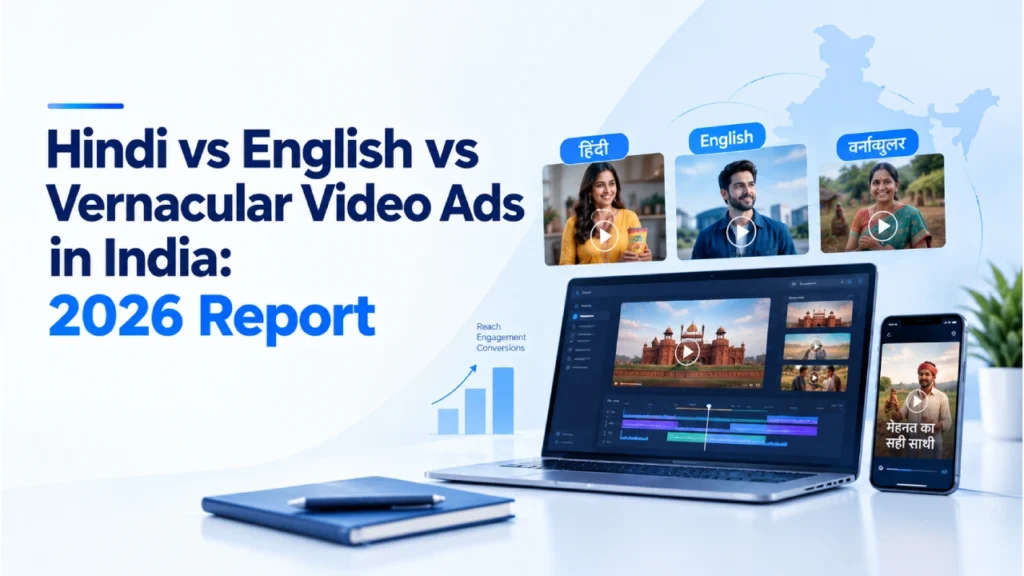
Hindi vs English vs Vernacular Video Ads: Three things follow from this. First, Indic-language use is close to universal, so an English-only plan is a deliberate choice to speak to a narrower audience. Second, growth is rural and small-town led, and those users arrive on mobile through short video. Third, even in urban India a majority prefer Indic languages for at least part of their consumption, so the “English for metros” rule is weaker than it used to be.
A caution on language-level data. The 2024 report groups Indic languages by a “conversion ratio”, which compares users who mainly use a language online with users who have used it in the past year. Tamil, Telugu and Malayalam show high ratios, Hindi and Kannada mid-range, and Gujarati, Marathi and Bengali lower. This describes how people use the internet, not how they respond to ads. It suggests where a native-language environment is strongest, but it should not be read as an ad-effectiveness ranking.
Hindi vs English vs Vernacular Video Ads: A Practical Comparison
| Approach | Where It Works Well | Where It Struggles | Typical Best Fit |
|---|---|---|---|
| English | Urban professional audiences, technology, premium and aspirational categories, B2B, national corporate communication | Tier 2 and Tier 3 audiences, categories needing trust and explanation, emotional storytelling in family settings | Corporate films, SaaS, luxury, investor communication |
| Hindi | Pan-India reach across a large Hindi-speaking belt, national mass campaigns, a bridge language in many cities | Can feel like an imposition in states where Hindi is not the home language, and may miss local texture even in Hindi states (Bhojpuri, Rajasthani, Haryanvi and other regional speech) | National FMCG, entertainment, mass-market services |
| Vernacular (Tamil, Telugu, Kannada, Malayalam, Marathi, Bengali, Gujarati and others) | State-level campaigns, categories driven by trust and family decisions, regional launches, festivals | Higher production effort per language, smaller audiences per version, quality risk if translation is shallow | Regional launches, banking and insurance, edtech, local retail, e-commerce festivals |
| Hinglish and mixed language | Youth, urban social video, creator-led content | Can date quickly and may not suit formal categories | Social campaigns aimed at younger urban audiences |
No row is “best”. The right choice depends on audience and objective.
What the Research Says About Engagement and Outcomes
Claims about language and ad performance vary a lot in quality. This table grades them honestly.
| Claim | Evidence Quality | Notes |
|---|---|---|
| Most Indian internet users use Indic languages online | Strong | Large IAMAI-Kantar survey data |
| Rural and small-town users now drive internet growth | Strong | IAMAI-Kantar 2024 and 2025 |
| Users trust local-language content more | Moderate | An earlier Google-KPMG study reported that around 70% of Indians find vernacular digital content more reliable than English. It is older research and measures perception, not purchase |
| Vernacular ads can lift click-through | Moderate, dated | An early study by ad network Ozone Media, now more than a decade old, found up to 30% more clicks on regional-language ads. It also found NRIs preferred English for financial products, which shows audience context matters |
| Regional creatives outperform English in specific campaigns | Anecdotal | One Bengaluru agency reports Kannada or Hindi variants beating English by roughly 20 to 40% on cost per lead for non-IT audiences. This is a single practitioner observation, not a benchmark |
| Brands are shifting budgets toward vernacular | Moderate | Brand leaders, including Dabur, have said a significant share of digital spend now goes to vernacular content for regionally relevant products. Meesho’s growth leader has said around 90% of its campaigns are localised |
The sound conclusion is directional. Language and cultural fit improve relevance and trust, and brands are acting on that. But precise uplift numbers circulating online, such as blanket claims of several-times-higher engagement, are rarely traceable to a primary source and should not be quoted as fact. The right way to know your own uplift is to test it, which the measurement section covers.
Also Read: Brand Storytelling Insight, Why Brands No Longer Need “Ads”, They Need Watchable Stories
Cultural Relevance and Regional Storytelling
Translation changes the words. Localisation changes the film.
Beyond dubbing. Indian advertising commentary has long noted a shift from dubbed ads to regionally conceived ones. Meesho’s “Arre Waah” campaign is a documented example. It was shot in three zonal languages, Hindi, Bengali and Tamil, and then extended into other languages, rather than being made in one language and dubbed.
What culture changes in a film:
- Idiom and humour. A joke built on a Hindi pun rarely survives translation into Marathi or Kannada.
- Festivals and seasons. Onam, Pongal, Durga Puja, Ganesh Chaturthi, Bihu and Diwali carry different weight in different states. A national “festive” film can miss all of them.
- Casting and faces. Viewers notice when characters do not look or sound like people from their region.
- Locations and settings. Homes, markets, clothing and food signal belonging within seconds.
- Family roles and authority. Who decides, who persuades and who is respected differs between communities, and this affects how a product story is staged.
- Dialect. Even within a language, urban, rural and regional speech differ. Standard “textbook” language can feel formal or distant.
When one story travels. Some ideas are universal, such as a parent’s pride or a first salary. These can be shot once and adapted lightly. Others are rooted in a place, and forcing them across regions reads as generic. The skill is deciding which is which before the shoot.
Subtitles, Voiceovers and Native Production Compared
| Approach | How It Works | Strengths | Risks | Best For |
|---|---|---|---|---|
| Subtitles | Original audio with translated text | Fast and economical, preserves original performance, works for sound-off viewing | Reading effort, text can crowd the frame, less emotional pull | Explainers, corporate films, social video where many watch muted |
| Dubbed voiceover | Replaced audio in another language | Familiar audio for the viewer, moderate cost | Lip-sync mismatch on camera speakers, flat performance if casting is weak | Product and service films, narration-led ads |
| Native-language production | Scripted and performed in each language | Highest authenticity, natural humour and rhythm | Highest cost and coordination | Brand films, festive campaigns, regional launches |
| Hybrid (shoot once, adapt) | Shot to allow several audio and graphic versions | Best cost-to-relevance balance if planned early | Needs planning before the shoot | Multi-region campaigns |
Production points that matter:
- Plan for subtitles in framing. Keep key action and graphics clear of the lower third.
- Capture clean ambient sound separately so each language version can be mixed without redoing effects and music.
- Avoid text baked into shots. Where possible, keep on-screen text in separate graphic layers so each language can be swapped.
- Allow for different speech lengths. Some languages take more time to say the same line, which affects timing and edit pacing.
- Review every translation with a native speaker, not just a translator. Tone and register matter.
On AI dubbing and translation tools. Voice and translation tools can speed up drafts and first versions across languages. Quality varies by language and by voice, and human review is needed for tone, cultural sense and correctness, particularly for lesser-served languages. We treat these as production aids, not substitutes for native review.
How to Measure Whether Language Is Working
Because published uplift numbers are mixed, the safest approach is to run your own comparison.
A simple test design
- Pick one core creative and one market.
- Create a language-only version (same film, translated or dubbed).
- Create a culturally adapted version (rewritten for that region, with local casting or settings where practical).
- Keep the media plan, budget and audience the same across versions.
- Compare view-through rate, completion, click-through, cost per lead or acquisition, and, where budget allows, a brand-lift or recall survey.
- Run long enough to see stable results, and repeat for a second region before generalising.
Metrics to watch: completion and view-through (relevance), click-through and cost per lead (response), recall and favourability (brand effect), and comments and shares (cultural resonance).
Test both English against vernacular and translated against adapted. The second comparison is often more revealing.
Category Notes (Editorial Assessment)
These are our practical views from production planning, not research findings.
- FMCG and everyday products. Strong case for regional-language and culturally rooted films, especially for Tier 2 and Tier 3 reach.
- Banking, insurance and fintech. Trust and clarity matter, so local-language explanation tends to help. Check regulatory wording in every language.
- Edtech. Parents and students often decide in different languages. Plan for both.
- E-commerce. Festival-led regional content and creator-led video fit well.
- Premium and luxury. English or Hinglish often suits the positioning, though regional storytelling can still work for heritage and craft.
- B2B and corporate communication. English is usually primary, with regional versions for employee communication, plant-floor training and local stakeholder outreach.
- Public information and social campaigns. Native language is usually essential for understanding.
Also Read: The State of Video Marketing in India 2027, Full Industry Outlook
Cost and Production Implications
Each additional language is more than a line in the budget. It adds script adaptation, native review, voice or casting, recording, edit versions, subtitle files and quality checks. Native production adds casting, location and crew considerations on top.
A practical approach is to quote languages as a separate line item and to choose a tier per market: subtitles for secondary markets, dubbed versions for mid-priority markets, and native production for priority regions. Deciding this before the shoot is much cheaper than retrofitting afterward.
Common Mistakes
- Translating word for word and calling it localisation
- Using one “standard” Hindi for every Hindi-speaking region
- Treating all southern languages as interchangeable
- Placing subtitles over important visuals
- Skipping native-speaker review
- Judging results on a single campaign
- Comparing language versions with different budgets or audiences
Trends to Watch in 2026-2027
- Short video as the main format. With about 61% of internet users consuming short video, regional creators and short formats shape expectations.
- Rural-led growth. Rural users are growing faster than urban users, which increases the importance of vernacular reach.
- Connected TV and OTT. Regional OTT and connected TV give brands premium vernacular environments.
- Voice interfaces. Voice use in Indian languages is rising, which affects how people discover products.
- Faster localisation workflows. Better translation and dubbing tools shorten production, while raising the importance of human review.
- Creator-led regional content. Local creators carry trust that polished national films may not.
Regional Video Production by Cybertize Media Productions
Hindi vs English vs Vernacular Video Ads: Cybertize Media Productions is a Delhi NCR-based production company working with brands across India. For multi-language campaigns we plan localisation before the shoot, so one production can support subtitled, dubbed and, where it matters, natively performed versions.
We work script-first with human creative direction. We use AI-assisted tools selectively for drafts and workflow speed, and we rely on native-speaker review for every language. Language versions are quoted as separate line items so budgets stay transparent.
If you are planning a campaign across regions, share your markets, languages, objectives and timeline, and we will propose a production plan that fits your budget.
Methodology and Source Notes
What this report is. A compiled analysis built from published research and reported results. It is not a survey or a controlled test.
Sources used:
- IAMAI and Kantar, Internet in India Report 2024 (user counts, Indic language use, urban preference, language conversion ratios)
- IAMAI and Kantar, Internet in India Report 2025, as reported in Indian business press (958 million active users, rural share, short-video consumption, survey base)
- IAMAI and Nielsen, 2024, as widely reported (68% preference for native-language content)
- Google and KPMG study on Indian languages, as reported by Storyboard18 and Forbes India (around 70% find vernacular digital content more reliable)
- Exchange4media coverage of an Ozone Media study on regional-language ad clicks (dated)
- Exchange4media coverage of the IAMAI-Kantar report, including brand comments from Dabur
- Storyboard18 and Forbes India coverage of vernacular advertising, including Meesho’s “Arre Waah” campaign and localisation share
- Apex Influence, Meta Ads guide for India (practitioner observation on Kannada and Hindi variants)
What was excluded. Several benchmarks widely repeated on marketing blogs, such as blanket multipliers for engagement or cost reductions attributed to named brands, could not be traced to primary documents and were not used.