Table of Contents
Generative AI for Ad Film Pre-Production: Pre-production has always been the part of filmmaking nobody outside the industry thinks about, and the part everyone inside it knows actually determines whether a shoot day goes well. It is also, as it turns out, the part generative AI has changed the fastest and the most thoroughly, faster even than the much more talked about video generation stage that comes after it.
At Cybertize Media Productions, we have watched this shift happen stage by stage over roughly two years, and it is worth walking through honestly, because the pattern is consistent and useful. AI has gotten remarkably good at speeding up exploration at every stage of pre-production. It has not gotten good at replacing the judgment that decides which explored direction is actually right. Here is what that looks like in practice, stage by stage.
Also Read: Can AI Replace an Ad Film Director? A Practical Analysis of AI vs Human Direction
How Generative AI for Ad Film Pre-Production works:
Idea: From Blank Page to a Room Full of Angles, see how Generative AI for Ad Film Pre-Production works
The oldest and slowest part of any ad concepting process used to be the blank page, a creative team staring at a brief trying to generate the first few workable angles before any real discussion could begin. Large language models have genuinely collapsed this step. A team can now run the same brief through ChatGPT and Claude in the same session and get meaningfully different creative angles back within minutes, using one model’s output as a check against the other rather than relying on a single tool’s take.
This has become common enough that dedicated workflows exist specifically for it, structured processes that take a product or brand brief and generate a batch of fully specified concept directions, headline, visual direction and audience angle included, ready for a creative team to react to rather than build from nothing. The actual value here is volume and speed of divergent thinking, not final judgment. A tool can hand a team fifteen headline variations and a dozen visual directions in the time it used to take to brainstorm three. What a tool cannot do is know which of those fifteen headlines actually fits what this specific brand has said before, or which visual direction will read as authentic rather than generic once a client who knows the brand intimately looks at it. That filtering remains entirely a human creative judgment call, just applied to a much larger set of raw material than teams used to generate on their own.
Script: Faster Drafts, the Same Need for a Real Writer
Scripting is where AI’s usefulness starts to narrow slightly, and the narrowing is instructive. Language models are genuinely strong at producing a fast first draft structure, an opening hook, a mid section building toward the product moment, a closing line, built from a chosen concept direction. They are considerably weaker at the specific thing that actually makes an ad script work, a line of dialogue or voiceover that sounds like a real person rather than a competent paraphrase of the brief.
This is also where current ad industry tooling has started splitting models by task rather than treating any single one as a universal writer. Comparative testing in 2026 found one leading model consistently outperforming at headline generation and high volume creative variation, while a competing model held an edge on maintaining brand consistent tone across a longer sequence of connected copy, a distinction worth knowing before committing a script’s final pass to whichever tool happens to be open. The practical workflow that has emerged treats AI for Ad Film Pre-Production as a fast first draft and option generation tool, with a human writer or creative director doing the pass that actually makes a script sound like it was written for this specific brand and this specific audience, not assembled from generic best practice.
Shot List: Translating a Script Into an Executable Plan
A shot list is where a script’s narrative beats turn into a concrete, numbered plan a crew can actually execute, every shot’s size, angle, movement and approximate duration, mapped against the production schedule. This stage has historically been one of the more mechanical parts of pre-production, which makes it a reasonable candidate for AI assistance, and current tooling has started to genuinely help here, generating a first pass shot breakdown from a locked script that a line producer or director then adjusts for the realities of a specific location and crew.
The limitation shows up exactly where it tends to show up everywhere in this pipeline. A generated shot list can correctly infer that a product reveal probably needs a close up and that an establishing moment probably needs a wide shot, but it has no way of knowing that a specific location has a load bearing pillar directly where that wide shot was planned, or that the client specifically wants to avoid a certain angle because of a past campaign controversy. Shot listing with AI assistance moves faster. Shot listing without a human review pass against the actual location and client history remains a genuinely risky shortcut.
Storyboard: The Stage AI Has Changed the Most Visibly
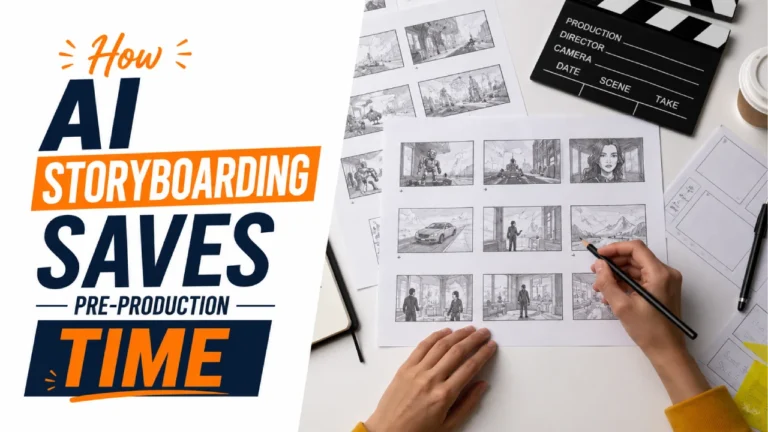
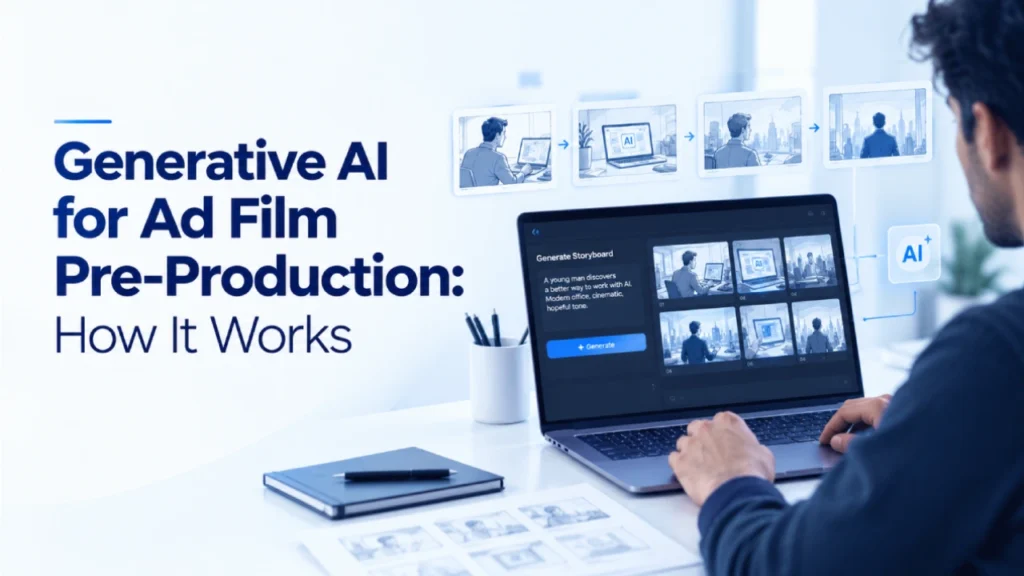
This is the stage where generative AI’s impact has been the most dramatic and the most visible to clients directly, because storyboarding used to be entirely dependent on an illustrator’s time and availability. Traditional storyboarding for a mid sized production could consume two to three weeks of a director and illustrator working together. AI assisted storyboarding tools have compressed a comparable visual sequence down to a matter of minutes in many cases, letting a director describe a shot in plain language and get back a usable visual frame almost immediately.
Generative AI for Ad Film Pre-Production: For ad shoots specifically, this has changed the client approval conversation more than almost anything else in this pipeline. A production team can now show a client two or three fully visualised concept directions before committing budget to one, rather than describing directions verbally and asking a client to imagine the difference. What has not changed is the judgment about which generated frame actually serves the story and which one is just a technically competent image. Every serious production still runs a human pass over an AI generated storyboard sequence, checking it against story logic and against what is realistically achievable within the shoot day’s actual schedule and budget, the same checks a human storyboard artist’s work has always needed.
Previsualisation: Seeing the Film Before It Is Shot
Previsualisation takes a storyboard a step further, often into rough motion, camera movement tests, lighting mockups, sometimes a full animated rough cut of the entire film before a single frame of real footage exists. This is where the compression effect across the whole pipeline becomes most measurable. End to end AI assisted pre-production workflows, covering concepting through a working previsualisation pass, have pushed overall pre-production timelines on larger productions from roughly sixteen to twenty weeks down to eight to eleven weeks, and dedicated previsualisation tools have reported turnaround improvements of similar scale on individual projects.
This stage is also where AI for Ad Film Pre-Production tools have started accepting genuinely technical creative input rather than just plain language description, some current platforms now take structured camera parameters directly, pan direction, movement speed, lens behaviour, letting a director previsualise a specific camera move rather than describing it and hoping the generation matches intent. The result is a previsualisation pass that increasingly resembles the actual planned shoot closely enough to catch problems that would otherwise only surface on set, a wide shot that does not work with the planned blocking, a camera move that needs more floor space than the location actually has.
Production: Where Pre-Production’s Work Actually Pays Off
By the time an ad film reaches an actual shoot day, the honest measure of whether AI assisted pre-production worked is how little needs to be figured out live. A well interpreted idea, a tightly written script, a realistic shot list, a storyboard that has already been checked against the location, and a previsualisation pass that has already surfaced the obvious problems, together mean the shoot day is mostly about capturing what has already been agreed, with the crew’s attention going toward performance and craft rather than discovering the plan for the first time under time pressure.
This is also precisely why AI for Ad Film Pre-Production adoption has concentrated so heavily in pre-production rather than in the shoot itself. The decisions that happen live on set, adjusting an actor’s performance between takes, reacting to a location that looks different from the previsualisation, managing a client’s in the moment feedback, remain decisions that depend on reading real people and real physical space in real time, which is a fundamentally different problem from generating a plausible frame or a competent first draft. AI has made every stage leading up to that moment faster. It has not changed what actually has to happen once the camera rolls.
Also Read: Top AI Tools for Film Production in 2026 and 2027
What This Means Going Forward using Generative AI for Ad Film Pre-Production in 2026 -2027:
The pattern across every stage in this pipeline is consistent enough to draw a clear conclusion from. Generative AI is extremely good at the part of pre-production that involves generating options quickly, more headlines, more visual directions, more shot variations, more storyboard frames, more previsualised camera moves. It remains limited, in exactly the same way across every stage, at the part of the job that involves deciding which of those generated options actually serves the brand, the story and the specific context a human production team understands and a model does not.
The production teams getting genuine value from this shift are not the ones hoping AI will make the judgment calls for them. They are the ones using it to generate more raw material to judge, faster, while keeping every actual decision about what makes the final cut exactly where it has always belonged, with the people who understand what the film is actually trying to do.