
Table of Contents
A corporate film is supposed to do one job: make someone outside the company understand, in a few minutes, why this company deserves their trust. Most corporate films in India do not do this job. They open with a drone shot of the factory, cut to the MD sitting behind a desk talking about “vision” and “excellence,” and close with a logo animation. Nobody outside the marketing department ever watches it twice.
Need Corporate Film Production Team in India? Choose Cybertize Media
This report is the result of an internal benchmarking exercise we ran at Cybertize Media Productions Private Limited, reviewing corporate film output across five major Indian industry verticals: manufacturing, IT, healthcare, real estate, and education. Our goal was not to name and rank specific companies. It was to build a usable scoring framework that any business, agency, or production house in India can apply to its own corporate film, and to document what the data tells us about where Indian corporate filmmaking is succeeding and where it is consistently falling short.
Why a Benchmark Report, and Why Now
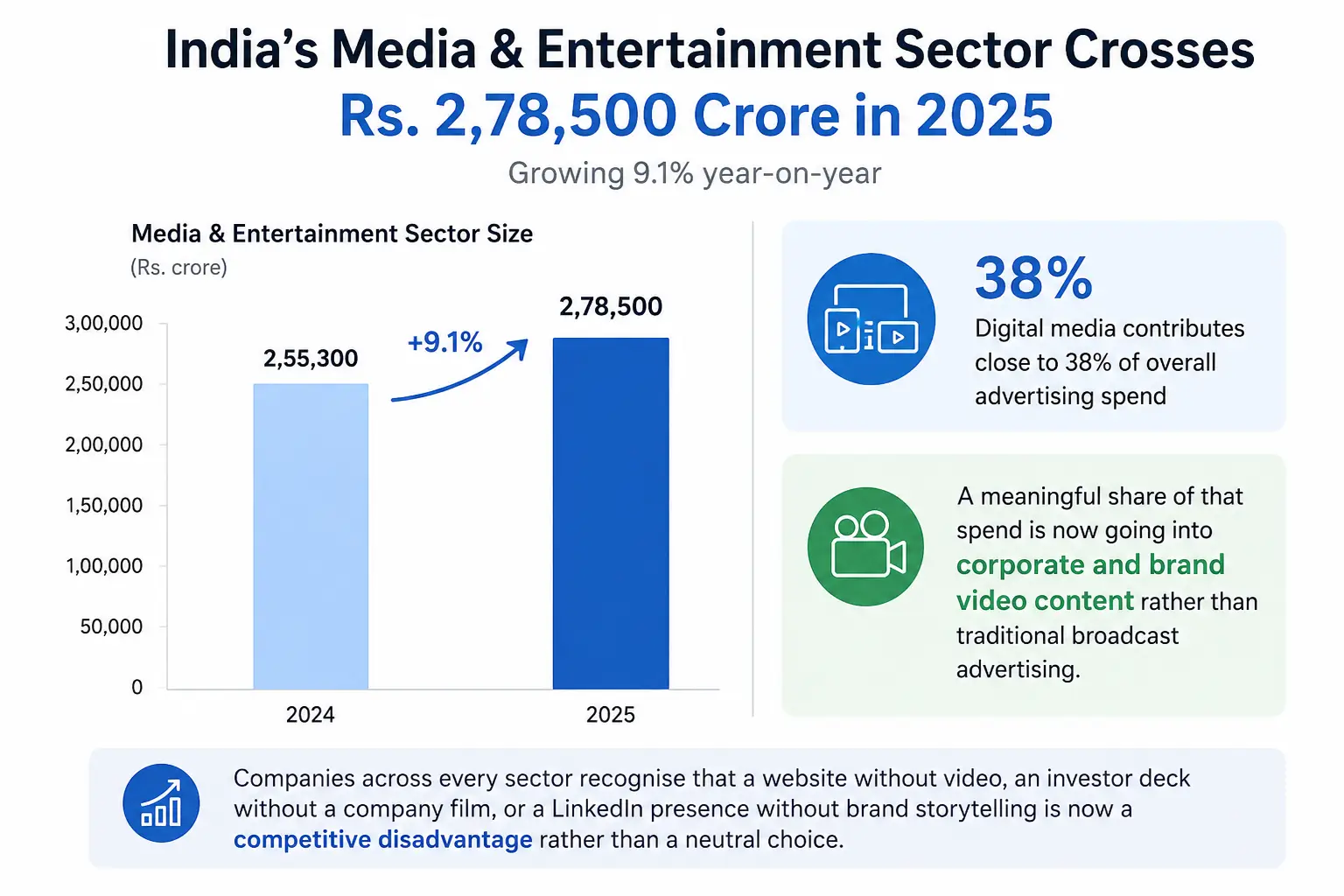
India’s media and entertainment sector crossed Rs. 2,78,500 crore in 2025, growing 9.1% year-on-year, with digital media contributing close to 38% of overall advertising spend. A meaningful share of that spend is now going into corporate and brand video content rather than traditional broadcast advertising, as companies across every sector recognise that a website without video, an investor deck without a company film, or a LinkedIn presence without brand storytelling is now a competitive disadvantage rather than a neutral choice.
At the same time, the bar for what counts as “good” corporate video content has risen sharply. Audiences are watching short-form, vertical, fast-cut content on platforms like Instagram and YouTube Shorts for 55 to 60 minutes a day on average. When a company then asks a prospective client, investor, or job candidate to sit through four minutes of slow drone footage and stock corporate music, the contrast is stark, and it does not work in the company’s favour.
The purpose of this benchmark is to give Indian businesses an honest, structured way to evaluate where their own corporate film stands, and what needs to change.
The Scoring Framework
We built our scoring model around four core pillars. Each pillar is scored out of 25, for a total possible score of 100. This is the same framework we use internally when auditing a client’s existing corporate film before a reshoot or refresh.
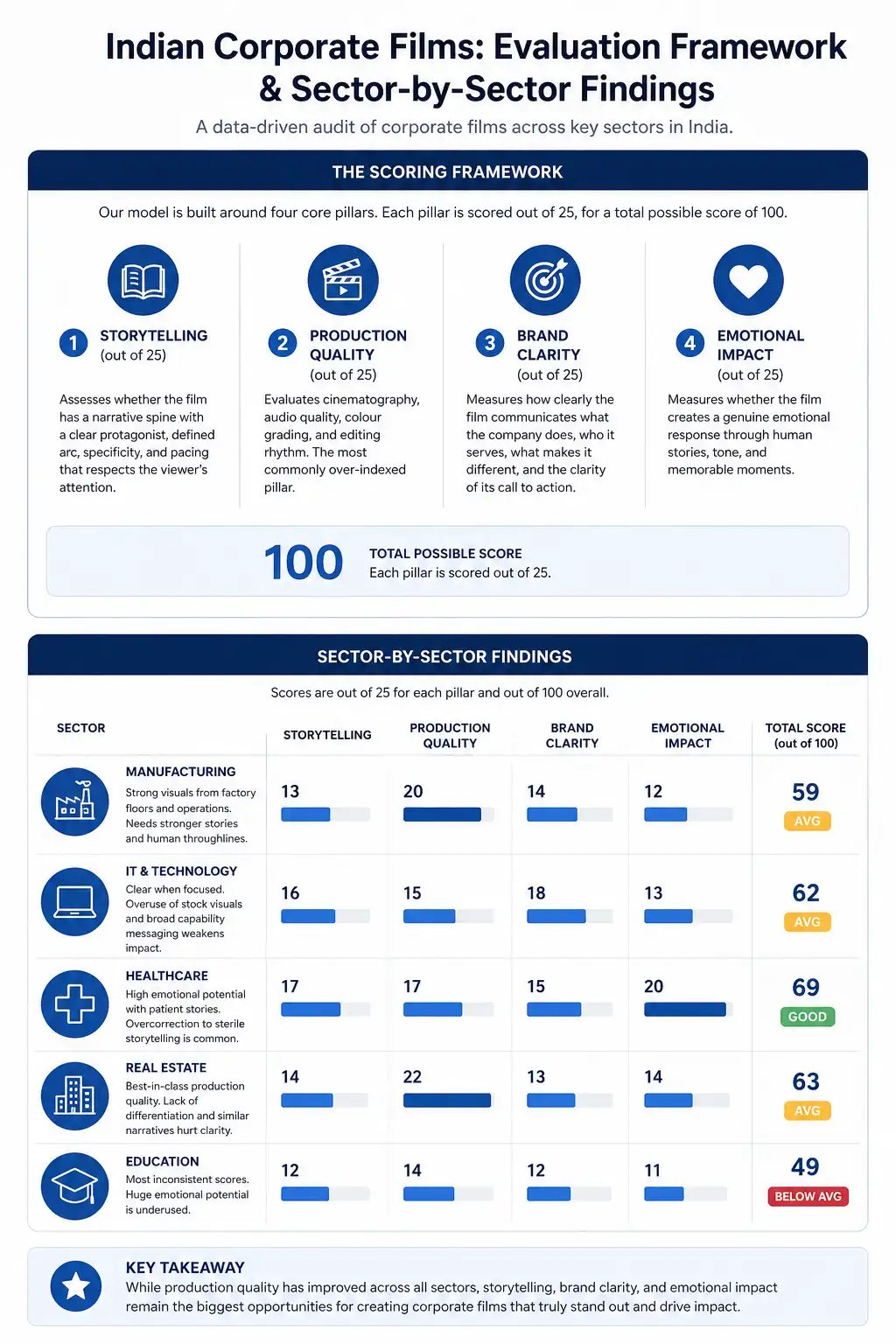
1. Storytelling (out of 25)
This pillar evaluates whether the film has a narrative spine or is simply a sequence of visually pleasant but disconnected shots. We look for: a clear protagonist (the company, a founder, a customer, or an employee), a defined arc (a problem, a turning point, a resolution), specificity over generality (real numbers, real moments, real people, rather than abstract claims like “we are committed to excellence”), and pacing that respects the viewer’s attention span.
Most corporate films we reviewed score poorly here, not because the underlying company story is weak, but because the script was written by committee, designed to please every internal stakeholder rather than to move an external viewer. A film that tries to say everything ends up saying nothing memorable.
2. Production Quality (out of 25)
This is the most commonly over-indexed pillar in Indian corporate filmmaking, and also the easiest to evaluate objectively. We look at cinematography (lighting, framing, camera movement), audio quality (a frequently overlooked weak point, since poor audio breaks viewer trust faster than imperfect visuals), colour grading consistency, and editing rhythm.
Production quality has gone up significantly across Indian corporate film output in the last three years, largely driven by the falling cost of high-end camera and lighting equipment and the increasing availability of skilled DOPs and editors outside the traditional Mumbai and Delhi production hubs. The technical floor has risen. The problem is no longer “does this look professional.” It is “does this look like every other corporate film in the same industry.”
3. Brand Clarity (out of 25)
This pillar asks a simple question: after watching this film, does the viewer know exactly what this company does, who it serves, and what makes it different from its competitors? We evaluate message hierarchy (is there one central idea, or five competing ones), differentiation (does the film say anything a competitor’s film could not also claim), and call to action clarity.
This is consistently the weakest pillar across every sector we reviewed. Indian corporate films frequently default to generic positioning language, words like “innovative,” “customer-centric,” “world-class,” and “trusted partner” that appear in nearly every company’s film regardless of sector, and that carry zero differentiating value because they could be copy-pasted onto a competitor’s video without anyone noticing.
4. Emotional Impact (out of 25)
This pillar measures whether the film creates a genuine emotional response, whether that is trust, pride, excitement, or empathy, rather than passive information absorption. We look at human presence (real employees, real customers, real moments rather than stock-feeling reenactments), music and sound design alignment with tone, and whether the film has at least one moment designed to be memorable rather than purely informational.
Films that score well here tend to share one trait: they take a risk. They let a real employee speak in their own words instead of a scripted line. They show an unscripted, slightly imperfect moment instead of a polished one. They commit to a single emotional tone instead of trying to be inspiring, informative, and entertaining all at once.
Sector-by-Sector Findings
Manufacturing
Manufacturing corporate films in India lean heavily on production quality, often the strongest pillar in this sector because factory floors, machinery in motion, and large-scale operations are inherently visual and photogenic. Drone shots of plants, slow-motion shots of machinery, and wide establishing shots of production lines are common, and when shot well, they create genuine visual impact.
The weak point in manufacturing films is consistently storytelling and emotional impact. Many manufacturing films are essentially a visual inventory of capabilities (we have this machine, this certification, this capacity) without a human throughline. The strongest manufacturing films we observed broke this pattern by centring the film around a single employee’s journey on the floor, a specific client problem the company solved, or a founder’s origin story tied to the factory itself, rather than treating the factory as the protagonist.
IT and Technology
IT sector corporate films score well on brand clarity when the company has a narrow, well-defined service offering, and score poorly when the company tries to communicate a broad, undifferentiated capability list (cloud, AI, cybersecurity, data, consulting, all in one 90-second film). The strongest IT corporate films we reviewed picked one capability and told one client story in depth, rather than attempting a comprehensive capability overview.
Production quality in IT corporate films is frequently let down by an overreliance on stock footage of people typing on laptops, abstract data visualisation graphics, and generic office B-roll, none of which differentiate one IT company from another. The opportunity in this sector is significant: IT companies that show real product interfaces, real client outcomes with named (with permission) clients, and real engineering culture consistently outperform companies using generic tech-stock visual language.
Healthcare
Healthcare corporate films carry the highest emotional stakes and, when done well, the highest emotional impact scores of any sector we reviewed. Patient stories, when shot with genuine care and appropriate consent and sensitivity, consistently outperform clinical, facility-focused films that lean entirely on equipment shots and accreditation badges.
The most common failure point in healthcare corporate films is an overcorrection toward sterile, formal, brochure-style storytelling, likely driven by regulatory caution, that drains the film of the warmth the sector inherently has access to. The strongest healthcare films we observed balanced clinical credibility (accreditations, technology, expertise) with genuine human moments (a doctor’s perspective in their own words, a patient’s recovery story told with dignity), without leaning entirely on either.
Real Estate
Real estate corporate films score highest on production quality, almost universally, because the category has matured fastest in adopting drone cinematography, architectural visualisation, and high-end lifestyle shoot aesthetics. This is the sector where Indian corporate film production has reached genuinely international visual standards most consistently.
Brand clarity is the recurring weak point. Many real estate corporate films look nearly identical to one another: aspirational drone shots of the skyline, a family walking through a furnished model apartment, soft piano or ambient electronic music, and a voiceover discussing “a lifestyle beyond your imagination.” The films that broke through this sameness did so by grounding the story in a specific buyer persona, a specific neighbourhood narrative, or a specific construction or design philosophy that a competitor genuinely could not claim.
Education
Education sector corporate films, covering schools, colleges, ed-tech companies, and training institutes, scored the most inconsistently of any sector, with the widest gap between the top and bottom of the range. The best education films we reviewed centred entirely on student and alumni outcomes told in their own voice, while the weakest relied on stock footage of generic campus shots, library b-roll, and an administrator reading a mission statement to camera.
Emotional impact is where education has the most untapped potential. Few sectors have more inherently emotional source material (a student overcoming a challenge, a teacher’s impact, a transformation in confidence or capability) and few sectors underuse it as consistently as education currently does in its corporate video output.
Also Read: UGC Videos vs Brand Videos: Which Should Your Business Invest In?
What the Top 5% Are Doing Differently
Across every sector we reviewed, the corporate films that scored highest across all four pillars shared a small number of common traits, regardless of industry.
They commit to one idea. The strongest films resist the internal pressure to include every department, every product line, and every leadership quote. They pick a single message and build the entire film around proving it.
They use real people in real moments. Scripted, on-the-nose corporate testimonials score consistently lower on emotional impact than unscripted or lightly guided conversations with real employees, clients, or customers speaking in their own words.
They are built for the platform they will actually live on. A film built only for a website homepage performs poorly when clipped for LinkedIn or Instagram. The highest-scoring corporate film projects in 2026 are increasingly shot and edited with a modular approach, a long-form hero film alongside short-form cutdowns, from the start, rather than as an afterthought.
They invest in sound as much as picture. Across every sector, audio quality and music or sound design alignment were strong predictors of overall score. A visually competent film with flat, generic stock music consistently scored lower on emotional impact than a less polished film with thoughtful, well-mixed sound design.
They earn the ending. The weakest corporate films end with a logo animation and a tagline. The strongest end with a specific, often unexpected human moment, a closing line from a real employee or customer, a single striking image, that the viewer actually remembers after the film ends.
How to Use This Framework on Your Own Corporate Film
If you want to apply this scoring model to your own existing corporate film, here is a practical approach.
Watch your film once, all the way through, without pausing, exactly as a first-time external viewer would. Then score each of the four pillars out of 25 honestly. Most companies, when they do this exercise without internal bias, find that their film scores strongest on production quality and weakest on brand clarity and emotional impact, which mirrors the pattern we found across the broader market.
A film scoring 75 or above out of 100 across this framework is genuinely competitive in the current Indian corporate video landscape. A film scoring below 60 is likely underperforming relative to what your production budget could be achieving, and is a strong candidate for a strategic reshoot or a structural recut rather than a fresh production from zero.
A Note on Methodology
This report reflects an internal benchmarking exercise conducted by Cybertize Media Productions Private Limited, drawing on patterns observed across corporate film output in the manufacturing, IT, healthcare, real estate, and education sectors in India. It is intended as a scoring framework and directional industry analysis rather than a numerically ranked list of named companies. We have deliberately avoided publishing comparative scores for specific named organisations, since a fair, verifiable, company-by-company ranking would require direct access to private brand briefs, budgets, and internal performance data that is not publicly available for the majority of the companies reviewed. What we can offer with confidence is the framework itself, and the sector-level patterns it surfaced, both of which are directly usable by any business evaluating its own corporate film today.
How Cybertize Media Productions Can Help
We built this benchmark because we use a version of it internally on every corporate film project we take on, before the first script draft and again before final delivery. If you want an honest, structured score of your existing corporate film against this framework, or you are planning a new corporate film and want to start from a position that already accounts for what is and is not working across your sector in 2026, that is exactly the kind of conversation we have with clients every week.
Cybertize Media Productions Private Limited is a full-service video production company based in India, working with manufacturing, IT, healthcare, real estate, and education sector clients on corporate films, ad films, and brand storytelling. This benchmark framework is the same scoring model we apply internally on every corporate film project we produce.