Table of Contents
There is a moment every person who works in production eventually experiences. They are in an edit suite, the picture is locked, the grade is done, the film looks exactly as it should. Then someone switches the audio from a temporary track to the wrong piece of music, or leaves a stretch of silence where there should be something underneath, and the whole film changes. It does not look different. But it feels completely different. Cheaper. Thinner. Less trustworthy somehow.
That moment is an education in something that most brands still do not fully understand, which is that sound is not how your video content sounds. It is how your brand feels. And in 2026, the brands investing the most in how they feel are consistently the ones winning on trust, recall, and loyalty at every level of the market.
This is not a piece about music licensing or voice-over rates. It is about why the world’s most valuable brands treat sound design as a strategic asset in the same category as visual identity, and what happens to brands that continue treating it as an afterthought.
The Brain Hears Before It Sees
Start with the neuroscience because the neuroscience is the reason everything else in this piece is true.
Sound reaches the brain faster than visual information. The auditory cortex processes incoming sound signals and begins building emotional responses before the visual cortex has completed its analysis of the image on screen. This is not a metaphor about how music makes us feel. It is a neurological sequencing fact, and it has enormous implications for how any piece of video content is actually experienced.
By embedding emotional cues within audio branding, businesses tap into subconscious recognition, ensuring consumers feel before they think. That sentence should sit on the wall of every production studio and brand marketing team in India. The emotional response a viewer has to your content begins in the audio layer before they have consciously processed a single visual element.
This is why what Intel discovered decades ago, and what brands like Netflix, McDonald’s, and Microsoft have since perfected, is that sound bypasses rational thought and connects directly to emotional memory.
The implications are direct. If you are producing a brand film, a corporate video, an ad film, or any piece of video content and you are treating sound design and music as decisions to be made after the picture is locked, you are making your most important emotional decisions last, with the least budget, the least time, and the least creative attention. You are building a house and decorating the foundation.
What Premium Brands Are Actually Spending
The numbers in the sound design and sonic branding space tell a story that should make any brand with a serious marketing budget pay close attention.
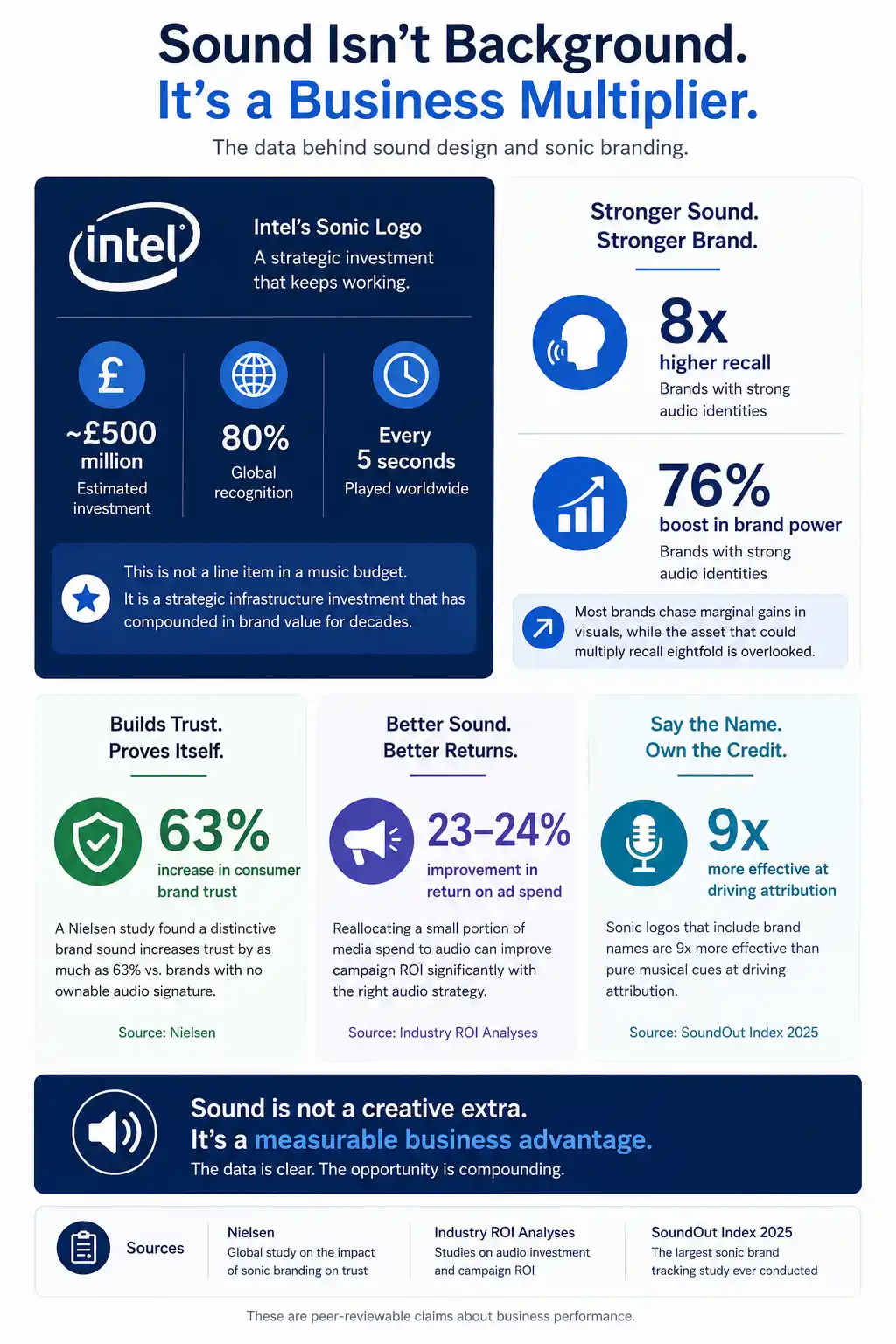
Intel’s sonic logo, with an estimated £500 million investment, achieves 80% global recognition and plays once every five seconds worldwide. That is not a line item in a music budget. That is a strategic infrastructure investment that has compounded in brand value for decades.
Brands with strong audio identities enjoy eight times higher recall and a 76% boost in brand power. For context: most brands spend significant budget chasing marginal improvements in visual creative performance, while the single asset that could multiply recall eightfold sits underinvested and inconsistent.
Also Read: Modern Video Production Is No Longer About Cameras, It’s About Attention Engineering.
A Nielsen study found that a distinctive brand sound can increase consumer brand trust by as much as 63% when compared to brands with no ownable audio signature. And from a direct ROI standpoint, reallocating a small portion of media spend to audio can improve campaign ROI significantly, with one analysis showing up to a 23 to 24% improvement in return on ad spend with the right audio strategy.
Sonic logos that include brand names are nine times more effective at driving attribution than pure musical cues, according to the SoundOut Index 2025, the largest sonic brand tracking study ever conducted.
These are not niche statistics from audio industry trade bodies with a financial interest in promoting sound design. They are from Nielsen, industry ROI analyses, and large-scale tracking studies. They are peer-reviewable claims about business performance.
The Brands That Built Sound Into Their Architecture
Let us look at what this investment actually looks like in practice, because the abstract case for sound design is much less instructive than the specific decisions real premium brands made.
Netflix and the “Ta-Dum”
The “Ta-Dum” sound was developed by Oscar-winning sound designer Lon Bender and his team. The goal was to create a sound that was as recognisable as the iconic visual logos of major film studios like Universal or MGM.
Two seconds. That is the duration of the Netflix sonic identity. It is shorter than most people’s reflexive thumb-scroll on social media. And yet it creates what researchers describe as a doorway moment, a tiny ritual that signals something is about to begin. It triggers anticipation. It re-establishes the emotional contract between the viewer and the platform before a single frame of the content plays. Netflix’s Ta-Dum feels like a doorway moment, a tiny ritual that signals “something is about to begin.”
The reason it works at that level is not because it is catchy. It is because it is consistent. Every single time a Netflix title starts, across every device, in every country, in every language, the same two-second sound plays. That consistency, at scale and over years, is what turns a piece of audio design into a neurological trigger.
Intel and the Five-Note Chime
Intel’s sonic logo is perhaps the most studied example of commercial sound design in marketing history. Five notes. Approximately two seconds. Intel’s sound mark is short and repeatable, designed to live across many formats.
What Intel understood early, and what most brands are still catching up to, is that a sonic signature is not a jingle. A jingle is designed to be remembered consciously, to have the brand name in it, to be singable. A sonic signature is designed to be recognised instantly at a subconscious level, to trigger brand association before the listener has had time to think about what they just heard.
Neuroscience research shows that repeated exposure to this kind of sonic signature activates the brain’s reward pathways while simultaneously strengthening neural connections to visual brand cues. The result is a cross-modal sensory experience where seeing the logo can actually trigger a mental “hearing” of the signature, and vice versa. You see the Intel logo and your brain plays the chime. You hear the chime and your brain retrieves every positive association you have ever built with Intel as a brand. That is not accident. That is architecture.
Apple and the Sonic Universe

Apple treats sound as a complete design system. Apple’s synthy leitmotif conveys luxury and innovation, perfectly aligning with its brand image. But the depth of Apple’s investment in sound goes well beyond a sonic logo. Every interaction sound in every Apple product, the keyboard click, the notification chime, the camera shutter, the payment confirmation, is designed to carry the same emotional signature: precise, clean, slightly warm, unmistakably premium.
Apple TV got a new audio logo in 2025, created by Finneas, with three different versions: a five-second ident, a one-second sting, and a version over ten seconds suited to playing at the start of films. This is what it looks like to treat sound design as a modular, scalable system rather than a one-off decision.
When a user picks up an Apple product, every sound they encounter is a small, consistent confirmation that they are holding something premium. The sound design is doing brand work constantly, invisibly, in the background of every interaction. Most brands have never designed a single interaction sound deliberately.
Why Sound Carries More Emotional Weight Than Visuals in Video
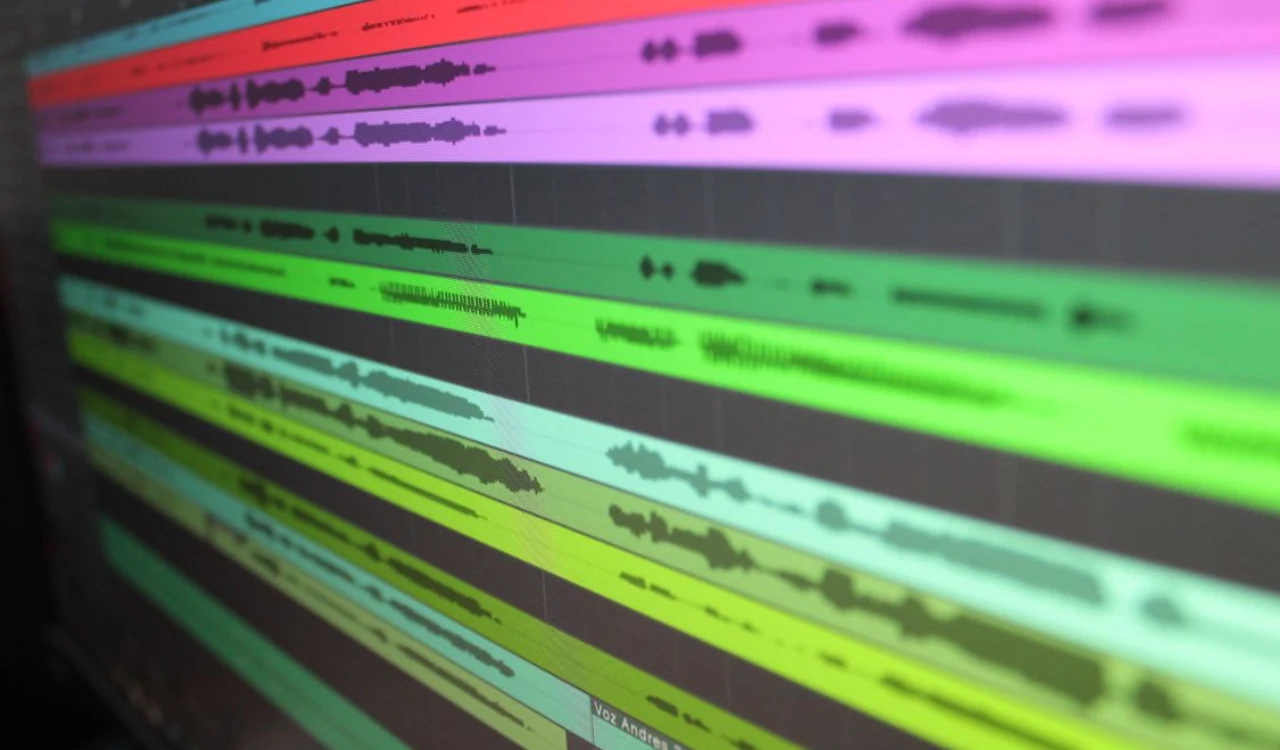
Here is the thing about film and video production specifically that makes sound investment so consequential: in a video, you can close your eyes and the audio still works. You cannot close your ears.
Research on film editing and emotional response confirms what editors have understood intuitively for a century. Accelerating the pace of events creates heightened emotional intensity, characterised by urgency and anticipation, while slowing down the narrative generates moments of calm and composure. But this pacing effect operates most powerfully through sound, not visuals. The music is what tells the viewer’s nervous system whether to feel tense or relaxed in any given moment of a film. The edit sets the rhythm, but the audio gives the rhythm its emotional meaning.
This is why the same footage cut to different music can feel completely different in tone, not slightly different, but categorically different in what it communicates about the brand. A product launch film cut to minimal, sparse piano reads as premium and deliberate. The same footage cut to high-energy electronic music reads as exciting and accessible. The footage has not changed. The brand perception communicated by that footage has changed entirely.
Also Read: Why Every Fast-Growing Startup Needs a Brand Story Film, A Comprehensive Insight
Most production workflows lock the picture and then choose the music. The most effective production workflows choose the emotional arc of the audio first and then build the picture around it.
The Five Layers of Sound Design That Premium Brands Get Right
Sound design in brand and video production operates across five distinct layers. Premium brands invest deliberately in all five. Most brands invest in one or two, usually inconsistently.
Layer one: The sonic logo or brand signature. The short, ownable audio identifier that lives across all touchpoints. Two to five seconds. Consistent across every platform and format. Designed to trigger brand recall at a subconscious level before conscious recognition occurs.
Layer two: The music DNA. A defined set of musical parameters: tempo range, instrumentation, emotional register, genre influence, and harmonic character that guides every music choice across all brand content. Without this, different campaigns sound like they come from different companies. With it, every piece of content reinforces the same emotional positioning.
Layer three: The sound design palette. Every non-musical sound in a brand’s content: the ambient environments in product films, the SFX in ad films, the UI notification sounds in apps and digital products. These are usually treated as functional rather than expressive. Premium brands treat them as expressive.
Layer four: The voice identity. The vocal texture, pace, emotional cadence, and tonal register of every human voice associated with the brand. This involves defining vocal texture, emotional cadence, and timbre in the same way brands define typography or colour palettes. A luxury brand that uses a fast-talking, casual-register voice-over in its product films is undermining its visual positioning with its audio layer.
Layer five: Silence. The deliberate use of silence as a creative tool is almost entirely absent from most brand video production. Silence in the right moment creates anticipation, gravitas, and emphasis that no sound can replicate. The brands that understand silence use it. The brands that do not fill every moment with background music and have content that never lands a hit with the same force.
What the Indian Production Market Is Missing
The Indian advertising and corporate video production market is in an interesting position on this topic.
Production quality in India has risen significantly in the last five years. The visual craft of Indian ad films and brand content is, at its best, genuinely world-class. DPs, colourists, and art directors in India working at the top of the market are producing content that competes internationally on visual terms.
The audio investment has not kept pace.
The most common pattern in Indian brand video production is a generic stock music track selected from a library on the last day of post-production, usually by the editor, with minimal creative direction from the brand or the production company. The track is often chosen for mood (“this sounds premium,” “this sounds energetic”) rather than for brand alignment, emotional architecture, or strategic consistency across the content.
The result is that Indian brands frequently produce visually strong content with audio that undermines the visual work. A beautifully shot corporate film with a generic stock orchestral track sounds exactly like every other beautifully shot corporate film with a generic stock orchestral track. The visual differentiation the brand invested in is acoustically erased.
Also Read: India Corporate Film Benchmark Report 2026, Excellence in Corporate Storytelling
The programmatic audio market is set to grow to $2.26 billion as digital audio listenership is projected to reach 79% of people per month. India’s share of that market is growing rapidly. Brands that build deliberate sonic identities now will own audio real estate that is exponentially more expensive to build once the market matures.
Sound Design in Video Production: A Practical Framework
For brands and production companies working on video content today, here is a practical framework for treating sound design as a strategic investment rather than a finishing task.
Start with the emotional brief, not the visual brief. Before the script is written, define what the viewer should feel at the start of the film, in the middle, and at the end. Then ask: what music and sound design architecture creates those states? The answer to that question should inform the script, the pacing, the edit, and the visual choices, not the other way around.
Commission original music when the content justifies it. Stock music is not inherently wrong, but it is fundamentally unownable. Any competitor can license the same track tomorrow. When you are producing content that will define your brand’s emotional positioning at a major moment, the question of whether to commission original composition is not a luxury question. It is a brand ownership question.
Build consistency before you build variation. The brands with the strongest sonic identities did not achieve them through bold experiments. They achieved them through relentless consistency over time. A mid-size Indian brand that commits to the same musical DNA across every piece of content for three years will build more audio brand equity than a large brand that uses a different music approach in every campaign.
Treat audio post-production as a creative discipline, not a technical one. Sound mixing and mastering are technical skills. But the decisions about what sounds are in the mix, what emotional weight each element carries, and how silence is used are creative decisions. They require a sound designer with creative direction, not just a mix engineer executing a brief.
Build modular sonic assets. A brand sonic identity should be a system, not a single asset. A full five-second sonic logo, a one-second sting, a thirty-second brand music track, and an ambient soundscape for long-form content. These are the building blocks of a consistent audio presence that can scale across every format and every platform the brand operates in.
What Cybertize Media Productions Brings to This
At Cybertize Media Productions Private Limited, sound design is a first-class decision in our production process, not an afterthought.
We work with clients at the brief stage to define not just what a film should say or look like, but what it should feel like at every moment. We treat the audio architecture of a piece of content as something that needs to be designed from the concept stage, not retrofitted after the picture edit is done.
This changes the way we approach music selection, sound design, voice-over direction, and the use of silence across everything we produce. It changes how we brief composers and sound designers. And it changes what the finished content delivers for the brands we work with, because the emotional experience of viewing the content is built from the inside out, with the audio carrying its full share of the strategic weight from the first frame to the last.
Sound is not finishing. Sound is foundation.
Cybertize Media Productions Private Limited is a full-service video production company based in India, working with brands and businesses on ad films, corporate films, brand storytelling, and content where sound design is built into the process from the brief stage, not bolted on at the end.