Table of Contents
Video Production Attention Engineering Guide: There is a belief that runs deep in the production industry, one that most people inside it never examine because it feels so obviously true. The belief goes like this: if the image is beautiful enough, and the sound is clean enough, and the gear is good enough, the content will work.
It made sense for a long time. When distribution was limited, when there were twenty TV channels instead of twenty million YouTube channels, when a viewer who sat down to watch something had no other option available at the tap of a thumb, visual quality was the thing that separated great production from mediocre production.
That world no longer exists. And the production industry that has not yet fully reckoned with that change is producing expensive content that loses its audience in the first eight seconds and then wonders why the metrics are flat.
This is a piece about what actually creates effective video content in 2026. It is not a piece about gear or software or trends. It is about a fundamental shift in what the real craft of production now is: the engineering of attention.
Video Production Attention Engineering Guide: What Happened to the Viewer
Let us start with the data, because the data here is genuinely alarming and most production conversations simply skip past it.
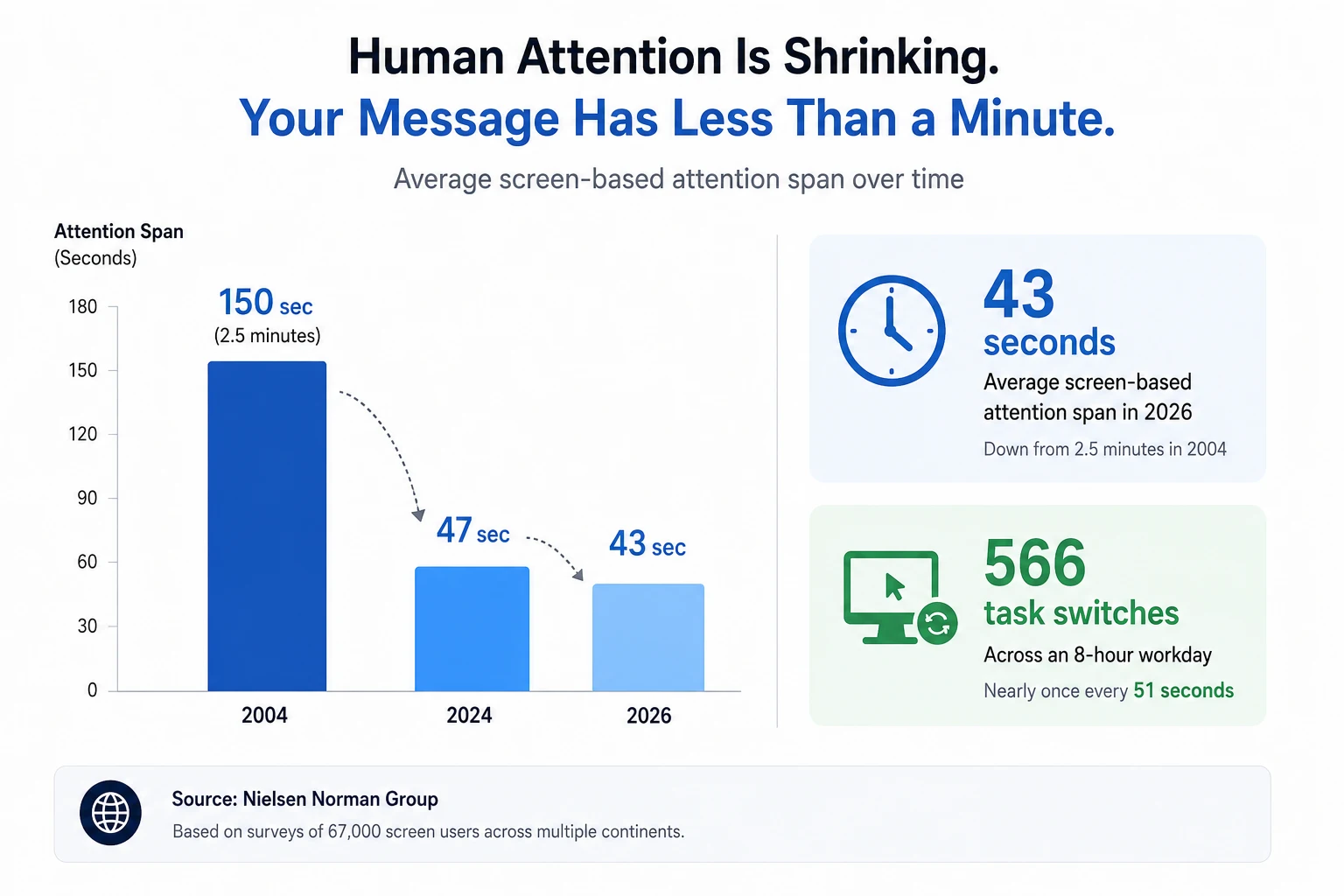
In 2004, the average human screen-based attention span was roughly two and a half minutes. By 2024 it had dropped to 47 seconds. By 2026, research published by the Nielsen Norman Group, drawing on surveys of 67,000 screen users across multiple continents, confirms that average screen-based attention has fallen again, now sitting at approximately 43 seconds. Users switch tasks an average of 566 times across an eight-hour workday, nearly once every 51 seconds.
These numbers describe an environment that is structurally hostile to passive viewing. People are not choosing to be distracted. The platforms that deliver content have been deliberately designed, at a neuroscience level, to maximise task-switching because more switches means more ad impressions. The result is that any piece of content entering that environment is now competing not just with other content but with a trained neurological reflex to scroll past.
The TikTok completion rate data makes this visible in a number that should be on the wall of every production studio: videos between 11 and 18 seconds generate the highest completion rates, replay loops, and overall engagement. TikTok videos under 15 seconds achieve an average completion rate of 76.4%. For videos between 31 and 60 seconds, that completion rate drops to 41.8%. For videos over 60 seconds, it drops further still. More than 52% of respondents in a 2025 study admitted they skipped videos longer than 60 seconds even when the topic genuinely interested them.
Over 70% of TikTok viewers make their stay-or-leave decision within the first three seconds of any video. Content that drops below 60% retention in that three-second window faces minimal algorithmic promotion, which in practice means minimal distribution regardless of what happens in the rest of the film.
The camera did not cause any of this. The camera cannot solve any of this. The camera is the least relevant variable in whether any piece of content holds an audience in 2026.
What Attention Engineering Actually Means
Video Production Attention Engineering Guide: The phrase “attention engineering” might sound like a Silicon Valley euphemism, but it describes something real and craft-based that the best filmmakers and editors have always done intuitively, and that most modern production pipelines still do not do systematically.
Attention engineering is the deliberate, structured design of every element in a piece of content, from the first frame to the last, to maintain a viewer’s cognitive engagement moment to moment. It draws on what neuroscience and film psychology have been telling us for decades, and it treats the viewer’s brain as the primary material the production is working with, not the image sensor.
Here is what that looks like in practice.
The hook is not an introduction. The single most common mistake in branded and corporate video production is opening with an introduction. A company logo. A founder’s name and title. A wide drone shot establishing the location. These are signals to the viewer that nothing of consequence is happening yet, and that they can safely check out until something starts. In an environment where 70% of viewers have already decided whether to stay within three seconds, an introduction is a skip trigger, not a welcome.
The hook is a question, a conflict, an image, or a piece of information that makes the viewer feel they will miss something important if they stop watching. It does not need to be dramatic. It needs to be specific and slightly incomplete, a gap that the viewer’s brain wants to close.
Pacing is a physiological tool, not an aesthetic preference. Research published in Frontiers in Psychology in 2025, tracking neural responses to film editing through eye-tracking and neuroimaging, confirms that accelerating the pace of events creates heightened emotional intensity, while slowing down the narrative generates calm and reflection. Increased editing pace drives activity in the prefrontal cortex during attention shifts and significant activation of the amygdala during emotional climaxes.
This is not a metaphor. The cut is a neurological event. Every editorial decision, every choice about how long to hold a shot and when to cut, is a decision about the viewer’s brain state. An editor working without that understanding is building a machine without reading the manual.
Also Read: Why Every Fast-Growing Startup Needs a Brand Story Film
Sound is the primary emotional carrier, not a supporting role. Research consistently shows that audiences tolerate imperfect visuals in a way they do not tolerate imperfect audio. The brain processes sound and music before visual information reaches conscious analysis. The music underneath a corporate film is not decoration. It is the first emotional signal the viewer receives, and if it conflicts with the visual or narrative tone, the entire piece feels off in a way the viewer often cannot articulate but definitely feels.
The best production teams in the world treat sound design and music as architectural decisions made at the same stage as shot lists and storyboards, not as something to sort out in post when the picture is locked. Most Indian production workflows still treat audio as the last item on the post-production checklist.
The body keeps the score, and so does the edit. The Kuleshov Effect, the foundational discovery of Soviet filmmaker Lev Kuleshov that demonstrates how viewers automatically create emotional meaning from two unrelated shots placed in sequence, has been understood in film theory for a century. Most production pipelines ignore it entirely in practice. The implication of Kuleshov’s finding is that the meaning of any given shot is not contained in the shot itself. It is created in the relationship between that shot and the one before it. This means every cut is a meaning-making event, not just a visual transition. An editor who understands this is not cutting footage. They are composing meaning.
Why the Indian Production Industry Is at an Inflection Point
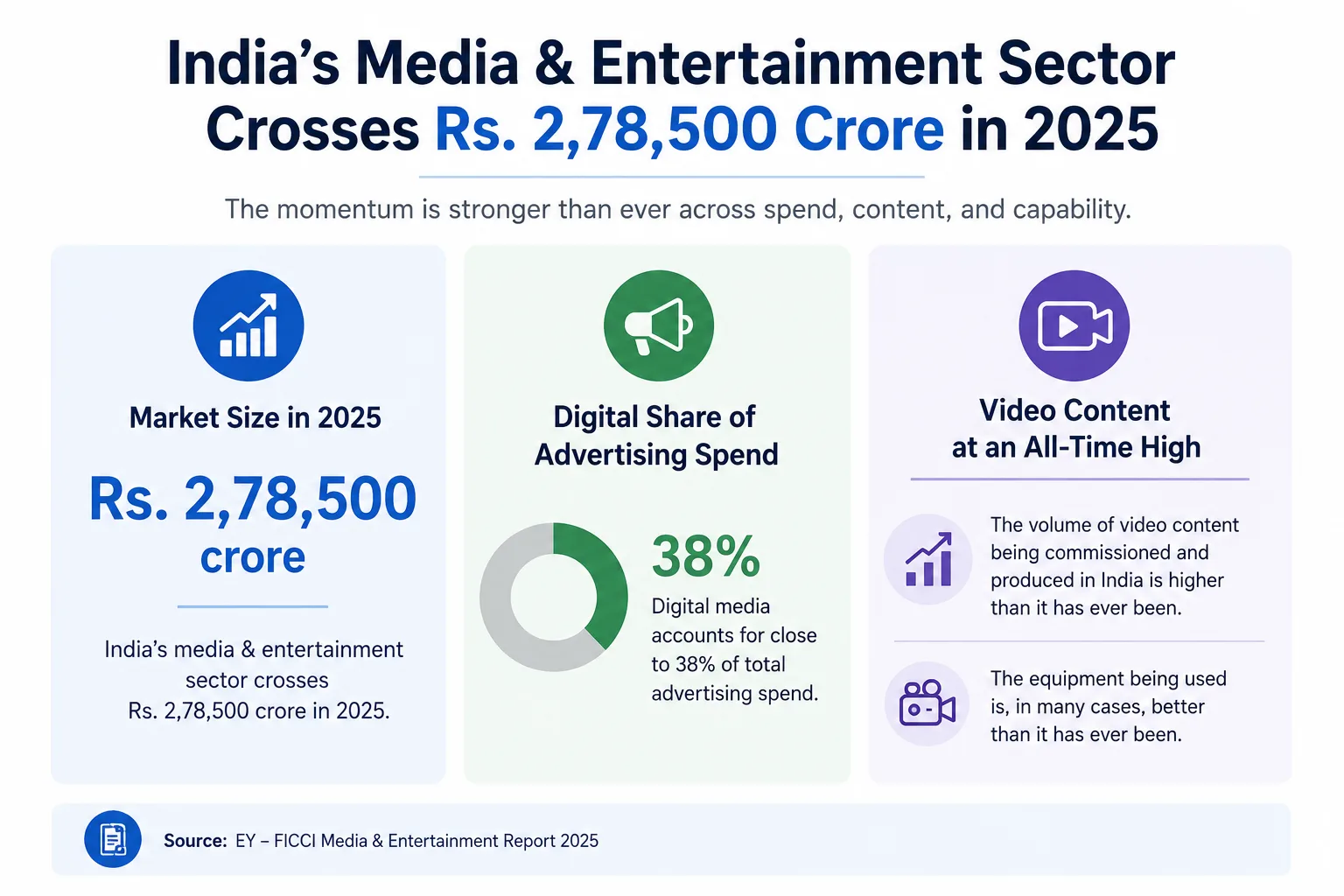
India’s media and entertainment sector crossed Rs. 2,78,500 crore in 2025, with digital media accounting for close to 38% of total advertising spend. The volume of video content being commissioned and produced in India is higher than it has ever been. The equipment being used is, in many cases, better than it has ever been.
And yet. Most brand films still open with drone shots and a logo. Most corporate videos still feature a managing director delivering a script that sounds like a press release. Most explainer videos still have a talking-head structure that burns through the viewer’s patience before the main point arrives.
The production quality conversation in India has largely been about cameras and formats. Are we shooting 4K? Do we have the right lenses? Can we do a grading pass that looks cinematic? These are not irrelevant questions. But they are secondary questions masquerading as primary ones, and the energy the industry puts into answering them comes at the direct expense of the questions that actually determine whether a piece of content succeeds.
The primary questions are: What does the viewer feel in the first three seconds? What keeps them in the fifth second, the twentieth second, the fortieth second? What do they remember two days after watching? What did we ask them to do, feel, or believe, and did the piece of content actually move them in that direction?
These are not cinematography questions. They are cognitive design questions. They require a different frame of reference entirely.
The Three Layers of Attention Engineering
For anyone working in production or commissioning video content, here is a practical breakdown of how attention engineering operates across three distinct layers.
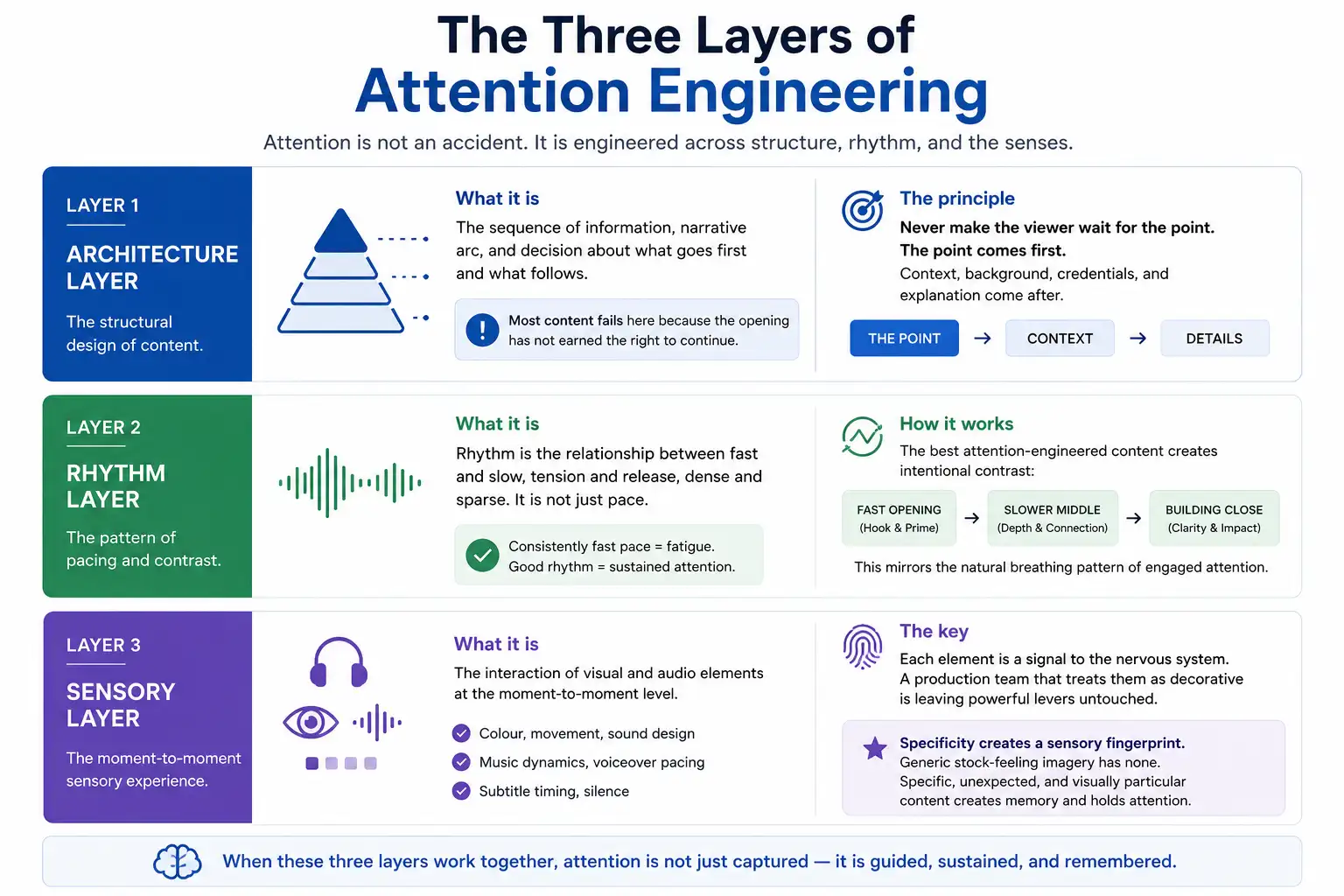
Layer one: the architecture layer.
This is the structural design of the content, the sequence of information, the narrative arc, the decision about what goes first and what follows. Most content fails at this layer not because the later material is weak but because the opening has not earned the right to continue. The architecture layer is where a scriptwriter and a director who understand attention dynamics are worth more than any piece of equipment in the kit.
The principle here is simple but routinely violated: never make the viewer wait for the point. The point comes first. The context, the background, the credentials, and the explanation come after.
Layer two: the rhythm layer.
This is where editing operates. Rhythm is not the same as pace. Pace refers to how fast things are happening. Rhythm refers to the relationship between fast and slow, tension and release, dense and sparse. A piece of content with a consistently fast pace does not have good rhythm. It has fatigue.
The best-engineered content in terms of attention creates intentional contrast: a fast-cut opening, a slower mid-section that delivers emotional depth, a building close. This mirrors the natural breathing pattern of engaged attention. The viewer’s brain relaxes into the slower moments because the faster moments have primed it to stay alert.
Layer three: the sensory layer.
This is the interaction of visual and audio elements at the moment-to-moment level. Colour, movement direction, sound design, music dynamics, voiceover pacing, subtitle timing, the presence or absence of silence. Each of these elements is a signal to the nervous system. A production team that treats them as decorative is leaving the most powerful levers in the room untouched.
The sensory layer is also where the specificity principle operates. Generic stock-feeling imagery, the kind of footage that could belong to any company in any industry, has no sensory fingerprint. It creates no sensory memory. The images that hold attention and stick in the mind are specific, slightly unexpected, and visually particular in a way that generic production cannot replicate.
What This Means for Brands Commissioning Video Content
If you are a brand, a startup, or a company that regularly invests in video production, the practical implication of everything above is this: the brief you give to your production company matters more than the equipment they use.
Video Production Attention Engineering Guide: A brief that specifies camera and format but not emotional arc, hook strategy, or intended viewer response is a brief designed to produce visually acceptable content that no one watches for long. A brief that specifies what the viewer should feel in the first five seconds, what question the film should leave them asking, and what specific action or belief change it is designed to produce, is a brief that can produce content that actually moves people.
The questions worth asking when you commission a production:
What is our hook strategy for the first three seconds of this piece? How are we engineering the transition from the opening to the body of the content to prevent drop-off? What is the rhythm structure across the full length of the piece, and where are the intentional moments of tension and release? How is the sound design reinforcing the emotional logic of the edit? What specific visual elements are we using that no competitor’s film could also use?
If the production team you are working with cannot answer these questions fluently before the shoot, the shoot itself will not solve the problem. Beautiful footage is infinitely easier to make than content that holds the attention of someone who could, at any moment, tap away.
The Real Reason Great Films Feel Different
Most people who watch a piece of video content that genuinely moves them, or that they find themselves rewatching, cannot articulate exactly why it works. They say it “felt real” or “just grabbed me” or “I don’t know, I just couldn’t stop watching.” These are descriptions of an experience, not an explanation of a mechanism.
The mechanism, when you look at it from a production standpoint, is almost always the same. Something specific in the first three seconds created a gap that the viewer’s brain wanted to close. The rhythm of the edit matched the natural pacing of engaged human attention without ever going so fast it became fatiguing or so slow it became boring. The sound design created an emotional undercurrent that ran beneath the surface of the visible content and shaped how every image was interpreted. The ending landed on a specific, memorable image or idea rather than a generic resolution.
None of this is accidental in great films. All of it is engineered. The craft of doing it well looks invisible from the outside, which is exactly what good engineering looks like. You do not notice the architecture of a building that works. You only notice the one that does not.
Also Read: UGC Videos vs Brand Videos, Which Should Your Business Invest In?
That invisibility is the point. Attention engineering is not about visible technique. It is about building the conditions for the viewer to get so absorbed in what they are watching that they stop thinking about whether they are watching it. When that happens, the camera has done its job, but only because everything else did its job first.
Video Production Attention Engineering with Cybertize Media Productions
At Cybertize Media Productions Private Limited, we have been working through this shift in how we think about production for long enough to have built it into our process rather than our philosophy.
Every project we take on now begins with what we call an attention audit: a structured conversation with the client about the viewer they are actually targeting, the context in which that viewer will encounter the content, the window of attention they realistically have, and what needs to happen in the first three seconds to hold that window open long enough for the rest of the piece to do its work.
That conversation happens before the script. Before the shot list. Before we talk about cameras.
The reason is simple. In a world where average screen-based attention sits at 43 seconds and trending down, the single most valuable thing we can offer a client is not the ability to make things look beautiful. It is the ability to build content that someone actually watches to the end, remembers afterwards, and does something about. That takes engineering. And engineering starts with understanding the material you are working with, which in video production in 2026, is not light. It is the human mind.
Also Read: The Complete Ad Shoot Checklist, What Every Brand in India Gets Wrong Before Day One
Cybertize Media Productions Private Limited is a full-service video production company based in India, working with brands and businesses on ad films, corporate films, brand storytelling, and content built for the attention economy. We build content designed to be watched, remembered, and acted on.